

Which Interfacing Is Best for Structured Jacket Lapels?
Last Updated: October 28, 2026
Quick Summary
For structured jacket lapels, a firm sew-in interfacing gives the most traditional build, while a fusible suits faster, lighter work. The Vilene S13 / 313 heavy sew-in suits substantial fronts, and the S80 / 240 firm sew-in gives firmer lapel structure and roll. Match the weight of the interfacing to your fabric and always test on a sample first.
- Choose sew-in interfacing for the firmest, most traditional lapels.
- Vilene S13 / 313 heavy sew-in costs £4.50 and suits heavy jacket fronts and lapels.
- Vilene S80 / 240 firm sew-in costs £8.50 and gives firm lapel structure and roll.
- Vilene H410 / 316 fusible costs £6.50 per metre and needs light stability.
- Match interfacing weight to fabric weight, and test with your chosen fabric before starting.
Table of Contents
- Why Structured Jacket Lapels Need the Right Interfacing
- Fusible vs Sew-In Interfacing for Lapels
- Vlieseline Vilene S13 / 313 Heavy Sew-In Interfacing: Review
- Vlieseline Vilene S80 / 240 Firm Sew-In Interfacing: Review
- Vlieseline Vilene H410 / 316 Fusible Interfacing: Review
- Iron-On Interfacing H250/305: Review and Limitations
- Hair Canvas for Tailoring and Its Place Alongside Modern Interfacings
- Choosing Interfacing for Wool Jackets
- How to Apply Fusible Interfacing to Lapels Without Bubbling
- Booking Your Interfacing Order and Next Steps for Your Jacket
- Frequently Asked Questions
Why Structured Jacket Lapels Need the Right Interfacing
A jacket lapel’s structure is influenced by the interfacing. The choice depends on the fabric and the result you want.
Interfacing can provide support to a garment. Which type to choose depends on the fabric and the result you want.
The choice depends on your cloth and the result you want. Below, we compare the sew-in and fusible options in the catalogue and the lighter iron-on choice.
Fusible vs Sew-In Interfacing for Lapels
The first decision is method. Fusible interfacing bonds to the fabric under heat and pressure. Sew-in interfacing is stitched into place.
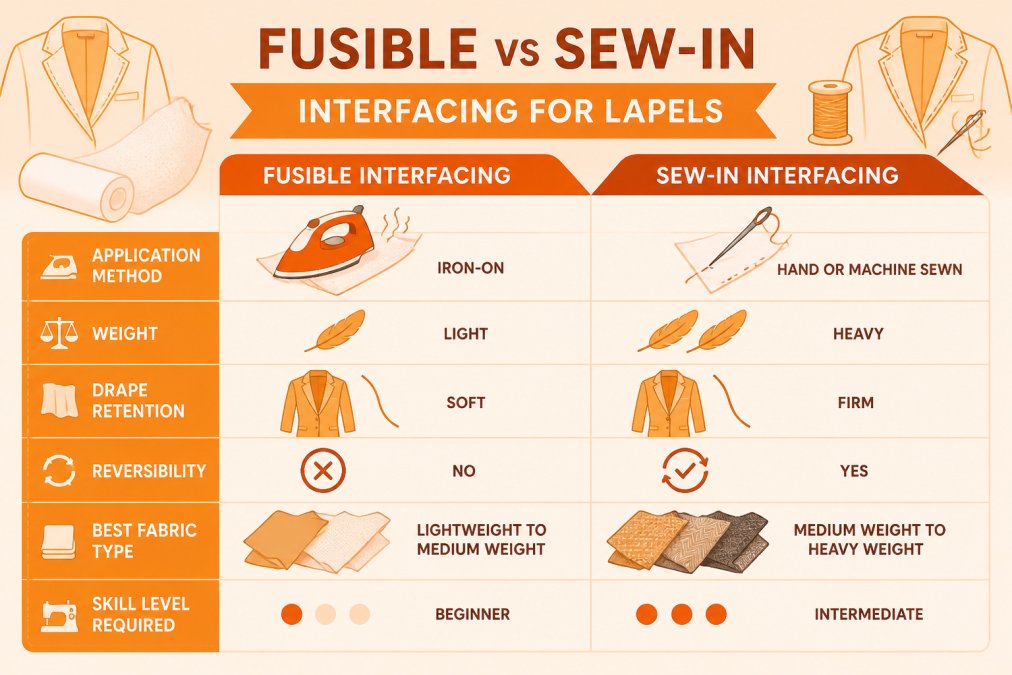
The table below summarises the listed options.
| Interfacing | Method | Best For | Price (per unit) |
|---|---|---|---|
| Vilene S13 / 313 | Sew-in | Heavy jacket fronts and lapels | £4.50 |
| Vilene S80 / 240 | Sew-in | Firm lapel structure and roll | £8.50 |
| Vilene H410 / 316 | Fusible | Garment fronts needing light stability | £6.50 per metre |
| Iron-on H250 / 305 | Fusible | Light to medium cottons and handicrafts | £3.50 per metre |
Watch out: test with your chosen fabric before starting your project.
Vlieseline Vilene S13 / 313 Heavy Sew-In Interfacing: Review
The S13 / 313 is our heavier sew-in option, designed for adding support to substantial fabrics, including jacket fronts and smaller garment sections.
Sew it into the project as directed by your pattern and test with your chosen fabric before starting. It costs £4.50.
You can order the Vilene S13 / 313 heavy sew-in interfacing directly from our range.

Vlieseline Vilene S80 / 240 Firm Sew-In Interfacing: Review
The S80 / 240 is a firm sew-in interlining at £8.50. The listing describes it as suitable for adding firm support to pelmets, bags and textile craft projects.
Attach it by hand or machine as your project requires.
If you want to see the firmer option in person, you can buy the Vilene S80 / 240 firm sew-in interfacing from us.

Vlieseline Vilene H410 / 316 Fusible Interfacing: Review
The H410 / 316 is a soft iron-on interfacing with stabilising lengthwise threads, supplied 90cm wide. It is listed for garment fronts and smaller pieces that need help holding their shape. It costs £6.50.
Align the interfacing's lengthwise threads with the fabric grain before fusing.
Vlieseline Vilene S13 / 313 Heavy Sew-In Interfacing →
You can buy the Vilene H410 / 316 fusible interfacing here, supplied by the metre.

Iron-On Interfacing H250/305: Review and Limitations
The H250 / 305 is an iron-on option at £3.50 per metre. It is 90cm wide, made from 60% polyester and 40% cellulose, and weighs 62g per square metre. It is listed for light to medium-weight fabrics, such as cotton, and for shaped pieces and handicrafts.
To apply it, place the coated side on the wrong side of the outer fabric. Slowly slide the iron 5 to 6 times over each spot on the wool setting, dry, allowing the heat to act on each area for about 8 seconds. After fixing the pieces, let them cool flat for 20 minutes so the adhesion can stabilise.
If a lighter fusible suits your project, you can order the H250 / 305 iron-on interfacing by the metre.
Hair Canvas for Tailoring and Its Place Alongside Modern Interfacings
Our current range does not include hair canvas, so the practical question is whether the modern sew-in and fusible products here can stand in for it. For most home sewists they can, especially the S13 / 313 and S80 / 240 sew-in options. Where you want the full traditional build, hair canvas remains the reference point, and it is worth knowing the method even if you choose a synthetic layer for convenience.
Choosing Interfacing for Wool Jackets
As a rule, match the weight of the interfacing to the weight of the wool. A medium suiting in wool generally pairs well with the H410 / 316 fusible or a sew-in layer, while a heavier coating will call for the S13 / 313 or S80 / 240. If you plan to pair your interfacing with a wool outer, our Abraham Moon Parquet Wool By The Metre is a useful fabric to order alongside it.
How to Apply Fusible Interfacing to Lapels Without Bubbling
Test with your chosen fabric before starting your project.
Common mistakes to avoid:
Booking Your Interfacing Order and Next Steps for Your Jacket
Choose your interfacing by method first, then by weight. Sew-in products suit the firmest, most traditional lapels, and fusibles suit faster, lighter builds. Test on a sample before cutting into your final cloth, and always check the weight against your fabric.
If you are unsure which option to choose, contact us.
Frequently Asked Questions
What is the best interfacing for structured jacket lapels?
The Vlieseline Vilene S13 / 313 Heavy Sew-In Interfacing at £4.50 is listed for adding support to substantial fabrics, including jacket fronts and smaller garment sections. The Vilene S80 / 240 Firm Sew-In Interfacing at £8.50 is listed for adding firm support to pelmets, bags and textile craft projects. The Vilene H410 / 316 is a soft iron-on interfacing with stabilising lengthwise threads, listed for garment fronts and smaller pieces that need help holding their shape. Test with your chosen fabric before starting your project.
Should I use fusible or sew-in interfacing for jacket lapels?
The Vlieseline Vilene H410 / 316 Fusible Interfacing is 90cm wide and costs £6.50. Its listing describes it as a soft iron-on interfacing with stabilising lengthwise threads for garment fronts and smaller pieces that need help holding their shape.
What weight of interfacing should I use for a jacket?
The Vilene S13 / 313 is listed for adding support to substantial fabrics, including jacket fronts and smaller garment sections. The Vilene S80 / 240 is listed for adding firm support to pelmets, bags and textile craft projects. The Iron-On Interfacing H250/305 per metre is 90cm wide, weighs 62g per square metre and costs £3.50 per metre; it is listed for light to medium-weight fabrics, such as cotton, and for shaped pieces and handicrafts.
How do I stop fusible interfacing from bubbling on a jacket?
For the Iron-On Interfacing H250/305, place the coated side on the wrong side of the outer fabric. Slowly slide the iron 5 to 6 times over each spot on the wool setting, dry, allowing the heat to act on each area for about 8 seconds. After fixing the pieces, let them cool flat for 20 minutes so the adhesion can stabilise. Test with your chosen fabric before starting your project.
Can I use hair canvas to interface jacket lapels?
Hair canvas is the traditional choice for high-end tailoring because it gives a natural, springy roll to lapels and lasts well over many years of wear. It is usually hand-padstitched into position, which takes more time than fusing or machine sewing. For most home sewists, a sew-in or fusible interfacing from the range above will achieve a good structured result with far less effort, though hair canvas remains an option for those wanting traditional bespoke-style construction.

Where to Find a Sewing Machine Shop Near You?
How Long Does a Rotary Cutter Blade Last?
Related Posts

Overlocker Maintenance Tips for a Longer Machine Life

How Long Does a Rotary Cutter Blade Last?

Where to Find a Sewing Machine Shop Near You?

7 Reasons Skipped Stitches Happen on Stretch Knit Fabrics

7 Ways to Tell if Fabric is Synthetic or Natural

Quilting Patterns for Beginners: Step by Step
