

Is a Heavy Duty Sewing Machine Worth It?
Table of Contents
- Heavy Duty Sewing Machine Features That Matter
- Heavy Duty vs Regular Sewing Machine: What's the Real Difference?
- Heavy Duty Sewing Machine for Denim and Thick Fabrics
- Heavy Duty vs Industrial Sewing Machine: Where Each Fits
- Quick Comparison: Heavy Duty Models at a Glance
- Is the Investment Worth It? Who Benefits Most
- Cost, Durability, and Long-Term Value
- Frequently Asked Questions
Last Updated: October 6, 2026
Heavy Duty Sewing Machine Features That Matter
A heavy duty sewing machine is worth the investment if you regularly work with thick fabrics, dense layers, or demanding projects like denim alterations, upholstery, or canvas work. The real question isn't whether to buy one, it's whether your sewing habits justify the cost and space it takes up.
At Fabric Mouse, we've helped hundreds of sewists decide between a regular machine and a heavy duty model. The difference isn't just marketing speak. A proper heavy duty sewing machine handles what a standard domestic machine simply cannot: multiple layers of denim without skipped stitches, leather without needle breakage, and sustained sewing without the motor struggling.
But here's what most guides get wrong: you don't need industrial strength for home sewing. The jump from a regular machine to a heavy duty one solves real problems. The jump from heavy duty to semi-industrial often doesn't, unless you're running a production business.
Metal Chassis and Feed System Strength
The metal frame is where heavy duty machines earn their name. A standard domestic machine uses a plastic or partial metal body. A heavy duty sewing machine uses a reinforced metal chassis that absorbs vibration and maintains needle alignment under pressure.
This matters because thick fabrics fight back. When you're pushing denim through a regular machine, the motor strains, the needle flexes slightly, and stitches become uneven. A metal chassis keeps everything rigid. The needle stays true. The feed dogs grip consistently.
The feed system, those metal teeth that pull fabric forward, is equally critical. Heavy duty machines have stronger, more aggressive feed dogs. They don't slip on slippery fabrics. They don't choke on multiple layers. When you're sewing four layers of canvas, the difference between adequate feed and strong feed is the difference between clean stitches and skipped ones.
Presser Foot Pressure Control
This is the feature that separates a heavy duty sewing machine from everything else in its price range. Manual presser foot pressure adjustment lets you dial in exactly how firmly the foot holds fabric against the feed dogs.
Why does this matter? Different fabrics need different pressure. Lightweight cotton needs gentle pressure or it bunches. Thick denim needs aggressive pressure or it slips. A machine with fixed pressure can't adapt. A heavy duty machine with adjustable pressure handles both, and everything in between.
The Janome HD2200, for example, includes manual presser foot pressure adjustment alongside adjustable stitch length and width. This combination gives you real control when moving between garment fabrics and heavier household projects. You're not fighting the machine; you're working with it.
Without this adjustment, you're locked into one pressure setting. That works fine for one type of fabric. It fails for the rest.
Heavy Duty vs Regular Sewing Machine: What's the Real Difference?
A regular sewing machine handles everyday fabrics: cotton, light blends, basic repairs. A heavy duty sewing machine handles those same tasks but adds capacity for thicker materials, sustained use, and more demanding projects.
The practical differences come down to three things: motor power, build quality, and design priorities.
A standard domestic machine has a motor rated for intermittent use. You sew for an hour, take a break. The motor isn't designed for continuous work. A heavy duty sewing machine has a stronger motor built for longer sessions without overheating. That matters if you're quilting a large project or working through a pile of alterations.
Build quality separates the two most obviously. Standard machines prioritise affordability and feature count. Heavy duty machines prioritise durability and reliability. Less plastic, more metal. Fewer computerised stitches, more mechanical strength. Simpler operation, better longevity.
Design priorities matter too. A standard machine tries to do everything: decorative stitches, automatic features, screen displays. A heavy duty sewing machine focuses on what actually matters for tough work: stitch consistency, presser foot control, and raw sewing power.
The Brother HF37 exemplifies this. It's mechanical, straightforward, and built around a metal chassis. It includes 37 stitches, enough for real work, not so many that you're lost in menus. It has automatic needle threading and a free arm, but nothing fancy. Everything serves the core purpose: reliable sewing on tough fabrics.

A regular machine at the same price point would have more stitches, probably a screen, and a lighter build. It would feel fancier. It would fail faster on denim.
Heavy Duty Sewing Machine for Denim and Thick Fabrics
Denim is the acid test for any sewing machine. Four layers of denim, the standard for a jeans hem, will expose every weakness in a regular machine. Skipped stitches, needle deflection, motor strain: these are the signs of a machine that isn't built for the job.
A heavy duty sewing machine handles denim without complaint. The reinforced feed system grips the fabric firmly. The stronger motor drives the needle through without hesitation. The metal chassis keeps everything aligned.
This isn't theoretical. When you're hemming jeans, you're sewing through two layers of denim plus two layers of thread. That's roughly equivalent to six layers of standard cotton. A regular machine's needle will flex slightly under that pressure. A heavy duty machine's needle stays perfectly vertical.
Canvas, upholstery fabric, and outdoor materials all demand the same treatment. Leather requires even more care, you need a machine that won't choke on the thickness or damage the material.
The FEIYUE FY e381, at £199, is designed exactly for this. It's light enough to move around your sewing space but strong enough to cope with thicker fabrics. Beginners often worry they'll damage an expensive machine by pushing it too hard. The FY e381 removes that anxiety. It's built to handle real-world sewing, including denim hems and heavier household fabrics.

For more demanding work, multiple garments, production-level quilting, or sustained use, the Janome HD2200 at £399 adds manual presser foot pressure adjustment. This feature alone transforms how you work with varying fabric weights. You're not compromising between settings; you're optimising for each project.
Heavy Duty vs Industrial Sewing Machine: Where Each Fits
The line between heavy duty and industrial is sharper than most people realise. They're not points on the same scale; they're different machines for different purposes.
A heavy duty sewing machine is built for extended home use and semi-professional work. You can sew for hours without the machine struggling. It handles thick fabrics reliably. It's designed for someone who sews regularly but isn't running a production business.
An industrial sewing machine is built for factories. It runs eight hours a day, five days a week. It produces thousands of identical seams. It prioritises speed and consistency above all else. It's often single-stitch only, no decorative stitches, no buttonholes, no flexibility.
The Janome HD9 sits in the grey area between the two. At £1,329, it's a semi-industrial machine with a 225mm by 140mm working area and sewing speeds reaching 1,600 stitches per minute. It's designed for long seams, quilting, and heavier fabric projects where stitch consistency and space matter. But it sews straight stitch only, no zigzag, no buttonholes.
Fabric Mouse x FEIYUE | FY e381 Heavy Duty Sewing Machine →

That's the trade-off. Industrial and semi-industrial machines sacrifice versatility for power and speed. They're brilliant if you know exactly what you need to sew. They're useless if you want variety.
For home sewing, even serious home sewing, you want a heavy duty machine, not an industrial one. The Baby Lock Hagane at £1,795 is a specialist straight-stitch machine for projects using heavier fabrics, leather, and thicker threads. Its high-torque motor gives you controlled sewing at low speeds, from 40 stitches per minute up to 1,500. The Teflon-coated presser foot and needle plate help materials move smoothly.
That's heavy duty engineering applied to a specific problem: working with genuinely demanding materials. It's not industrial because it's designed for a home or small studio, not a factory. But it's far more capable than a standard heavy duty machine.
Quick Comparison: Heavy Duty Models at a Glance
Here's how the main options stack up across the features that actually matter:
| Machine | Price | Stitch Types | Key Feature | Best For |
|---|---|---|---|---|
| FEIYUE FY e381 | £199 | Basic utility | Foot pressure adjuster | Beginners and home sewers |
| Brother HF37 | £279 | 37 stitches | Metal chassis, LED lighting | Repairs and hobby sewing |
| Janome HD2200 | £399 | 22 stitches | Adjustable presser foot pressure | Dressmaking and alterations |
| Janome HD9 | £1,329 | Straight stitch only | 1,600 SPM, 225mm arm space | Long seams and quilting |
| Baby Lock Hagane | £1,795 | Straight stitch only | High-torque motor, 40-1,500 SPM | Leather and heavy materials |
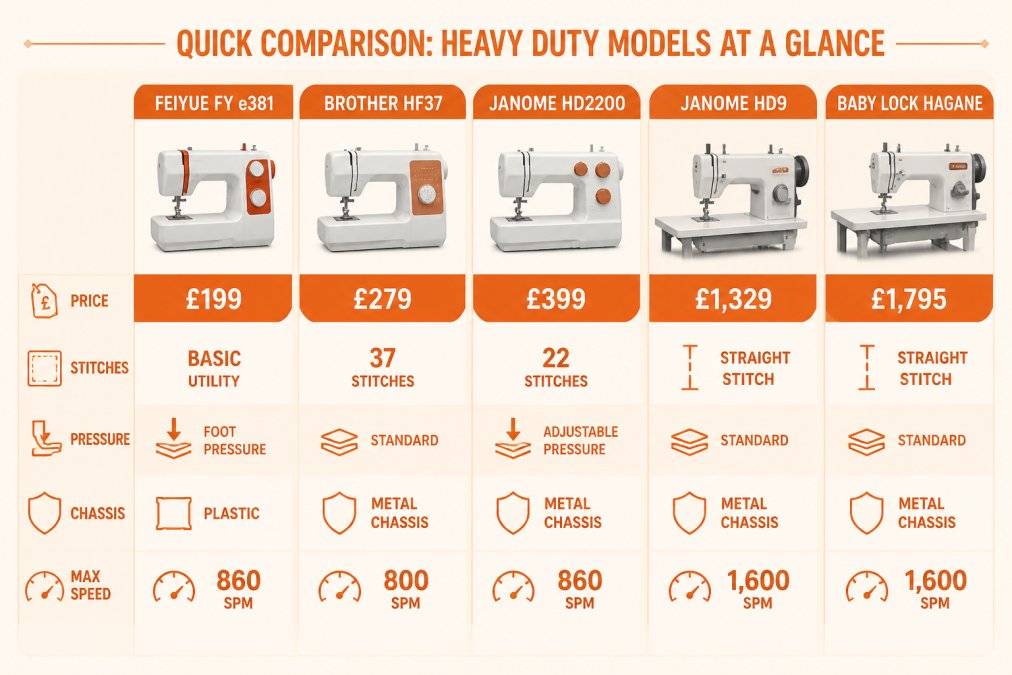
The price range tells you something important. You can get a capable heavy duty sewing machine for under £300. The jump to £1,300+ isn't about being heavy duty, it's about specialisation. The Janome HD9 and Baby Lock Hagane are semi-industrial machines for specific tasks.
For most home sewers, the sweet spot is £200-£400. That's where you get metal construction, presser foot control, and genuine durability without paying for features you'll never use.
Is the Investment Worth It? Who Benefits Most
A heavy duty sewing machine is worth it if any of these apply to you:
You sew regularly, at least once a week. A machine that costs £300-£400 amortises quickly when you're using it consistently. After a year of weekly sewing, you've paid less than £10 per session. That's cheaper than a coffee.
You work with thick fabrics. Denim, canvas, upholstery, or leather. A regular machine will either fail or frustrate you. A heavy duty machine handles these materials without complaint.
You're tired of skipped stitches and needle breakage. This is the most common reason people upgrade. They've spent months fighting a regular machine, then switch to a heavy duty model and wonder why they didn't do it sooner.
You want a machine that lasts. Heavy duty machines are built to last decades. A regular machine might last five years of regular use. A heavy duty machine will outlive your interest in sewing.
You're learning to sew or returning to it after years away. A heavy duty machine builds confidence. It doesn't fight you. It doesn't make you question whether you're doing something wrong. It just works.
You're not a candidate for a heavy duty machine if you sew occasionally, a few times a year, and stick to lightweight fabrics. A regular machine is fine for that. You're not getting enough value to justify the cost.
You're also not a candidate if you need a machine that does everything: decorative stitches, buttonholes, monogramming, screen displays. Heavy duty machines deliberately skip those features. They're built for strength, not versatility.
Cost, Durability, and Long-Term Value
The initial cost of a heavy duty sewing machine is higher than a regular one. A decent regular machine costs £150-£250. A heavy duty machine starts at £199 and goes up from there.
But cost per year of use tells a different story. A regular machine used regularly might last five years. A heavy duty machine often lasts 20+ years. The heavy duty machine costs more upfront, but it costs less per year of ownership.
There's also the cost of frustration. A regular machine that skips stitches on denim forces you to either accept poor results or stop sewing those fabrics. A heavy duty machine removes that constraint. You can sew what you want, when you want, without worrying about the machine failing.
Durability is where heavy duty machines shine. Metal construction resists wear. Mechanical systems don't fail like electronic components do. Parts are available and inexpensive. Repair costs are low because there's less to break.
We stock machines from FEIYUE, Brother, Janome, and Baby Lock because they hold up. We also offer professional machine servicing and repairs for all brands. That support matters when you're investing in something that will be part of your sewing life for years.
The real value question is simple: will you use this machine enough to justify the cost? If yes, a heavy duty sewing machine is one of the best investments you can make in your sewing. If no, save your money.
A heavy duty sewing machine is worth it if you sew regularly and work with challenging fabrics. The initial investment pays for itself through years of reliable performance and the confidence that comes from a machine that won't let you down.
We recommend starting with the FEIYUE FY e381 at £199 if you're new to heavy duty machines or the Brother HF37 at £279 if you want more stitch options and a proven mechanical design. Both machines include metal construction, the core features that make heavy duty machines worth buying.
Contact us at Fabric Mouse for guidance on which machine suits your sewing style, and we'll help you find the right fit. We offer free UK delivery, expert setup support, and professional servicing for all the machines we stock.
Frequently Asked Questions
What is the difference between a heavy-duty sewing machine and a regular sewing machine?
Heavy-duty sewing machines feature reinforced metal chassis, stronger feed systems, and adjustable presser-foot pressure to handle multiple fabric layers and thicker materials like denim and canvas. Regular machines prioritise versatility with decorative stitches and lighter construction. Heavy-duty models sacrifice stitch variety for raw power and stability, making them ideal if you're sewing thick fabrics consistently rather than switching between lightweight garments and heavy projects.
Can a heavy-duty sewing machine sew denim and thick fabrics reliably?
Yes. Heavy-duty machines are specifically designed for denim, canvas, upholstery, and multiple layers. The FEIYUE FY e381 and Brother HF37 both handle denim hemming and repairs with ease. For extremely demanding projects like leather or webbing, specialist machines like the Baby Lock Hagane offer high-torque motors and adjustable stitch lengths from 1-7 mm, giving you precise control at slower speeds where thicker materials need extra power.
Is a heavy-duty sewing machine suitable for beginners?
Absolutely. Beginners benefit from heavy-duty machines because they're mechanically straightforward and forgiving. The FEIYUE FY e381 (£199) and Brother HF37 (£279) are both beginner-friendly with simple dial controls, no confusing menus, and reliable performance. Their strength means you won't outgrow the machine quickly, and the sturdy construction builds confidence as you learn. If you plan to sew anything thicker than cotton occasionally, starting with a heavy-duty model saves you from upgrading later.
How long do heavy-duty sewing machines typically last?
Heavy-duty machines with solid metal bodies and mechanical construction often last 10-20+ years with basic maintenance. The Janome HD2200 and Brother HF37 are built for durability with metal frames that withstand years of regular use. Semi-industrial machines like the Janome HD9 are engineered for longer production runs and extended lifespan. Longevity depends on use frequency and care, but the robust engineering of heavy-duty models means they're a long-term investment rather than a short-term purchase.
Best Fabric Shops in North Yorkshire: 2026 Guide
How to Thread a Sewing Machine Correctly
Related Posts

How to Thread a Sewing Machine Correctly

Best Fabric Shops in North Yorkshire: 2026 Guide

5 Best Portable Sewing Machines for Classes

Best Fabric Drape for Summer Dresses

Why Your Sewing Machine Smells Like Burning

How to Choose Your First Sewing Machine
