

Best Embroidery Machine for Small Business 2026
Table of Contents
- What Makes the Best Embroidery Machine for Small Business
- Embroidery Machine Comparison Table
- Single-Needle Machines: Starting Your Small Business
- Multi-Needle Machines: Scaling Production Speed
- BAi Commercial Machines: Home-Based Business Setup
- Essential Embroidery Business Supplies Beyond the Machine
- Commercial Embroidery Machine Maintenance for Longevity
- How to Price Custom Embroidery Services Profitably
- Which Machine Should You Choose?
- Frequently Asked Questions
Last Updated: 29 September 2026
What Makes the Best Embroidery Machine for Small Business
Choosing the right embroidery machine for small business operations is one of the most important investments you'll make as a maker or entrepreneur. The machine you select will determine your production speed, design flexibility, and ultimately, your ability to scale profitably. But here's what most guides miss: the "best" machine isn't always the most expensive or feature-rich. It's the one that matches your current workflow, not the business you hope to have in five years.
At Fabric Mouse, we've helped embroiderers move from hobby projects to profitable operations. The difference between success and frustration often comes down to choosing the right needle count, embroidery area, and support system. Whether you're starting with a single-needle machine or scaling up to multi-needle production, this guide will show you exactly which machine suits your business stage and budget.
The best embroidery machine for small business 2026 depends on three core factors: your production volume, the types of items you embroider, and how much you're willing to invest upfront. A single-needle machine works beautifully for custom one-off orders and small batches. A 6-needle machine accelerates production when you're handling repeat jobs. A 10 or 15-needle commercial machine becomes essential once you're running multiple designs daily across different thread colours.
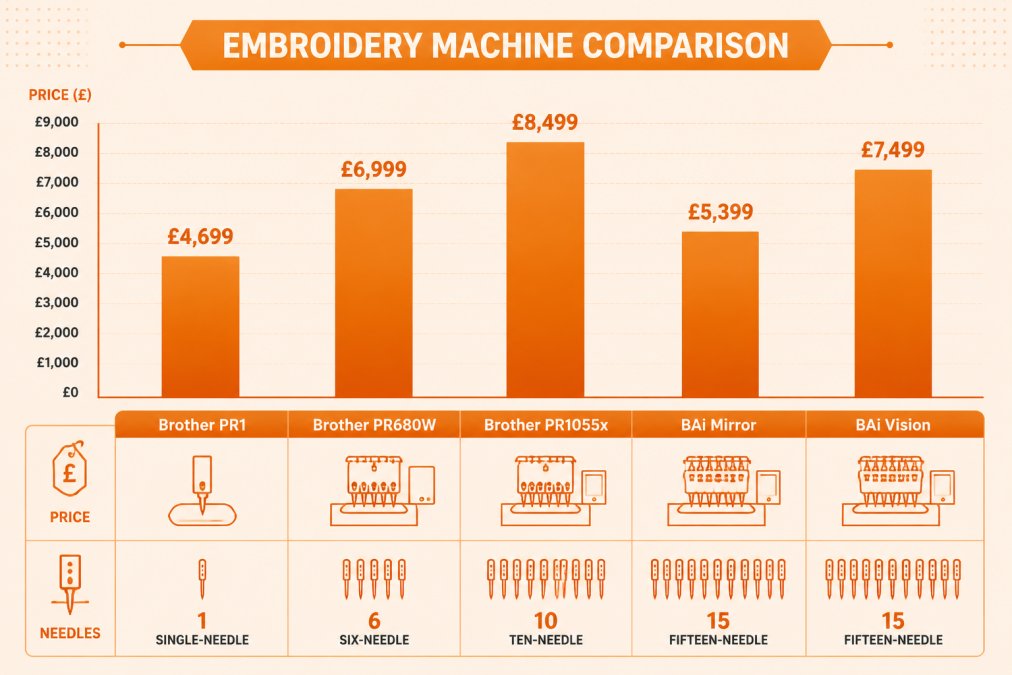
Embroidery Machine Comparison Table
| Machine Type | Needle Count | Embroidery Area | Speed (SPM) | Price Range | Best For |
|---|---|---|---|---|---|
| Single-Needle Entry | 1 | 100 x 100mm | 400 | £699-£699 | Beginners, small custom orders |
| Single-Needle Professional | 1 | 300 x 200mm | 1000 | £3,499-£4,699 | Start-up embroidery businesses |
| 6-Needle Multi | 6 | 200 x 300mm | 1000 | £6,999 | Growing businesses, repeat orders |
| 10-Needle Multi | 10 | 360 x 200mm | 1000 | £8,499-£9,999 | High-volume production, multi-colour designs |
| 15-Needle Commercial | 15 | 500 x 400mm | 1200 | £5,399-£7,499 | Home-based commercial operations |
Single-Needle Machines: Starting Your Small Business
Single-needle machines are where most embroiderers begin, and for good reason. They're affordable, straightforward to operate, and produce professional-quality results. The learning curve is gentle, and you won't feel overwhelmed by unnecessary features.
A single-needle machine works best when your business model focuses on custom, made-to-order items rather than bulk production. You'll spend time changing thread colours between designs, but that's acceptable when you're handling one or two orders at a time. The embroidery area matters more than you might think at this stage. A smaller hoop limits what you can embroider on larger garments like jacket backs or oversized tote bags.
Brother PR1: Professional Results in Compact Form
The Brother PR1 delivers industrial-quality embroidery without needing a dedicated workshop. This machine sits at the sweet spot for start-up embroidery businesses. It features a generous 300 x 200mm embroidery area, which handles most garment decoration work comfortably. The built-in touchscreen lets you edit designs directly on the machine, and the crosshair laser positioning ensures perfect placement every time.
What makes this machine stand out is the wireless transfer via the Artspira app. You can send designs from your phone or tablet in seconds, which simplifies your workflow when you're juggling multiple client orders. Automatic thread trimming and needle threading save you time on repetitive tasks. At £4,699, it's a genuine investment, but the features justify the cost for anyone serious about turning embroidery into income.
The PR1 is ideal if you're decorating apparel, accessories, and promotional items for small local businesses or direct-to-consumer clients. The machine handles delicate fabrics and bold designs with equal ease. When you order the Brother PR1 from us, you're not just buying a machine, you're joining a community of supported makers. We include: Full setup and demonstration, Ongoing support and advice, Optional training sessions, Free UK delivery, which removes the guesswork from getting started.
Brother VR: Versatility for Pockets and Sleeves
The Brother VR is the only machine in this category with free-arm embroidery capability, which opens up projects that standard machines can't handle. You can embroider pockets, sleeves, and tubular items without removing them from the machine. This feature alone sets it apart for anyone offering custom workwear, polo shirts, or branded apparel.
The machine includes 305 built-in patterns and 20 fonts, giving you creative flexibility without relying entirely on client designs. The large embroidery area and LED pointer make precise positioning straightforward. At £3,499, it's more affordable than the PR1, though it lacks some of the advanced editing features and the wireless app connectivity.
The VR shines for embroiderers who want to expand beyond flat garments. If your clients are asking for embroidered caps, sleeves, or curved items, this machine pays for itself quickly. The trade-off is slightly fewer built-in designs and a smaller touchscreen compared to the PR1. For many small businesses, that trade-off is worth the lower price and the free-arm versatility.
Multi-Needle Machines: Scaling Production Speed
Multi-needle machines transform your business model. Instead of changing threads between colours, you load multiple thread colours upfront and let the machine switch automatically. This single change can double your production speed and reduce the mental load of managing thread changes throughout the day.
The jump from single to multi-needle is significant. You're no longer limited to one-colour designs or designs with frequent thread changes. Multi-colour logos, complex artwork, and gradient effects become practical. The machine handles the heavy lifting, which means you can take on larger orders or more clients without working longer hours.
Brother PR680W: The Sweet Spot for Growing Businesses
The Brother PR680W is the most popular choice for embroiderers scaling from hobby to serious business. Six needles is the right balance between speed and complexity. You can handle most commercial embroidery work without the investment or space requirements of a 10 or 15-needle machine.
The 200 x 300mm embroidery area is generous enough for jacket backs, large logos, and complex designs. The 10.1-inch LCD display is crisp and easy to read, and the zoom function helps you see fine detail work. Speed reaches 1,000 stitches per minute, which means a typical design finishes in minutes rather than the 10-15 minutes a single-needle machine requires.
What sets the PR680W apart is the workflow optimisation features. The stitch simulator lets you preview designs before stitching, catching mistakes before they waste thread and time. The automatic colour sequencing feature reduces setup errors. The largest crosshair pointer on the market ensures perfect needle placement. At £6,999, it's a genuine investment, but the speed and accuracy gains justify the cost for any business handling repeat orders.
The PR680W works beautifully for apparel decoration, promotional items, workwear personalisation, and club or school embroidery. If you're embroidering the same design repeatedly for different clients, the machine's efficiency becomes your competitive advantage. Fabric Mouse provides ongoing support and advice, which is crucial when you're learning to manage a more complex machine.
Brother PR1055x and PR1060W: High-Volume Production
The 10-needle Brother machines are for embroiderers who've proven their business model and are ready to scale hard. The PR1055x (£8,499) and PR1060W (£9,999) handle high-volume production with built-in camera positioning, wireless connectivity, and the ability to manage 10 thread colours simultaneously.

The extra needle count means fewer thread changes and faster completion of complex multi-colour designs. The 360 x 200mm embroidery area is one of the largest available on a single-head machine. Speed remains at 1,000 stitches per minute, but the time savings from automatic colour changes compound quickly across a full day of production.
Both machines include wireless LAN connectivity, which lets you link up to 10 machines together using optional PE-Design 11 software. This feature matters if you're planning to grow into a full embroidery operation with multiple machines. The built-in camera sensor positions designs with precision, eliminating the guesswork of manual placement.
The PR1055x is the better choice if you're balancing creative work with commercial production. The PR1060W is optimised for pure commercial output, with simplified workflows and production tracking. Both are serious investments.
These machines suit apparel businesses, promotional product companies, custom merchandise operations, and embroiderers offering high-volume services to corporate clients. If you're embroidering workwear for large employers or promotional items for events, a 10-needle machine becomes essential.
BAi Commercial Machines: Home-Based Business Setup
BAi embroidery machines represent a different category entirely. These 15-needle commercial machines are designed specifically for home-based embroidery businesses. Unlike traditional commercial machines that require dedicated industrial space, BAi machines fit into spare corners, dining rooms, or small workshops.
The key difference is the built-in emergency shut-off switch and safety features designed for home use. You meet health and safety standards easily, which matters for insurance and peace of mind. The machines come fully set up and ready to embroider from day one, with all accessories included: cap embroidery kits, flat hoops, spare parts, and instruction manuals.
The Mirror: Entry-Level Commercial Power
The BAi Mirror (£5,399) offers 15 needles and commercial-grade stitching in a home-friendly package. The embroidery area is generous, and the speed reaches 1,200 stitches per minute, which is faster than Brother's 10-needle machines. For a home-based business, this speed is a game-changer. You can complete designs in half the time of a 6-needle machine.

What makes the Mirror practical for home use is the included heavy-duty stand with a removable side table. Your workspace stays organised, and the machine is sturdy enough to handle all-day embroidery without shifting. The full UK warranty and free delivery with ground-floor setup remove the logistics headache.
The Mirror suits home-based embroiderers moving into commercial production. If you're embroidering hats, clothing, bags, and patches, the 15-needle setup handles everything efficiently.
The Vision: Upgraded Performance for Scaling Operations
The BAi Vision (£7,499) is the step up for embroiderers who've proven demand and want faster production. The embroidery area is larger (500 x 400mm), and the speed reaches 1,200 stitches per minute. The memory capacity is substantial: 100 million stitches or 1,000 designs, so you can store your entire design library on the machine.
The independently developed Institch i5 electronic control system is more user-friendly than earlier models, with a learning curve that favours novices. If you're hiring staff or training family members to help with production, this matters. The machine is intuitive enough that someone without embroidery experience can learn quickly.
The Vision is ideal for embroiderers who've scaled beyond hobby territory and are running a genuine small business. The larger embroidery area means fewer hooping changes for bigger designs. The speed means you can handle rush orders without working into the evening. At £7,499, it's a significant investment.
Brother PR1055x Multi-Needle Embroidery →
Essential Embroidery Business Supplies Beyond the Machine
Your machine is only part of the equation. The supplies you choose affect both your output quality and your profitability. Thread quality, hoops, stabiliser, and software all influence your results and your margins.
Thread matters more than most beginners realise. Cheap thread breaks, shreds, and produces dull, uneven stitches. Professional embroidery thread from brands like Sakura Thread and Richword thread produces consistent, vibrant results. Budget approximately £2-£4 per spool for quality thread, and stock a range of colours.
Hoops and stabilisers work together. The right stabiliser prevents puckering, stretching, and thread breaks. Different fabrics require different stabiliser weights: lightweight for delicate fabrics, heavyweight for denim and canvas. Sew Fine sewing cabinets provide organised storage for your hoops and supplies, keeping everything accessible during production.
Embroidery software extends what your machine can do. Wilcom EmbroideryStudio Essentials (£799) is an entry point into professional digitising. If you're converting client artwork into embroidery files, this software gives you the tools without the steep learning curve of higher-level versions. Wilcom EmbroideryStudio Lettering (£599) is the focused choice if you're primarily doing monograms and text-based designs.
Design sourcing is another cost. Some embroiderers build their own library. Others subscribe to design services or purchase pre-digitised files. Budget £50-£200 per month for designs, depending on your production volume and whether you're creating custom artwork for clients.
Commercial Embroidery Machine Maintenance for Longevity
Your embroidery machine is precision equipment. Maintenance determines whether it runs reliably for years or develops costly problems within months. Neglect is expensive; preventive care is cheap.
Daily maintenance takes five minutes. Brush out lint from the needle area and bobbin case after every few hours of stitching. Check that all thread guides are clear. Empty the bobbin case dust trap. These simple steps prevent thread breaks and needle damage.
Weekly maintenance includes cleaning the tension discs and checking needle sharpness. Dull needles produce skipped stitches and fabric damage. Replace needles every 8-10 hours of stitching, or whenever you notice quality degradation. Keep spare needles on hand so you're never caught without one.
Monthly maintenance involves running a test design on scrap fabric to check tension, stitch quality, and colour accuracy. This habit catches problems early. If tension is drifting or stitches are skipping, you've got a specific issue to address rather than guessing what's wrong.
Professional servicing every 12 months keeps your machine in peak condition. Fabric Mouse offers professional machine servicing and repairs, which includes deep cleaning, tension calibration, and any necessary adjustments. This service helps maintain your machine's condition.
Keep your machine covered when not in use. Dust and lint are your machine's enemies. A simple dust cover costs £20 and extends your machine's life significantly.
How to Price Custom Embroidery Services Profitably
Pricing is where many embroiderers leave money on the table. They charge based on time spent rather than value delivered, which undervalues their work and creates a ceiling on income.
Start by calculating your true costs. Thread, stabiliser, electricity, machine depreciation, and labour all factor in. A typical embroidered design costs £1-£3 in materials and overhead.
But here's where most guides get it wrong: your price should reflect what clients are willing to pay, not just your costs. A custom logo embroidered on 50 polo shirts for a corporate client is worth more than the same design on a single t-shirt. Volume discounts are real, but your base price per item should stay firm.
Common pricing structures:
Per-piece pricing: Charge £5-£15 per embroidered item, depending on design complexity and garment type. Simple names or logos sit at the lower end. Complex multi-colour artwork sits at the higher end.
Design fee plus per-piece: Charge £50-£200 for custom digitising, then £3-£8 per embroidered item. This structure works for clients bringing their own artwork.
Bulk pricing: Offer tiered pricing: 1-10 pieces at full price, 11-25 pieces at 10% discount, 26-50 pieces at 15% discount, 50+ pieces at 20% discount. This incentivises larger orders without cutting your margins too thin.
Rush fees: Charge 25-50% extra for orders needed within 48 hours. This compensates for disrupting your production schedule.
Test your pricing with a few clients. If you're consistently booked weeks in advance, your prices are too low. If you're struggling to fill orders, you might be too high.
Which Machine Should You Choose?
The right machine depends on your current business stage, not your aspirations. Here's the decision framework:
Choose a single-needle machine if: You're handling fewer than 5 orders per week, your designs are primarily single-colour or simple multi-colour work, and you want to test the market before committing serious capital. The Brother PR1 (£4,699) is the professional choice. The Brother VR (£3,499) is ideal if you need free-arm capability for sleeves and pockets.

Choose a 6-needle machine if: You're consistently handling 5-15 orders per week, many designs repeat, and you want to speed up production without overcommitting to a larger machine. The Brother PR680W (£6,999) is the proven choice for this volume.
Choose a 10-needle machine if: You're handling 15-30+ designs per week, your clients demand fast turnaround, and you're ready to invest in serious production equipment.
Frequently Asked Questions
What features should I look for in an embroidery machine for small business?
Focus on embroidery area size (larger for versatility), stitch speed (measured in stitches per minute), needle count (single for simplicity, multi-needle for faster production), and built-in design library. Consider automatic threading, colour touchscreen, and wireless connectivity for efficiency. For home-based setups, compact machines like the Brother PR1 offer professional results in smaller footprints. Larger businesses benefit from multi-needle machines like the Brother PR680W or BAi commercial models.
Is a multi-needle embroidery machine necessary for a small business?
Not initially. Single-needle machines like the Brother PR1 are excellent for start-ups, offering professional quality and lower investment. Multi-needle machines become valuable once you're completing designs regularly and want to reduce thread-change time. The Brother PR680W bridges this gap with six needles, ideal for businesses growing from hobby to commercial production without the cost of a full 10 or 15-needle system.
How do I choose between domestic and commercial embroidery machines?
Domestic machines (Brother PR1, VR) suit hobbyists and start-ups with lower volume and tighter budgets. Commercial machines (BAi Mirror and Vision) are designed for continuous use and higher stitch counts, with safety features like emergency shut-off switches. BAi machines are specifically engineered for home-based businesses, combining commercial reliability with space-saving design. Choose commercial if you're running a registered business and expect consistent daily use.
What are the essential supplies I need alongside my embroidery machine?
Beyond the machine, invest in quality thread (Richword and Sakura Thread are reliable UK options), hoops in various sizes, stabiliser, bobbin thread, and design software. Wilcom EmbroideryStudio Essentials (£799) offers professional editing tools. You'll also need a sewing cabinet or workspace organisation system, scissors, and replacement needles. Many machines include starter kits, but additional supplies will be necessary as your business grows.
Can I start an embroidery business with a home-use machine?
Yes. The Brother PR1 (£4,699) is designed specifically for home-based creators and start-up brands, delivering professional results without commercial-grade investment. BAi commercial machines like the Mirror (£5,399) are also engineered for home workshops with safety features meeting standards. Start with a single-needle machine to test your market, then upgrade to multi-needle or commercial equipment as demand grows.
Evaluating Fabric Quality When Buying Online
How to Choose Your First Brother Sewing Machine
Related Posts

How to Sew Mitered Corners on Hems

Standard Sewing Machine for Free-Motion Quilting: Pros and Cons

How to Use Quilting Rulers for Beginners

Types of Premium Cotton for Quilting

Why Bobbin Thread Bunches Up: Fix It Now

How to Grade Sewing Patterns for Custom Fit

How to Fix Gaping Armholes in Dresses: 7 Methods
