

How to Sew with Cotton Jersey Fabric: A Practical Guide
Quick Summary
To sew cotton jersey, use a ballpoint needle, a stretch thread and a narrow zigzag stitch, and cut with the greatest stretch running around the body. Pre-wash the fabric first, as cotton shrinks, and test every setting on an offcut before sewing the garment.
- Pre-wash cotton jersey before cutting, because cotton shrinks after its first wash.
- Use a ballpoint needle, which slips between the knit loops rather than piercing them.
- Choose a stretch thread so seams can move with the fabric when worn.
- Sew seams with a narrow zigzag, and finish hems with a twin needle or zigzag for flexibility.
- Test stitch settings on a scrap by stretching the seam, and adjust if stitches snap or ripple.
Table of Contents
- How to Sew with Cotton Jersey Fabric: A Practical Guide
- What Cotton Jersey Is and Why It Behaves Differently
- Preparing and Pre-Washing Cotton Jersey
- Best Needle for Jersey Fabric
- Selecting Thread for Knit Fabric
- Best Stitch for Stretch Fabric
- How to Stop Jersey Fabric Stretching When Sewing
- How to Hem Jersey Fabric
- Troubleshooting Wavy Seams and Skipped Stitches
- Booking Your First Jersey Project Session
- Frequently Asked Questions
How to Sew with Cotton Jersey Fabric: A Practical Guide
Last Updated: November 7, 2026
Cotton jersey is one of the most forgiving fabrics to sew, once you understand how it behaves. It stretches, it curls at the edges, and it can pucker if you treat it like woven cotton. Many people pick up a jersey project and then struggle with wavy seams or skipped stitches. The good news is that the fixes are simple. This guide walks you through each step, from choosing the right needle to finishing the hem.
What Cotton Jersey Is and Why It Behaves Differently
Cotton jersey is a knitted fabric, not a woven one. Its loops of yarn let it stretch in one direction more than the other. That stretch is what makes it comfortable for t-shirts, leggings and hoodies.
Knit fabric has no fixed grain in the way woven cloth does. Instead, it has a direction of greatest stretch, usually across the width. Cutting and sewing along that direction gives you the best results.
A few things set cotton jersey apart from woven cotton:
- It stretches. Sew it too tightly and seams pop when worn.
- It curls. Raw edges roll inwards, especially on lighter weights.
- It can shift. The layers can slide as you feed them under the foot.
Knowing this before you start saves a lot of unpicking later.
Preparing and Pre-Washing Cotton Jersey
Always pre-wash cotton jersey before cutting. Cotton shrinks, and a garment cut from unwashed fabric can end up smaller after its first wash.
Follow these steps:
- Wash the fabric at the temperature stated on the label.
- Dry it flat or on a low setting to limit further shrinkage.
- Press it lightly with the iron on a low heat, avoiding stretching it.
- Check the stretch direction by gently pulling it across the width.
Once it is prepared, lay it out on a flat surface. Pin your pattern pieces so the greatest stretch runs around the body, not up and down it.
Best Needle for Jersey Fabric
The right needle prevents skipped stitches and damaged fibres. Use a ballpoint needle, which has a rounded tip that slips between the knit loops instead of piercing them.
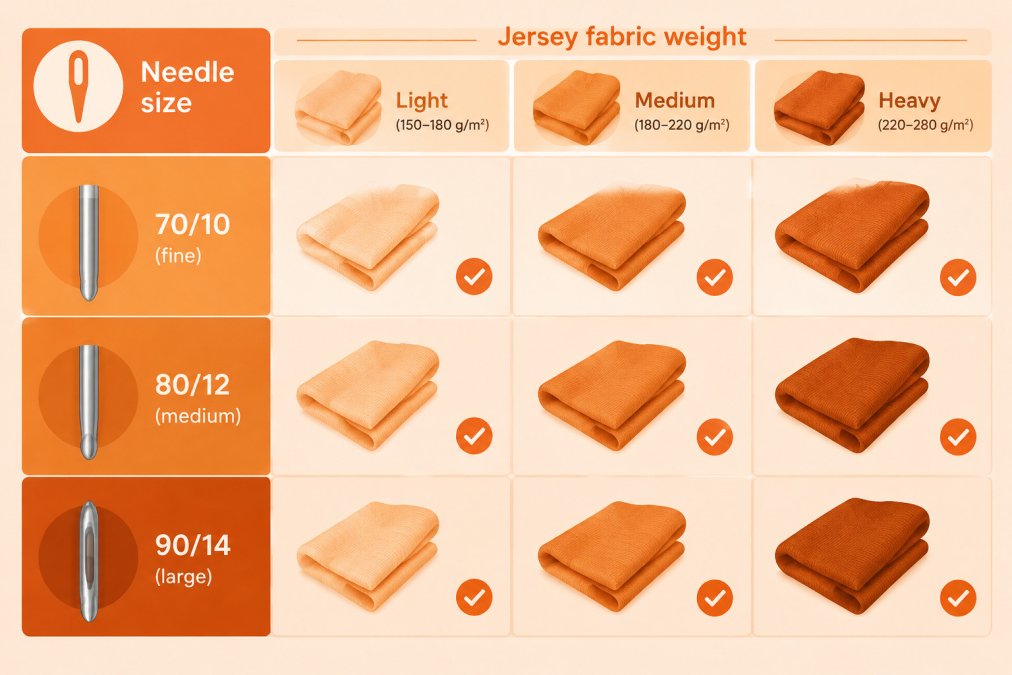
Hemline Ballpoint Sewing Machine Needles are a sensible starting point. Their assorted pack includes two size 70/10 needles, two size 80/12 needles and one size 90/14 needle, so you can match the size to your fabric weight. You can buy the Hemline ballpoint needles assortment here.

For a jersey-specific option, the Prym Jersey needles No.70 pack is worth a look. They come in sizes 70 to 90 and have a special point geometry that pushes the fibres aside rather than piercing them. You can find Prym Jersey needles No.70 here.

As a rough guide:
- Light jersey: size 70/10 or 80/12
- Medium jersey: size 80/12
- Heavy sweatshirt jersey: size 90/14
Change your needle often. A blunt or bent needle is one of the most common causes of skipped stitches.
Selecting Thread for Knit Fabric
Thread needs to stretch with the fabric. A rigid thread will snap when the seam is pulled, so choose a stretch thread for seams that will be worn.
Gütermann Maraflex is a good choice for jersey. It is a stretch thread for flexible straight-stitch seams in light to medium-weight jersey. Use it in both the needle and the bobbin, with low thread tension. Its material is 100% polybutylene terephthalate (PBT), and each reel is 150 metres. Use a jersey, stretch or super-stretch needle in size NM 70-80 with it. You can browse Gütermann Maraflex thread colours here.

Colour matching can be tricky on screen. Use the Gütermann shade number and treat screen colours as a guide only. Test the thread on an offcut before you start.
Best Stitch for Stretch Fabric
A seam in cotton jersey has to move with the fabric. A plain straight stitch has almost no give, so it cracks or pops the first time the garment is pulled over a head or a hip. The stitch you choose is therefore a balance between stretch, appearance and the equipment you own.
Start with a narrow zigzag
For most home sewists, a narrow zigzag is the default seam for cotton jersey. Set a stitch length of about 2.5 mm and a width of about 0.5 to 1 mm, narrow enough that the seam looks almost straight from the right side, wide enough that it opens when stretched. This is a starting point, not a rule: machines differ, so sew a test seam on an offcut, stretch it gently across the seam, and check that the stitches open rather than snap.
Compare the main seam options
| Method | Stretch | Appearance | Equipment | Best use |
|---|---|---|---|---|
| Narrow zigzag | Good | Near-straight from the right side | Any machine | Most seams on light to medium jersey |
| Lightning or stretch stitch | Very good | Decorative, slightly raised | Machines with the stitch built in | Seams under strain, such as sleeves and crotch seams |
| Overlocker (serger) | Excellent | Professional, trimmed edge | Overlocker | Knit garments sewn regularly; seams and edges in one pass |
| Twin needle | Good across, straight along | Two parallel rows, professional hem | Machine with a twin-needle capability | Hems and neckline bands |
| Straight stitch with stretch thread | Moderate | Neat | Any machine | Stable areas only, never a seam that is pulled on |
An overlocker is not essential. A narrow zigzag on a standard machine will produce a wearable jersey garment; an overlocker mainly speeds up edge finishing and gives a more professional inside. If you are weighing up whether to add one, our demonstrations and expert advice page explains how to try machines before deciding.
Match the stitch to the jersey
Cotton jersey is not one fabric. A light single-knit T-shirt weight with a little elastane needs a short, narrow zigzag and a fine ballpoint needle, because a wide stitch will ripple the cloth. A heavier loopback sweatshirt jersey with little or no elastane can take a longer stitch and a wider zigzag, and it is far less likely to curl at the seam. Double-knit jersey, which has a second set of loops on the reverse, is denser and more stable, so it tolerates a straighter stitch than a thin single knit. If the fabric has a high elastane content, test the seam by stretching it firmly before you commit, a stitch that looks fine flat can still crack under real wear.
Watch out: a lightning stitch that is set too long will perforate a light jersey and leave a visible ladder of holes along the seam line, so shorten the stitch length on fine fabrics.
Test before you sew the garment
Cut a scrap roughly 10 cm by 20 cm, sew a short seam across the middle, then pull it gently at right angles to the seam. If the stitches open and the fabric returns flat, the setting is right. If the seam ripples, shorten the stitch or reduce the tension. If the thread snaps, the stitch is too straight or the tension is too high. Keep the test scrap beside the machine and note the settings, because the same numbers will not transfer directly to a different machine or a different weight of jersey.
How to Stop Jersey Fabric Stretching When Sewing
Most wavy seams and grown necklines come from the fabric stretching during construction, not from the machine. The fix starts before you cut, with the direction of stretch and the pattern's requirements, and continues at the machine with support and even feeding.
Find the direction of greatest stretch first
Cotton jersey stretches more in one direction than the other. Fold the fabric so the two selvedges meet and hold it up: the direction that stretches most easily is usually across the width, running from selvedge to selvedge. That is the direction that should wrap around the body. On a pattern, the grainline arrow normally aligns with the lengthwise direction, so the greatest stretch runs across the pattern piece, not along it. Cutting a sleeve or a leg in the wrong direction gives a garment that twists and will not hang properly.
Watch out: on some jerseys the greatest stretch runs along the length rather than across the width, so always test the actual piece rather than assuming.
Check the pattern's stretch requirement
Knit patterns usually state a stretch percentage, commonly 25 per cent, 50 per cent or more. To check a fabric, fold a 10 cm section, mark 10 cm on the fold, stretch it comfortably and measure the new length. If it reaches 12.5 cm it has roughly 25 per cent stretch; 15 cm is roughly 50 per cent. A pattern written for 50 per cent stretch will be too tight in a fabric with only 25 per cent, and a very stretchy jersey used on a low-stretch pattern can make a neckline gape. Match the fabric to the pattern rather than forcing it.
Stabilise the areas that grow
Shoulder seams and necklines are the places most likely to stretch out of shape, because they sit on the bias of the knit and take the weight of the garment. A strip of lightweight fusible interfacing or clear elastic along the shoulder seam holds it at its intended length. For necklines, a strip of stay tape or a band cut slightly shorter than the opening gives the edge something to recover against. Apply stabiliser before sewing the seam, not after, and keep it narrow so it does not stiffen the drape.
Feed the fabric evenly
A walking foot helps because it moves the top layer at the same rate as the feed dogs below, which stops the upper layer being dragged forward. If you do not have one, reduce the presser-foot pressure if your machine allows it, and guide the fabric rather than pulling it. Let the feed dogs draw the cloth through and keep your hands flat on either side of the needle. On very stretchy jersey, a long basting stitch through the seam line before the final stitch holds the layers together and limits distortion.
Adjust the machine, not the fabric
If a seam still ripples, change one setting at a time: shorten the stitch, then lower the top tension slightly, then try a fresh ballpoint needle. Re-test on a scrap after each change so you know which adjustment made the difference. A seam that lies flat on the scrap will usually lie flat on the garment.
How to Hem Jersey Fabric
Hems on jersey should stretch with the garment. A standard turned hem can look stiff, so choose a method that flexes.
- Fold the hem to the wrong side, usually 2 to 3 centimetres.
- Pin or clip the fold in place, keeping the fabric flat.
- Stitch with a narrow zigzag or a twin needle for a neat, stretchy finish.
- Trim any excess fabric and press lightly.
A twin needle gives a professional look on the right side. It creates two parallel rows of straight stitching while the zigzag on the underside keeps the hem elastic. Use a stretch thread on both needles.
Troubleshooting Wavy Seams and Skipped Stitches
Most problems with jersey come down to a handful of causes. Work through this checklist when something goes wrong:
-
Skipped stitches
- Change to a fresh ballpoint needle.
- Check the needle is inserted fully and facing the right way.
- Make sure the needle size suits the fabric weight.
-
Wavy seams
- Reduce the tension slightly.
- Use a walking foot or stabiliser.
- Stop pulling the fabric through the machine.
-
Puckering
- Lengthen the stitch slightly.
- Check that the thread is a stretch thread.
-
Thread breaking
- Switch to a stretch thread such as Maraflex.
- Lower the top tension.
Always re-test on a scrap after changing one setting, so you know what made the difference.
Booking Your First Jersey Project Session
If you are new to sewing with knit fabric, a hands-on session can save time and frustration. Individual lessons with Stuart are available by arrangement for customers who need a little help using their sewing machine. They are separate from demonstrations, which help you choose a machine.
Please contact us before you travel so we can confirm what is available. You can get in touch with our team here, or find out more about demonstrations and individual expert advice here.
For a first project, we suggest a simple jersey top or a pair of leggings with a narrow zigzag seam and a twin-needle hem. Start small, test each step on a scrap, and build confidence before tackling a larger garment.
Frequently Asked Questions
What needle should I use to sew cotton jersey?
Use a ballpoint or jersey needle. Its rounded tip slips between the fibres instead of piercing them, which helps prevent skipped stitches and damaged knit loops. For light to medium cotton jersey, a size 70/10 or 80/12 is a sensible starting point. Hemline ballpoint needles and Prym jersey needles in sizes 70 to 90 are both suitable options. Always test on a scrap first, as the right size depends on fabric weight and thread.
Can I sew cotton jersey on a regular sewing machine?
Yes. You do not need a coverstitch or overlocker to sew cotton jersey on a standard domestic machine. A ballpoint or stretch needle, a stretch-friendly thread and a narrow zigzag or dedicated stretch stitch will handle most seams. Check your machine's manual for the stitch options it offers, as these differ between models. Practise on an offcut before cutting into your main fabric.
Do I need to prewash cotton jersey before sewing?
Pre-washing is strongly recommended. Cotton jersey can shrink when first laundered, so washing and drying it as you intend to launder the finished garment prevents a fitted project from changing size afterwards. Wash at the temperature stated on the label and press lightly before cutting.
How do I stop jersey seams from going wavy?
Wavy seams usually come from stretching the fabric as it feeds through the machine. Use a walking foot if your machine has one, sew with the fabric supported rather than pulled, and avoid tension that is too tight. Stabilise shoulder and neckline seams with a narrow strip of fusible tape or a second line of stitching. Always test a seam sample first to confirm the settings before sewing the finished piece.

Choosing Embroidery Software for Beginners: A Practical Guide
How to Clean and Oil Your Embroidery Machine Properly
Related Posts

How to Calculate Fabric Yardage for Beginners

How to Clean and Oil Your Embroidery Machine Properly

Choosing Embroidery Software for Beginners: A Practical Guide

How to Troubleshoot Sewing Machine Tension Problems

What Happens When a Sewing Machine Needle Breaks

Best Sewing Projects for Absolute Beginners: Start Here
