

Tips for Buying Sewing Machines Online
Table of Contents
- Why Buying from a Specialist Beats a General Marketplace
- Key Specs to Check When Buying Sewing Machines Online
- Comparison Table: Sewing Machine Types and Their Best Uses
- Choosing the Best Sewing Machine for Beginners 2026
- Essential Sewing Machine Accessories to Add to Your Order
- Sewing Machine Maintenance Tips for Long-Term Performance
- Understanding Delivery, Returns, and Warranty Support
- Common Mistakes to Avoid When Buying Sewing Machines Online
- Conclusion
- Frequently Asked Questions
Last Updated: September 23, 2026
Why Buying from a Specialist Beats a General Marketplace
Buying sewing machines online works best when you buy from a specialist who can advise on the machine, not a general marketplace that simply ships a box. A dedicated sewing retailer knows the difference between a mechanical workhorse and a computerised beginner model, and can tell you which one suits your projects before you spend a penny.
That distinction matters more than most shoppers expect. Marketplaces compete on price and volume; specialists compete on getting you the right machine the first time. At Fabric Mouse, a family-run business that has been trading since 1922, we have watched too many customers arrive with a bargain machine that fought them on every seam. The machine was cheap. The frustration was not.
A specialist also handles the practical side: setup guidance, warranty paperwork, and access to servicing when something goes wrong. That support is often the difference between a hobby that grows and a machine that gathers dust in a cupboard.
Key Specs to Check When Buying Sewing Machines Online
The specifications that actually matter when buying sewing machines online are stitch count, buttonhole type, motor type, and build weight. Everything else is marketing. Get these four right and you will rarely regret the purchase.
Stitch Count and Buttonhole Types
Stitch count tells you how many stitch patterns the machine offers, from basic straight and zigzag through to decorative and stretch stitches. A beginner needs 16 to 30 stitches; anything beyond that is a bonus rather than a requirement. Buttonhole type matters more than most buyers realise. One-step buttonholes size themselves automatically and produce consistent results, while four-step buttonholes require you to guide the machine through each stage. If neat buttonholes matter to you, prioritise a one-step system.
Mechanical vs Computerised: Which Suits You?
Mechanical machines use dials and levers, and they are simple, sturdy, and easy to repair. Computerised machines use a screen and buttons, offering automatic needle threading, speed control, and stitch selection at the touch of a finger. For absolute beginners, computerised models are often easier because the machine handles the fiddly parts. For sewists who mainly do straight seams on heavy fabric, a mechanical model can be perfectly adequate.
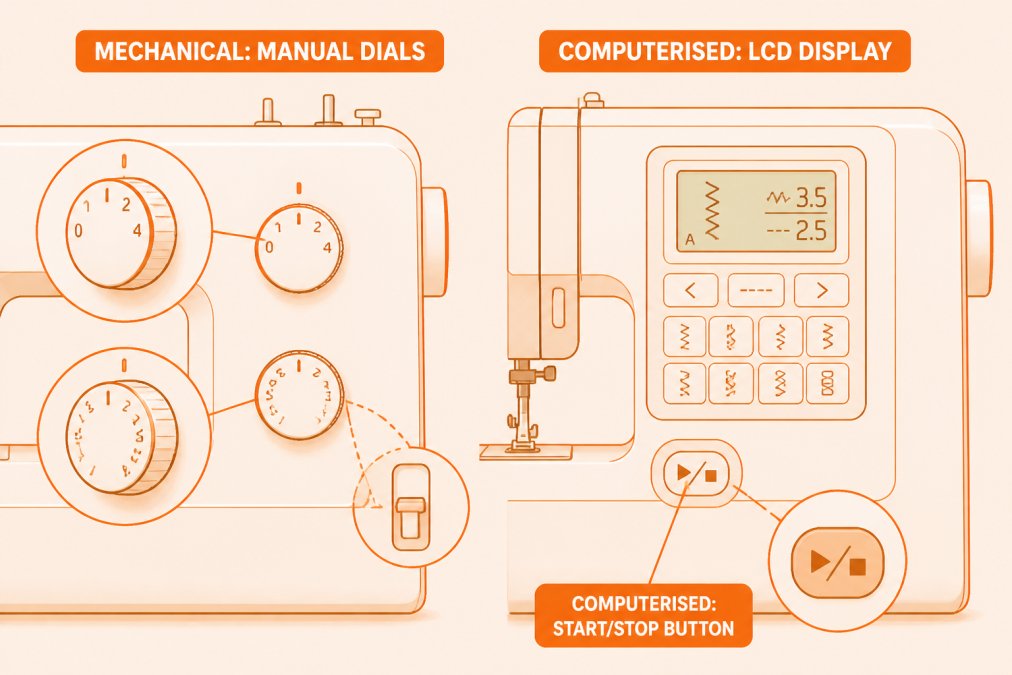
Comparison Table: Sewing Machine Types and Their Best Uses
Use this table to match machine type to your actual sewing habits before you browse listings.
| Machine Type | Typical Stitch Count | Best For | Portability |
|---|---|---|---|
| Mechanical | 10-25 | Straight seams, heavy fabric, simple mending | Light to moderate |
| Computerised | 30-60+ | Beginners, dressmaking, decorative work | Light and portable |
| Overlocker | 1-2 (seam finishing) | Neat edges, stretch fabrics, professional finishes | Moderate |
| Embroidery | 100+ (design files) | Monogramming, decorative panels, hobby embroidery | Varies by model |
Choosing the Best Sewing Machine for Beginners 2026
The best sewing machine for beginners in 2026 is a lightweight computerised model with an automatic needle threader, speed control, and a hard cover. Those three features remove the most common early frustrations: threading the needle, controlling speed on curves, and storing the machine safely.
Top Picks for New Sewists
The Brother Innov-is A16 is our strongest recommendation for a first machine. It offers 16 essential stitches, a jog dial for one-handed stitch selection, an automatic needle threader, and a speed control slider, all in a portable design at £399.00. For sewists who want room to grow, the Brother Innov-is A50 adds 50 built-in stitches and five one-step buttonholes at £449.00. If you prefer a different brand's feel, the Janome 230DC delivers 30 stitches, a start/stop button, and a hard cover at £449.00. Confident beginners ready for more stitch variety should look at the Brother Innov-is A65, which offers 60 stitches and seven one-step buttonholes at £499.00.

Essential Sewing Machine Accessories to Add to Your Order
Essential sewing machine accessories are the small purchases that determine whether your first project goes smoothly or stalls halfway through. Order them with the machine and you avoid a second delivery wait.
Start with a quality thread collection. Add a set of pin scissors for trimming threads and clipping curves, plus a fresh pack of machine needles in sizes 80/12 and 90/14 for medium and heavier fabrics. A seam ripper, a small screwdriver, and spare bobbins matched to your machine model round out the basics.
If you plan to take your machine to classes, a sturdy carry bag protects it in transit. Quilters should add a quarter-inch foot and a walking foot early, since both make piecing far more accurate.
Brother Innovis A50 Sewing Machine →
Sewing Machine Maintenance Tips for Long-Term Performance
Sewing machine maintenance tips boil down to three habits: clean the bobbin area, change the needle, and oil where the manual permits. Machines that receive this basic care run smoothly for decades.
- Brush lint from the bobbin case after every few hours of sewing
- Replace the needle after roughly eight hours of stitching, or sooner if it snags
- Oil the machine only at the points your manual specifies
- Keep the machine covered when not in use to prevent dust settling
- Book a professional service annually if you sew regularly
A common mistake is over-oiling. Too much oil attracts lint and creates a sticky mess that causes skipped stitches. Follow the manual exactly. If your machine starts skipping, bunching thread, or making unusual noises, stop sewing and book a service rather than pushing through. Fabric Mouse runs an authorised service centre for all brands, so repairs and servicing stay with people who know the machines.
Understanding Delivery, Returns, and Warranty Support
Delivery, returns, and warranty support are where specialist retailers separate themselves from marketplaces. A specialist confirms the machine is checked and packed properly before dispatch, and can talk you through the warranty terms in plain language.
Ask three questions before ordering: How is the machine packed for transit? What is the returns window and who pays return postage? Who handles a warranty claim, the retailer or the manufacturer? A retailer with an authorised service centre answers all three without hesitation.
Common Mistakes to Avoid When Buying Sewing Machines Online
The most common mistakes when buying sewing machines online are chasing the lowest price, ignoring the return policy, and buying more machine than your projects require. Each one costs money or momentum.
Skipping the spec check is another frequent error. A machine with 200 stitches sounds impressive, but if you mainly hem trousers and make cushion covers, those stitches sit unused while you paid for them. Equally, buying a machine that is too basic for your ambitions leads to an upgrade within a year, which costs more than buying correctly the first time.
Finally, do not overlook the accessories and servicing picture. A cheap machine with no spare bobbins, no local repair option, and no guidance is rarely a bargain once you add up the true cost.
Conclusion
Choosing well comes down to matching the machine to your actual projects, not the flashiest spec sheet. Fabric Mouse offers free delivery, 24-hour delivery, professional machine servicing and repairs, and a hands-on showroom where you can test machines before you commit. As an authorised service centre for all brands and a family-run business trading since 1922, we can guide you from first stitch to long-term ownership. Contact us to talk through which machine fits your sewing, and get started with Fabric Mouse with confidence.
Frequently Asked Questions
What should I look for when buying a sewing machine online?
Focus on stitch count, motor power, and whether you need a mechanical or computerised model. Check for a built-in needle threader, adjustable speed control, and included accessories like presser feet. For beginners, machines with 16-50 stitches such as the Brother Innov-is A16 or A50 offer simplicity without limiting future projects. Always verify the retailer offers UK delivery, setup guidance, and warranty support before committing.
How do I know if a sewing machine suits my skill level?
Match the machine's features to what you'll actually sew. Beginners do well with 16-30 stitches, a start/stop button, and a speed slider. The Janome 230DC and Brother Innov-is A16 fit this profile. Intermediate sewists wanting more decorative options should look at 50-60 stitch models like the Brother A50 or A65. If you plan to quilt or embroider regularly, consider a machine with drop feed and a larger throat space. Honest self-assessment prevents paying for features you won't use.
What accessories should I look for when purchasing a new machine?
Essential sewing machine accessories include extra bobbins, a variety of presser feet (zipper, buttonhole, hemming), quality needles, and a seam ripper. Many machines come with a hard cover, which protects your investment during storage or transport. If you plan to quilt, add a walking foot and quilting guide. For embroidery, hoops and stabiliser are necessary. Buying accessories alongside your machine often saves on separate shipping and ensures compatibility.
Is it safe to buy a sewing machine online from a specialist retailer?
Yes, buying from a specialist retailer is often safer than a general marketplace. Specialists provide detailed product specifications, setup guidance, and aftercare. Look for authorised stockists who offer warranty support and can service your machine. A specialist can also advise on sewing machine maintenance tips and help you choose the right model. Check that the retailer has a physical presence or showroom for added confidence and to test machines before purchase.
White Rose Sewing Alternatives for Beginners
How to Check Fabric Quality Online: 2026 Guide
Related Posts

How to Sew Mitered Corners on Hems

Standard Sewing Machine for Free-Motion Quilting: Pros and Cons

How to Use Quilting Rulers for Beginners

Types of Premium Cotton for Quilting

Why Bobbin Thread Bunches Up: Fix It Now

How to Grade Sewing Patterns for Custom Fit

How to Fix Gaping Armholes in Dresses: 7 Methods
