

7 Ways to Choose Fabric Online Without Touching It
Last Updated: October 30, 2026
Quick Summary
To choose fabric online without touching it, read the weight, drape, GSM, fibre content and stretch details in the listing, then order samples before committing to metres. Check how colours appear on your screen and compare them with a swatch where possible. Good listings give specific measurements, so treat them as a spec sheet.
- Read the weight and drape terms, and check photos of the fabric hanging.
- GSM means grams per square metre, so a higher number signals a heavier cloth.
- Check the percentage fibre content to see how the fabric will wash and wear.
- Screens change colour, so compare listing photos with a swatch and read colour reviews.
- Order samples of your top two or three choices before buying full yardage.
Table of Contents
- Why Buying Fabric Online Feels Risky and How to Reduce It
- Reading the Fabric Weight and Drape Guide in Product Listings
- What Is GSM in Fabric and Why It Matters Online
- Checking Fibre Content, Weave and Stretch Without Handling the Cloth
- Getting Colour Right on a Screen
- How to Order Fabric Samples Before Committing
- How to Calculate Fabric Yardage for Your Project
- Common Mistakes When Buying Fabric Online
- Your Next Step: Order a Sample and Start Your Project
- Frequently Asked Questions
Buying fabric online feels like a gamble. You cannot run your fingers over the cloth, hold it up to the light, or feel how it falls. Yet many UK sewists do it every week and come away happy. The difference is knowing what to look for. This guide from Fabric Mouse walks you through seven practical ways to choose fabric online without touching it, so you can order with confidence.
Why Buying Fabric Online Feels Risky and How to Reduce It
The risk is real. A fabric that looks soft on screen can turn out stiff, thin or shiny in person. Colours shift too. Most of the problem comes from missing information, not from bad luck.
Good listings fill that gap. They give you weight, fibre content, width and care details. We recommend reading every one of these before you add anything to your basket. If a listing skips them, that is a warning sign.
Treat the listing like a spec sheet, not an advert. The more specific the details, the easier your choice becomes.
Reading the Fabric Weight and Drape Guide in Product Listings
Weight and drape tell you how a fabric will behave once it is sewn. A light fabric flows and suits blouses or skirts. A heavier one holds its shape and suits jackets, bags or structured projects.
Look for these terms in a listing:
- Lightweight: flowing, good for dresses and linings
- Medium: versatile, suits most garments and quilts
- Heavyweight: structured, good for bags, coats and upholstery
- Drape: how the cloth hangs and folds under its own weight
Drape is harder to judge from words alone. Read reviews and look for photographs of the fabric hanging or being worn. These show you what the cloth really does.
Estimating Drape From a Photograph
A photo can tell you more than a description if you know what to look for. Check for soft, curved folds. Stiff fabric makes sharp, angular creases. Fabric that gathers and bunches loosely is usually lighter and more fluid.
Look at the same fabric in more than one photo if you can. A single image can flatter a cloth, but several angles give a clearer picture.
What Is GSM in Fabric and Why It Matters Online
GSM stands for grams per square metre. It measures how heavy a fabric is for its size. A higher GSM means a thicker, heavier cloth. A lower GSM means a lighter, more airy one.
GSM is one of the most useful numbers on a fabric listing. It removes guesswork from words like "light" or "heavy", which mean different things to different sellers.
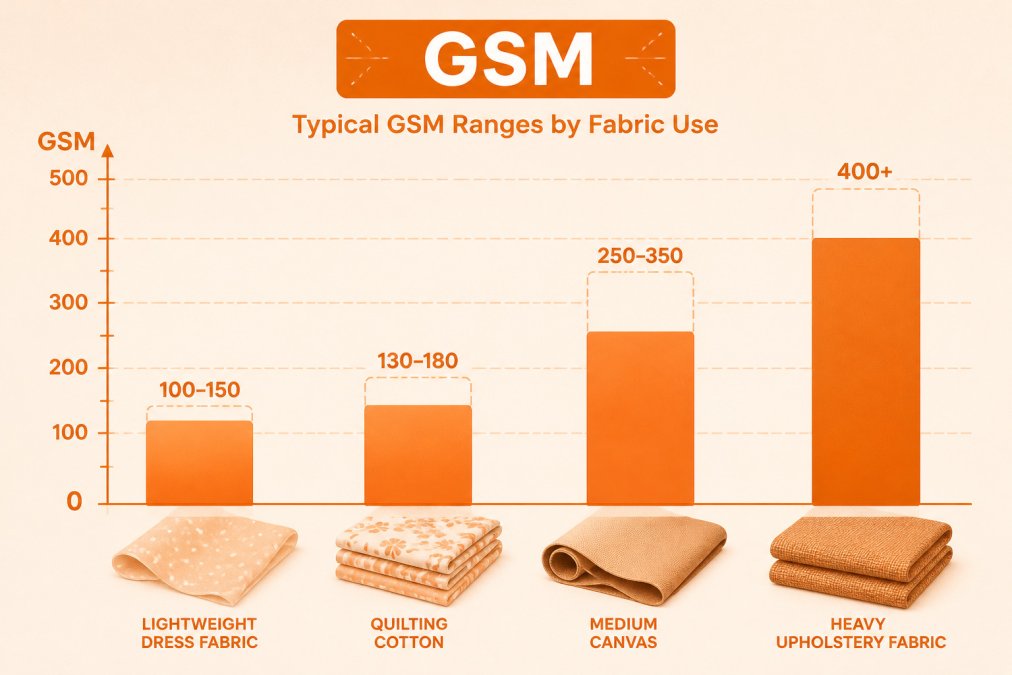
Use GSM to compare fabrics side by side. Two cottons with similar names can feel very different if one is 110 GSM and the other is 170 GSM. Always match the GSM to your project.
Checking Fibre Content, Weave and Stretch Without Handling the Cloth
Fibre content tells you how the fabric will wash, wear and feel. Common options include cotton, linen, wool, viscose and polyester. Natural fibres breathe well. Synthetics tend to resist creasing and hold colour well.
Weave matters too. A plain weave is stable and easy to sew. A twill has a diagonal pattern and drapes a little more. Knits stretch, so they need a different approach.
To check stretch online, look for these clues:
- The listing says "knit", "jersey" or "stretch"
- The fabric is described with a percentage of elastane or spandex
- Reviews mention how the cloth recovers after pulling
Look for a clear percentage breakdown of the fibre content rather than vague wording. Look for a clear percentage breakdown rather than vague wording. For a closer guide to judging the cloth itself, read how to evaluate fabric quality when buying online.
Fibre content, weave and stretch each change how a fabric sews and wears, and the listing usually gives you the clues to check them. To tell synthetic from natural fabric, look at the fibre content and how the cloth feels.
| Feature | What it tells you | Where to look |
|---|---|---|
| Fibre content | How it washes, wears and feels | A percentage breakdown in the listing |
| Plain weave | Stable and easy to sew | Described as plain weave |
| Twill | Diagonal pattern, drapes a little more | Described as twill |
| Knit | Stretches and needs a different approach | Listing says knit, jersey or stretch |
| Elastane or spandex | Adds stretch to the cloth | A percentage in the fibre content |
| Stretch recovery | Whether the cloth springs back | Reviews that mention recovery after pulling |
Getting Colour Right on a Screen
Screens show colour differently. Brightness, colour settings and the device you use all change what you see. A navy can look black, and a dusky pink can look bright.
A few habits help. Turn your screen brightness up a little and check the image in daylight if you can. Compare the listing photo with a swatch if the seller offers one. Read reviews that mention colour, as customers often say whether a shade looks true to life.
Be cautious with very bright or unusual colours. These are the ones most likely to surprise you once the fabric arrives.
How to Order Fabric Samples Before Committing
A sample is the safest way to test a fabric without buying metres of it. Samples are worth considering for any project where fit, colour or feel really matters.
Order samples for your top two or three choices. Feel them, wash a piece, and check how they behave under an iron. Then place your full order with confidence.
If you want to see and feel fabric in person before you commit, you are welcome to visit our showroom. You can also contact Fabric Mouse with a question about samples or an order before you buy.
How to Calculate Fabric Yardage for Your Project
Measure the project carefully before you order. Check the pattern envelope for the yardage it lists for your size, then add extra for pattern matching, shrinkage and mistakes. A rough rule is to add around 10 per cent.
For quilting, work out the finished size of the quilt and divide it into blocks. Count how many pieces each block needs, then total the fabric. Pre-washing can shrink cotton slightly, so buy a little more than you think you need.
Keep a note of the fabric width too. Wider fabric often means you need less length. Measure twice and order once.
Common Mistakes When Buying Fabric Online
Most problems come from a few predictable errors. Here are the ones we see most often:
- Ordering without checking the fabric width
- Choosing a heavy fabric for a light, flowing garment
- Forgetting to add extra for shrinkage or pattern matching
- Trusting a colour without checking reviews or a sample
- Skipping the care instructions
A common mistake is buying a beautiful print without thinking about how it will be washed. Check the care label in the listing before you commit.
Your Next Step: Order a Sample and Start Your Project
You now have seven practical ways to choose fabric online with confidence: read the weight and drape, check the GSM, understand the fibre content, allow for screen colour, order samples, calculate your yardage and avoid the common traps.
Pick one project and apply these steps to it. Browse our range of fabric for quilting, patchwork and sewing, order a sample or two, and start sewing. Our team is happy to help you find the right cloth for your next project.
Frequently Asked Questions
How can you tell if fabric is good quality online?
Look for a full fibre content breakdown, a stated weight in GSM or ounces per square yard, the fabric's width, and clear close-up photographs showing the weave. Good sellers also state shrinkage and whether the fabric is pre-washed. Vague descriptions such as 'lovely soft cotton' with no weight or fibre information are a warning sign. Reading reviews that mention how the cloth handled in practice is also useful, particularly comments about opacity, crease resistance and how the fabric held its colour after washing.
What should you check before buying fabric online?
Check the fibre content, weight, width, care instructions and whether the listing gives a shrinkage figure. Confirm the fabric is suitable for your project, for example a lightweight voile is not suited to a structured jacket. Check the returns and sample policy, and read the delivery terms so you know how long the order will take. If colour matters to your project, look for a note about how the colour was photographed and whether the seller offers a sample first.
What does GSM mean when buying fabric?
GSM stands for grams per square metre and is a measure of fabric weight. A higher GSM means a heavier, usually thicker and more opaque cloth. Because GSM describes the mass of a set area, it is a more reliable comparison than thread count, which can be misleading.
Should you order a fabric sample before buying?
For a project where drape, colour or handle matters, ordering a sample is usually worth the small cost and delay. A sample lets you check the weight in your hands, see how the fabric falls, and compare the colour in daylight against your other materials. Cutting a swatch is far cheaper than discovering a full order is too sheer or too stiff. Check the current cost and delivery time on the Fabric Mouse website before ordering.

Related Posts

Overlocker Maintenance Tips for a Longer Machine Life

How Long Does a Rotary Cutter Blade Last?

Which Interfacing Is Best for Structured Jacket Lapels?

Finding a Sewing Machine Shop: Visiting Fabric Mouse

7 Reasons Skipped Stitches Happen on Stretch Knit Fabrics

7 Ways to Tell if Fabric is Synthetic or Natural
