

The Best Cotton Fabric for Quilting: A 2026 Guide
Table of Contents
- What Makes Cotton the Best Fabric for Quilting
- Quilting Cotton vs Regular Cotton: Key Differences
- How to Choose Quilting Fabric: Weight, Weave and Thread Count
- Top Cotton Fabrics for Quilting from UK Suppliers
- Essential Quilting Tools for Beginners
- Best Practices for Washing Quilting Fabric
- How to Prevent Quilting Fabric from Fraying
- Common Mistakes When Buying Quilting Cotton
- Conclusion: Choosing the Right Cotton for Your Quilt
- Frequently Asked Questions
Last Updated: September 14, 2026
What Makes Cotton the Best Fabric for Quilting
Cotton fabric for quilting is the best choice because it combines a stable weave, breathable structure and predictable shrinkage with a price that makes large projects affordable. At Fabric Mouse, we have watched quilters return to cotton again and again for one simple reason: it behaves itself. It presses flat, holds a crease, feeds evenly under the needle and wears well through decades of washing.
Choosing the best cotton fabric for quilting starts with understanding what cotton actually does. Unlike synthetics, cotton fibres grip each other slightly, so seams lock together and blocks stay square. It also takes dye beautifully, which matters when you are matching a backing to a finished top.
Below, we will show you exactly how to compare weights, weaves and thread counts, then match them to specific UK quilting fabrics we stock.
Quilting Cotton vs Regular Cotton: Key Differences
Quilting cotton is a purpose-made fabric with a tighter, more uniform weave than general dressmaking cotton, and that difference decides how your quilt behaves over time. Standard cotton poplin may feel lovely against the skin, but it can shift and fray when cut into small pieces.
Three practical differences matter most:
- Weave density. Quilting cotton is woven to resist distortion when cut into 5cm squares. Dressmaking cotton is not.
- Fray resistance. Quilting cotton is usually finished to reduce fraying during piecing. General cotton frays freely.
- Body and drape. Quilting cotton holds a fold for pressing. Softer dress cottons flop.
A common mistake is buying a beautiful dressmaking cotton because the print is right. It will piece, but the seams will wobble and the finished quilt will feel limp. If a fabric is described as suitable for both dressmaking and quilting, treat that as a sign it sits somewhere in the middle, which is fine for simple patchwork but less forgiving for intricate blocks.
How to Choose Quilting Fabric: Weight, Weave and Thread Count
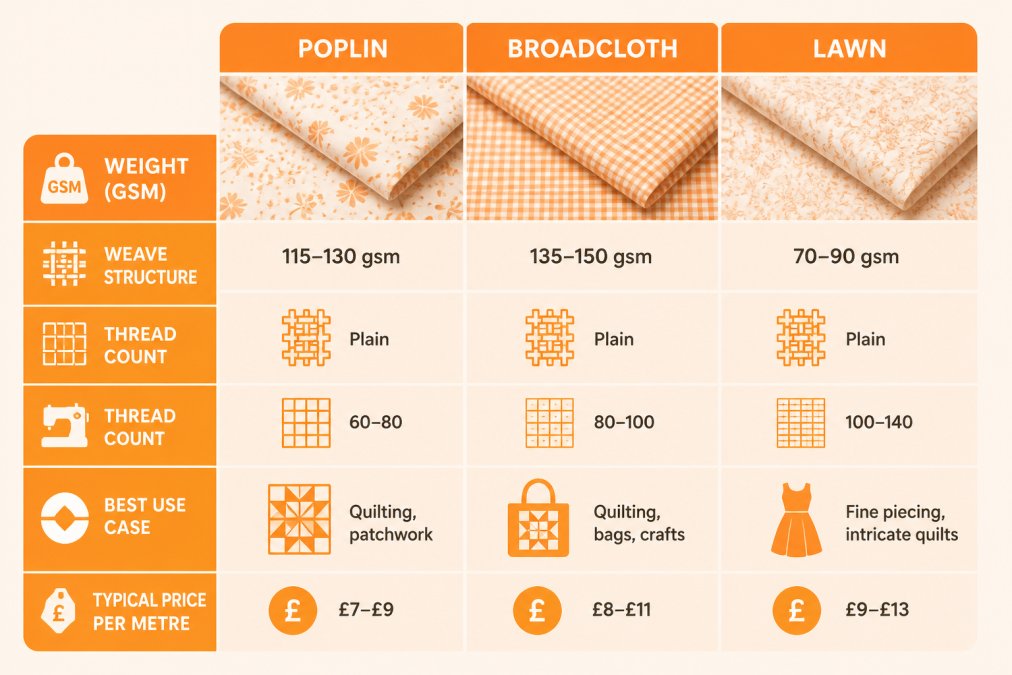
Choosing quilting fabric comes down to matching three measurable properties to your project: weight, weave and thread count. Get these right and the fabric almost disappears into the background, which is exactly what you want.
Understanding Fabric Weight and Weave
Fabric weight for quilting cotton typically sits between 110 and 150 gsm, and that range covers almost everything you will buy. Lighter weights around 110 gsm suit appliqué and delicate piecing. Heavier weights near 150 gsm hold their shape in bags and structured quilts.
Weave matters just as much. A plain weave is the standard for quilting cotton because it is stable in both directions. Twill and satin weaves drape differently and can distort when pieced.
The thing nobody tells you about weight is that it affects your needle choice. A 110 gsm cotton pieces beautifully with a 70/10 needle. Push past 150 gsm and you want an 80/12 to avoid skipped stitches.
Does Thread Count Matter for Quilting?
Thread count matters less than most buying guides suggest, but it still tells you something useful. A count between 60 and 80 threads per inch is typical for quality quilting cotton and gives a good balance of density and needle penetration.
Very high thread counts, the sort marketed on bedding, can actually work against you. Dense fabric resists a quilting needle and dulls it faster. For patchwork, aim for the middle of the range rather than the top.
If a listing does not state thread count, feel the fabric instead. Rub it between your fingers. Quilting cotton should feel smooth but have a slight tooth to it, not slick.
Top Cotton Fabrics for Quilting from UK Suppliers
The best cotton fabrics for quilting in the UK come from a handful of mills and converters whose quality is consistent enough to plan a project around. Here are the ranges we keep on the shelf and recommend most often.
Makower UK Solid Spectrum Plain Fabric
Makower UK Solid Spectrum Plain Fabric is our first recommendation for anyone building a stash. At £12.00 per metre, it is the workhorse solid you will reach for constantly, and it comes in a colour range wide enough to match almost any print.
Makower UK's fabric collections and manufacturing information
The weave is stable, the colours are consistent between dye lots and it presses like a dream. If you are a beginner, buy three or four metres in neutral tones and you will use every centimetre. The one drawback is that solids show every stray thread, so keep a lint roller nearby.
Moda Grunge Fabric Range
Moda Grunge is the range I recommend when a quilt needs texture without a print. Designed by BasicGrey for Moda Fabrics, Grunge is double-sided, with one face reading almost solid and the other carrying soft brushstrokes of lighter and darker tone. That versatility makes it an outstanding blender for sashings, borders and scrappy bindings.
We stock several colourways at £14.00 per metre, including Loganberry, Hyacinth, Periwinkle, Rouge and Rifle Green, plus Peach Nectar at £10.00 per metre. All are 100% cotton and cut continuously.
For a scrappy quilt, Rifle Green makes an exceptional binding. For a soft pastel project, Hyacinth and Periwinkle sit beautifully together. Where Grunge falls short is in very crisp, graphic quilts, where its distressed finish can look muddy against sharp geometric prints.
Stof Basic Harmony Pastel
Stof Basic Harmony Pastel is a 100% cotton range made in Japan, with subtle colours and small dot patterns. The Jade Teal Aqua Dot Spot design is the standout, and at £32.00 it suits quilters who want a fabric that works in both patchwork and dressmaking.
The quality is genuinely lovely. It is machine washable on a warm normal cycle, tumble dryable on medium and happy with a warm iron. Note that it is not intended for children's sleepwear.
For smaller projects, we also stock Seaside - The Beach by Nutex at £7.50 per half metre and F733/13 Chocolat by Fabric Freedom at £7.00 per half metre, both 100% cotton quilt-grade fabrics sold in 50cm increments.
| Fabric | Price | Weight/Type | Best For |
|---|---|---|---|
| Makower UK Solid Spectrum | £12.00/m | Medium quilting cotton | Blenders, backgrounds, beginners |
| Moda Grunge (most colourways) | £14.00/m | Medium quilting cotton | Sashing, borders, binding |
| Moda Grunge Peach Nectar | £10.00/m | Medium quilting cotton | Soft blenders, pastel projects |
| Stof Basic Harmony Pastel | £32.00 | Japanese quilting cotton | Feature fabric, dressmaking crossover |
| Seaside - The Beach (Nutex) | £7.50/half metre | Quilt-grade cotton | Coastal and novelty quilts |
| F733/13 Chocolat (Fabric Freedom) | £7.00/half metre | Quilt-grade cotton | Backings, neutral piecing |
Essential Quilting Tools for Beginners
Essential quilting tools for beginners come down to four things: a reliable machine, a stable surface, good thread and sharp scissors. Everything else is a refinement. Buy these well once and they will outlast several quilts.
Sewing Machines and Cabinets
A machine that feeds evenly at slow speed matters more than one with a hundred decorative stitches. FEIYUE sewing machines are a solid starting point for hobby quilters because they handle straight stitching on layered fabric without complaint, and the FEIYUE industrial sewing machines suit anyone moving into production work or heavy quilting.
Where you sew matters too. Sew Fine sewing cabinets give you a level, vibration-free surface at the correct height, which reduces strain on your shoulders during long piecing sessions. If you are working on a dining table, you will feel the difference within an hour.
At Fabric Mouse, we run a hands-on showroom where you can test machines before buying, and we act as an authorised service centre for all brands, so repairs and servicing stay straightforward.
Threads and Scissors
Thread choice affects how your quilt ages. Richword thread and Sakura Thread both hold up well through repeated washing.
For piecing, match your thread to the lighter fabric in the seam. For quilting, a slightly contrasting thread shows off your stitch pattern.
Pin scissors deserve a mention because they solve a specific annoyance. Those small, sharp snips let you trim threads at the machine without turning your work, and they keep your fabric scissors reserved for fabric only. Using your good shears on paper or thread is the fastest way to blunt them.
Best Practices for Washing Quilting Fabric
Best practices for washing quilting fabric begin before you cut, not after you finish. Pre-washing removes sizing and lets the fabric shrink on your terms rather than in the finished quilt.
Here is the routine we recommend:
- Unfold the fabric fully and check for colour bleeding by dampening a corner
- Wash on a warm, normal cycle with a colour catcher
- Tumble dry on medium or line dry until just damp
- Press while slightly damp to remove creases
- Fold and store flat until you are ready to cut
Skip the fabric softener entirely. It coats the fibres and makes marking and pinning harder.
For the finished quilt, wash on a gentle cycle with a mild detergent and dry flat or on low. Stof Basic Harmony Pastel, for example, is specified for a warm normal cycle and medium tumble dry, which gives you a reliable reference point for similar cottons.

How to Prevent Quilting Fabric from Fraying
Fraying is the single most common frustration in patchwork, and it is almost entirely preventable. The fix starts with how you cut and handle your pieces.
Pinking shears remain the simplest solution for edges that will be enclosed in a seam. For pieces that will sit exposed during construction, a light starch spray stiffens the edge and slows fraying considerably.
Other approaches that work:
- Cut with a sharp rotary blade and replace it regularly
- Handle pieces as little as possible before piecing
- Use a scant quarter-inch seam so more fibre stays inside the seam allowance
- Store cut pieces in a covered container rather than loose on a table
Pin scissors help here too. Trimming loose threads as you go stops them catching in the feed dogs and pulling more fibres free.
Common Mistakes When Buying Quilting Cotton
Buying mistakes cost more than money. They cost the hours you spend fighting a fabric that was never right for the job.
The biggest one is buying by print alone. A gorgeous print on a loose, floppy cotton will disappoint you in a pieced block. Check the weight and weave description before you fall for the design.
Buying too little is the second. Fabric requirements are usually calculated on 110cm width, and if you substitute a narrower bolt you will come up short. Always add 20cm for safety, especially if you plan to pre-wash.
A third mistake is mixing fabric qualities within one quilt. Combining a tightly woven quilting cotton with a loose dressmaking cotton means the two will shrink at different rates and the seams will pucker. Buy from one quality tier per project.
Finally, do not assume all "100% cotton" labels are equal. Quilt-grade cotton is graded for stability, and that grading is what you are paying for.
Conclusion: Choosing the Right Cotton for Your Quilt
Choosing the right cotton for your quilt is less about finding a single perfect fabric and more about matching weight, weave and quality to the job in front of you. Buy stable, quilt-grade cotton, pre-wash it, and your seams will stay square for years.
If you would rather not guess, come and see the fabric in person. At Fabric Mouse, we stock Makower UK, Moda Grunge, Stof and many quilt-grade cottons in our North Yorkshire showroom, with free delivery and 24-hour delivery available. Our team can help you match colours, calculate yardage and choose the right thread and machine for the project, and we service and repair sewing machines on site.

Get started with Fabric Mouse and build your next quilt on fabric you can trust.
Frequently Asked Questions
What is the difference between quilting cotton and regular cotton?
Quilting cotton is woven specifically for patchwork, with a tighter weave and less sizing than dressmaking cotton. It holds a crease well, frays less and is usually 110cm wide. Regular cotton can be lighter or stretchier, which makes piecing less accurate. Always check the label for 'quilt-grade' or 'patchwork' quality.
Does thread count matter for quilting fabric?
Thread count matters, but not in the way it does for bedding. For quilting, a thread count between 60 and 80 threads per square inch is ideal. Too low and the fabric feels thin; too high and it can be stiff and hard to needle. Look for a smooth, tight weave that holds its shape when you tug it gently.
How do I tell if a fabric is high quality for quilting?
Hold it up to the light: you should not see large gaps between threads. Rub it between your fingers; it should feel smooth, not rough or overly starched. Snip a small corner and fray it: quality cotton frays cleanly without excessive lint. Also check that the print is sharp and the colours are consistent across the bolt.
Should I pre-wash my quilting cotton before starting a project?
Pre-washing is recommended for most quilting cotton, especially for dark or saturated colours that may bleed. Use a gentle cycle with a colour catcher, then tumble dry low or line dry. This also preshrinks the fabric so your finished quilt will not distort after its first wash. However, some pre-cuts like jelly rolls should not be pre-washed.
Why is 100% cotton preferred for quilting?
100% cotton is breathable, durable and holds a press well, which makes piecing accurate. It also frays less than blends and ages beautifully. Cotton blends can be stretchy or pill over time. For heirloom quilts, pure cotton is the standard choice. Always check the fibre content before buying.
How do I prevent quilting fabric from fraying?
Pinking shears are a quick fix, but for long-term storage, consider overlocking or zigzag stitching the raw edges. You can also use a fray-check liquid on small pieces. Store fabric folded neatly in a dry place away from direct sunlight. For pre-cuts, handle them gently and avoid unnecessary handling until you are ready to sew.
Professional Sewing Machine Maintenance Tips: 2026 Guide
Best Sewing Studio Alternative for Beginners in 2026
Related Posts

How to Thread a Sewing Machine Correctly

Is a Heavy Duty Sewing Machine Worth It?

Best Fabric Shops in North Yorkshire: 2026 Guide

5 Best Portable Sewing Machines for Classes

Best Fabric Drape for Summer Dresses

Why Your Sewing Machine Smells Like Burning

How to Choose Your First Sewing Machine
