

Embroidery Machine Training Workshops in Yorkshire
Last Updated: November 2, 2026
Quick Summary
Embroidery machine training workshops in Yorkshire teach you to run a machine with confidence, from threading and hooping to stitch-out and finishing. Workshops split into taster days, beginner courses and machine-specific sessions, so check which type a provider is running before you book. Confirm the course matches your machine, or that machines are provided.
- A typical full-day workshop runs from around 10am to 4pm with a lunch break.
- Half-day taster sessions tend to run three to four hours.
- Beginners should switch their machine on at home and read the threading diagram before the session.
- Many workshop projects are designed for a 130mm by 180mm field or larger.
- Ask which file formats the workshop machines accept and whether you can bring designs on a USB stick.
Table of Contents
- What Embroidery Machine Training Workshops in Yorkshire Actually Cover
- Machine Embroidery Classes for Beginners: What to Expect on Day One
- How to Use an Embroidery Machine: The Skills Taught in Tuition Sessions
- Machine Embroidery Techniques Covered in Yorkshire Workshops
- Embroidery Machine Software Training: From Built-In Designs to Digitising
- Machine Compatibility and Preparation Checklist Before You Book
- How to Choose the Right Workshop: Class Size, Tutor Guidance and Value
- Location, Transport and Accessibility for Yorkshire Workshops
- Book a Machine Demonstration at Fabric Mouse Before Your First Course
- Frequently Asked Questions
What Embroidery Machine Training Workshops in Yorkshire Actually Cover
Embroidery machine training workshops in Yorkshire teach you to run a machine with confidence, from threading and hooping to stitch-out and finishing. This guide sets out what each type of workshop covers, how to judge whether a course suits your machine, and how to prepare so you get real value from the fee.
Most courses follow a similar spine: machine anatomy, stabiliser choice, hooping accuracy, and a finished sample. The difference between a good workshop and a mediocre one is how much hands-on stitching time you get and whether the tutor knows your specific model.
Course and Workshop Descriptions
Workshops split into three broad types. Taster days run for a few hours and cover threading, hooping and one small design, ideal if you have never touched an embroidery machine. Beginner courses stretch across one or two days and add stabiliser selection, fabric choice and multi-colour stitching. Machine-specific sessions focus on one model family, so the tutor can show you the exact menus, hoops and settings you will use at home. Ask any provider which type they are running before you book.
Course Duration and Daily Timetable
A typical full-day workshop runs from around 10am to 4pm, with a lunch break and short pauses between stitch-outs. Morning sessions usually cover setup and theory; afternoons are for stitching your own project. Half-day taster sessions tend to run three to four hours. Expect the timetable to include a demonstration, guided practice, and time to ask questions about your own machine.
Here is a quick comparison of the three main types of workshop on offer.
| Workshop type | Duration | Best for |
|---|---|---|
| Taster day | A few hours | Those who have never touched an embroidery machine |
| Beginner course | One or two days | Adding stabiliser, fabric choice and multi-colour stitching |
| Machine-specific session | Not stated | Learning your own model's menus, hoops and settings |
Machine Embroidery Classes for Beginners: What to Expect on Day One
Machine embroidery classes for beginners start with the machine switched off. That sounds slow, but it prevents the most common beginner error: threading with the presser foot down, which leaves the tension wrong and the thread tangled.
You will usually hoop a piece of stable woven fabric over tear-away stabiliser and stitch a small built-in motif. The goal is not a perfect design. It is understanding why the fabric moved, why the bobbin thread showed through, and how to fix it next time.
A common mistake is arriving with a machine you have never powered on. Switch it on at home first, run the needle up and down, and read the threading diagram before your session.
How to Use an Embroidery Machine: The Skills Taught in Tuition Sessions
Learning how to use an embroidery machine comes down to a short list of repeatable skills, and good tuition drills each one until it feels automatic:
- Threading the upper path and winding and loading the bobbin correctly
- Hooping fabric at the right tension, without stretching the grain
- Choosing stabiliser for woven, knit and stretch fabrics
- Setting stitch density, speed and thread tension for the design
- Positioning the design accurately using the machine's alignment tools
- Trimming jump stitches and finishing the back cleanly
Machine Embroidery Techniques Covered in Yorkshire Workshops
Machine embroidery techniques taught on these courses range from simple built-in motifs to appliqué, monogramming, quilting in the hoop and free-machine work.
Free-Machine Embroidery and Creative Stitching
Free-machine embroidery drops the feed dogs so you move the fabric yourself, drawing with the needle. It is the technique that unlocks creative stitching, texture and contemporary embroidery work.
Embroidery Machine Software Training: From Built-In Designs to Digitising
Embroidery machine software training moves you from picking a built-in design to editing and eventually digitising your own.
If digitising interests you, look at what Wilcom EmbroideryStudio Essentials covers before booking. Not every course includes software, so check the description carefully.
Machine Compatibility and Preparation Checklist Before You Book
Machine compatibility is the detail most bookings get wrong. A workshop built around a multi-needle commercial machine teaches different workflows from one built around a single-needle home model. Before you book, confirm the course matches your machine, or that machines are provided. A common cause of a wasted day is arriving with a machine whose hoop, file format or threading system the tutor cannot demonstrate.
Start with the hoop. Some home machines ship with a small hoop, while many workshop projects are designed for a 130mm by 180mm field or larger. If your machine only supports the smaller hoop, ask whether the course can be adapted or whether a larger hoop is supplied. Check the maximum embroidery field your machine supports against the course projects, and ask which hoop sizes the workshop uses. For multi-needle models, confirm the tutor is familiar with the needle spacing and thread path, as these differ from single-needle machines.
Brother PR1055x Multi-Needle Embroidery Machine →
File formats matter more than most learners expect. Most home machines accept a proprietary format such as PES, JEF or VIP, while commercial machines often use DST or EXP. Ask which formats the workshop machines accept and whether you can bring a design on a USB stick. If the course includes software, confirm whether it is included in the fee and whether it runs on your own laptop. For digitising, check that the software taught matches what you plan to use at home; our guide to what Wilcom EmbroideryStudio Essentials covers explains one common option.
Use this checklist:
- Confirm whether machines are provided or you bring your own
- Check the maximum embroidery field your machine supports against the course projects
- Ask which hoop sizes the workshop uses and whether larger hoops are supplied
- Confirm the software covered and whether it is included in the fee
- Check the file formats the machines accept and whether you can bring designs on a USB stick
- Ask whether your model's threading system is demonstrated
- Note what materials you need to bring, including stabiliser and fabric
- Confirm whether you need to bring your own bobbin and needles
If you are still deciding which machine to buy, our guide to how to pick embroidery machine specs explains how to match specifications to your plans. For those who prefer to practise on their own equipment, Bai embroidery and Poolin Embroidery, FEIYUE sewing machines and FEIYUE industrial sewing machines, Richword thread and Sakura Thread, a Sew Fine sewing cabinet and pin scissors are all available for those building their practice setup.
How to Choose the Right Workshop: Class Size, Tutor Guidance and Value
Class size and tutor guidance decide whether you leave competent or confused. Smaller groups mean the tutor can correct your hooping and tension by hand, whereas larger groups can become demonstrations you watch rather than skills you practise.
Value is not the lowest fee. Add the course fee, materials, travel and any software cost, then divide by the hours of guided stitching you actually get.
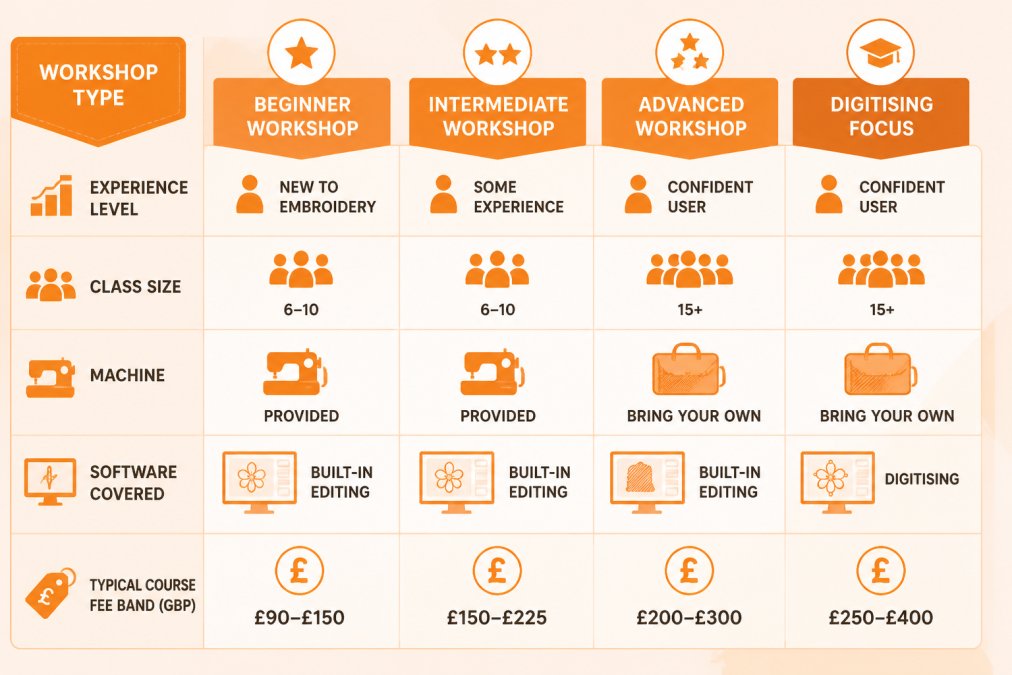
Workshop Dates, Availability and Booking
Ask the provider about workshop dates, the cancellation policy, and whether a deposit secures your place. If you need a specific machine covered, ask whether a bespoke session is possible.
Location, Transport and Accessibility for Yorkshire Workshops
Workshops run across the region, so travel time matters as much as the course itself. A workshop that starts at 10am may require a 7am departure if you are crossing the region, and carrying a machine on public transport adds its own challenges. Check parking, public transport links and step-free access before booking if you have mobility needs or are carrying a machine.
For those driving, confirm whether the venue has on-site parking or nearby pay-and-display, and whether there is a drop-off point close to the entrance. If you are bringing a machine, ask whether there are steps or lifts between the parking area and the workshop room. For public transport, check bus and rail connections to the nearest town and how far the venue is from the station; a short taxi ride may be easier than carrying equipment on foot. If you have mobility needs, ask about step-free access, accessible toilets and the width of doorways, as older venues may not have been adapted.
For longer workshops, consider whether an overnight stay is needed. If a course runs across two days, consider booking accommodation early. If you plan to combine a course with a showroom visit, check Fabric Mouse opening times first. Our team can advise on FEIYUE sewing machines and FEIYUE industrial sewing machines if you are planning to upgrade after the course.
Book a Machine Demonstration at Fabric Mouse Before Your First Course
Arriving at a workshop already familiar with an embroidery machine changes the day entirely. At our showroom you can see and test machines in person, including multi-needle and single-needle models. You can view the Brother PR 670e multi needle embroidery machine and enquire about it while you are there.

We are a family-run business, an authorised service centre for all brands, and we offer on-site parking and a café.
Frequently Asked Questions
Do I need to bring my own embroidery machine to a class?
It depends on the workshop. Check the booking details before you pay. If you are buying a machine, a hands-on showroom demonstration lets you test models such as the Brother Innov-is NV880E or the PR680W before committing to a course.
Are embroidery machine workshops suitable for complete beginners?
Yes. Look for sessions labelled taster days or all abilities, and ask whether machines are provided. If you are unsure which machine suits you, visit a showroom first to see the controls in person.
How long does it take to learn machine embroidery?
Software and digitising take longer, which is why embroidery machine software training is often offered as a separate course. Regular practice between sessions matters more than total course hours, so plan time at your machine each week.
What should I look for when choosing an embroidery machine course?
Check the experience level the course is aimed at, the class size, whether machines and materials are included, and which techniques and software are covered. Confirm the course duration and daily timetable, the total course fee, and what support you get afterwards. Ask whether the tutor covers your machine model. A workshop that matches your own machine and your goals, whether that is quilting, appliqué or starting a small business, is worth more than a generic session.
Choosing the right embroidery machine training workshop in Yorkshire comes down to matching the course to your machine, your level and your goals, then arriving prepared. Fabric Mouse can help you get there: explore our hands-on showroom, book a demonstration before you commit to a course, and rely on our authorised service centre for setup, servicing and repairs. Get started with Fabric Mouse and walk into your first workshop already confident at the machine.

Related Posts

7 Walking Foot Fixes for Sewing Slippery Fabrics Accurately

How to Store Quilting Fabric Without Creasing It

7 Ways to Choose Fabric Online Without Touching It

Overlocker Maintenance Tips for a Longer Machine Life

How Long Does a Rotary Cutter Blade Last?

Which Interfacing Is Best for Structured Jacket Lapels?
