

How to Pick Embroidery Machine Specs: 2026 Guide
Table of Contents
- What You Need to Know Before Choosing Embroidery Machine Specs
- Embroidery Hoop Size Guide: Matching Specs to Your Projects
- Embroidery Machine Connectivity Options: USB, Wireless and Beyond
- Stitch Speed and Productivity: What the Numbers Actually Mean
- Needle Count and Thread Systems: Single vs Multi-Needle Specs
- Best Embroidery Machine for Beginners: Which Specs Matter Most
- Common Mistakes When Comparing Embroidery Machine Specs
- Your Embroidery Machine Specs Checklist
- Frequently Asked Questions
Last Updated: September 16, 2026
What You Need to Know Before Choosing Embroidery Machine Specs
Choosing embroidery machine specs comes down to four numbers that decide almost everything: hoop size, stitch speed, needle count, and how the machine connects to your designs. Get those right and the rest of the specification sheet becomes detail. Get them wrong and you'll outgrow a machine within a year.
This guide from Fabric Mouse walks through each specification in plain terms, with the trade-offs that actually matter for home embroiderers and small studios. Below, we cover the hoop sizes that suit real projects, what stitch speeds mean in practice, and the mistakes that trip up most buyers comparing specifications side by side.
The core argument running through this guide is simple: embroidery machine specs are not a scoreboard. A higher number is not automatically better for your work. The right specification is the one that matches the projects you actually stitch, not the projects you imagine you might.
Embroidery Hoop Size Guide: Matching Specs to Your Projects
Embroidery hoop size is the single most restrictive specification on any machine, because you cannot stitch a design larger than the hoop. A 160 x 260 mm field handles most garment fronts, monograms, and quilt blocks. A 200 x 300 mm field opens up jacket backs and larger quilt panels.
The Brother Innovis 880E offers a 160 x 260 mm embroidery area, which covers the majority of home projects comfortably. Step up to the Brother Innovis V5 LE and you get 200 x 300 mm, enough for elaborate designs across clothing, quilting, and décor work.

Think about your largest likely project before anything else. If you quilt, measure your typical block. If you monogram, measure the widest garment front you'd stitch. Buy for that measurement, not for the smallest item you'll make.
A common mistake is buying a large hoop field and then discovering the machine's frame range doesn't support the shapes you need. Check both the maximum area and the frame shapes included.
Embroidery Machine Connectivity Options: USB, Wireless and Beyond
Embroidery machine connectivity options determine how easily you move designs from a computer to the needle. USB remains the most universal method, while wireless transfer removes the cable entirely on newer machines.
The Brother Innovis 880E includes wireless connectivity for transferring embroidery data, plus a built-in USB port for adding patterns directly. That combination suits most home setups, where you might download a design on a laptop and send it across the room without hunting for a cable.
Wireless matters more than it sounds. If you stitch frequently, the ability to send a design straight to the machine saves the small friction of copying files to a stick and walking it over. For a small business running multiple machines, wireless LAN connectivity on the Brother PR1055X allows you to connect up to ten machines and scale from a home setup into a fuller operation.

USB alone is perfectly workable. Wireless is the convenience upgrade, not a requirement.
Stitch Speed and Productivity: What the Numbers Actually Mean
Stitch speed is measured in stitches per minute, and the headline figure rarely tells the full story. A machine rated at 850 stitches per minute does not stitch every design at that rate, because speed drops with dense designs, thread changes, and colour sequencing.
The Brother Innovis 880E runs at up to 850 stitches per minute. The Brother PR680W reaches up to 1,000 stitches per minute in seven seconds, with industrial acceleration that keeps larger projects moving. For a business where time is money, that acceleration matters. For a hobbyist stitching on evenings and weekends, it matters far less.

What most guides miss is that thread changes, not raw speed, eat your time on multi-colour designs. A ten-needle machine like the Brother PR1055X changes colours automatically, which is where the real productivity gain sits.
Judge speed alongside needle count. Speed without automatic colour changes still leaves you standing at the machine.
Needle Count and Thread Systems: Single vs Multi-Needle Specs
Needle count separates single-needle machines from multi-needle workhorses, and it's the specification that most changes how you work. A single-needle machine threads one colour at a time. A multi-needle machine holds several threads ready, switching colours automatically as the design dictates.
The Brother PR680W carries six needles with individually customisable positions, plus 673 built-in embroidery designs and 50 lettering fonts. The Brother PR1055X steps up to ten needles, with auto-threading and colour sorting that keep a production run moving without constant stops.
Brother Innovis V5 LE Sewing & →
Multi-needle machines suit anyone stitching the same designs repeatedly, or working with multi-coloured logos and motifs. Single-needle machines suit one-off projects and beginners who want to learn the craft before investing in automation.
If you're coming from hand-guided work, expect the learning curve to sit in the software rather than the machine. The needles do their job; you just have to tell them where.
Best Embroidery Machine for Beginners: Which Specs Matter Most
The best embroidery machine for beginners prioritises ease of setup over raw capability. Three specs matter most: an automatic needle threader, a clear touchscreen, and a comfortable embroidery area you won't outgrow in months.
The Brother Innovis 880E fits this brief well. It includes an advanced needle threader, automatic upper and lower thread sensors, a 124 mm colour touchscreen, and a programmable jump stitch cutting function. Those features reduce the fiddly steps that frustrate new embroiderers.
For beginners who want one machine that also sews and quilts, the Brother Innovis V5 LE combines all three functions with over 500 built-in utility and decorative stitches, an auto presser foot, and a one-handed needle threader.
What most guides miss is that beginners rarely regret buying too much embroidery area. They regret buying too little. A slightly larger hoop field gives you room to grow without replacing the machine.
Common Mistakes When Comparing Embroidery Machine Specs
The biggest mistake when comparing embroidery machine specs is treating the specification sheet as a ranking. A machine with more needles, higher speed, and a bigger screen is not automatically the right machine for your projects.
Here are the traps that catch buyers most often:
- Chasing stitch speed over workflow. Thread changes and setup time dominate real stitching time, so ten needles with auto colour sorting often beats a faster single-needle machine.
- Ignoring the frame range. A large embroidery area means little if the included frames don't fit your garment shapes.
- Overlooking servicing. A machine is a long-term purchase, and access to professional servicing and repairs matters as much as the specs on the box. Fabric Mouse is an authorised service centre for all major brands.
- Buying for imagined projects. Spec for the work you actually do, then add a little headroom.
- Skipping a hands-on test. Specifications describe capability; only stitching tells you how a machine feels to use.
At Fabric Mouse, we've watched customers talk themselves into specifications they never use. The honest answer is usually the simpler machine.
Your Embroidery Machine Specs Checklist
Use this checklist to evaluate any machine before you commit. Work through each row and match it to your real projects, not your ambitions.
- Embroidery area: Does the hoop field fit your largest likely design?
- Frame range: Are the frame shapes you need included or available?
- Needle count: Single-needle for one-offs, multi-needle for repeat and multi-colour work
- Stitch speed: Check the realistic rate, not just the headline figure
- Connectivity: USB as a minimum, wireless if you stitch often
- Thread system: Automatic threading and sensors reduce setup frustration
- Servicing access: Confirm professional maintenance and repair support. Fabric Mouse offers this service.
- Hands-on test: Stitch a sample before buying
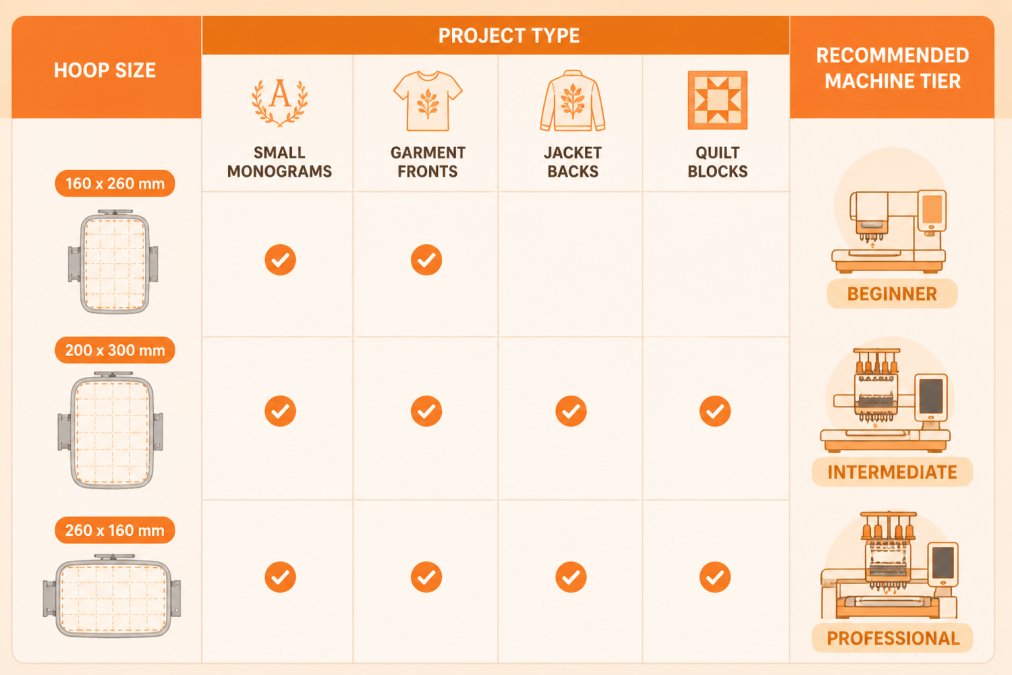
The matrix above shows how hoop size maps to project type, so you can match the specification to the work rather than the other way round.
The real challenge with embroidery machine specs isn't finding the numbers, it's knowing which ones your projects demand. Fabric Mouse is a family-run business that has served sewers and embroiderers since 1922, and as an authorised service centre for all brands, we can guide you through the specification sheet and keep your machine running long after purchase. Our showroom lets you test machines hands-on, and our team specialises in sewing, embroidery, overlockers, and quilting. Get in touch with Fabric Mouse to find the machine that fits your work, backed by expert advice and professional servicing.
Frequently Asked Questions
What is the most important feature to look for in an embroidery machine?
Hoop size is the spec that limits what you can physically embroider, so start there. A 160 x 260 mm area handles garment fronts and quilt blocks, while 200 x 300 mm opens up jacket backs and larger designs. After hoop size, look at stitch speed, needle count and connectivity. If you plan to embroider multi-coloured designs regularly, needle count matters more than raw speed.
Do I need a machine with a large embroidery hoop size?
It depends on your projects. If you mostly embroider small items like monograms, pockets or baby clothes, a compact hoop is fine. For jacket backs, large quilts or home décor, you need a generous hoop. The Brother Innovis V5 LE offers a 200 x 300 mm embroidery area, which suits most garment and quilting work without going to an industrial setup.
What should a beginner look for in embroidery machine specs?
Focus on ease of use over maximum capability. An automatic needle threader, adjustable speed control and a clear touchscreen reduce the learning curve significantly. A 124 mm colour screen, like the one on the Brother Innovis 880E, lets you preview and edit designs without connecting to a computer. Wireless connectivity is a bonus for transferring patterns easily.
Are automatic thread trimmers necessary on an embroidery machine?
They are not essential, but they save considerable time on multi-colour designs. Without a trimmer, you manually cut jump threads between colour changes, which adds minutes to every project. Machines with a programmable jump stitch cutting function handle this automatically, letting you move on to the next colour without stopping to snip threads by hand.
Best Sewing Studio Alternative for Beginners in 2026
Why Choose Expert Sewing Machine Support in 2026
Related Posts

Lord of the Rings Fabric: A Guide for Quilters

How to Thread a Sewing Machine Correctly

Is a Heavy Duty Sewing Machine Worth It?

Best Fabric Shops in North Yorkshire: 2026 Guide

5 Best Portable Sewing Machines for Classes

Best Fabric Drape for Summer Dresses

Why Your Sewing Machine Smells Like Burning
