

Why Choose Expert Sewing Machine Support in 2026
Table of Contents
- What Expert Sewing Machine Support Actually Means
- The Real Cost of Skipping Professional Care
- Sewing Machine Maintenance Tips That Keep You Stitching
- Sewing Machine Service Intervals: When to Book In
- How to Troubleshoot Sewing Machine Tension
- What to Look for in an Expert Support Provider
- Expert Support for Embroidery and Industrial Machines
- Why Expert Sewing Machine Support Saves You Money
- Frequently Asked Questions
Last Updated: September 17, 2026
What Expert Sewing Machine Support Actually Means
Expert sewing machine support is the combination of professional servicing, hands-on guidance and ongoing technical advice that keeps a machine running accurately for years rather than months. It's the difference between a shop that sells you a machine and a partner that keeps it stitching.

At Fabric Mouse, we've watched that distinction play out since 1922. A machine bought online with no support network often ends up boxed in a loft within two years, while one bought with proper guidance and a servicing plan is still producing quilts a decade later.
The practical elements are straightforward:
- Scheduled servicing by qualified engineers
- Repairs carried out on-site rather than sent away
- Advice on tension, thread and needle choices for your fabric
- Guidance on which accessories genuinely improve your results
That last point matters more than most people expect. A common mistake is buying a machine on specification alone, then discovering the support behind it is a call centre reading from a script.
The Real Cost of Skipping Professional Care
Skipping professional care costs far more than a service. Neglected machines develop timing faults, worn feed dogs and stretched belts, and those repairs typically cost several times what routine servicing would have.
The hidden expense is frustration. A machine that skips stitches or snaps thread mid-project doesn't just need money, it needs time you'd rather spend sewing. Many sewers blame their own technique for months before realising the machine is simply overdue a service.
There's a warranty angle too. Manufacturers expect machines to be maintained, and replaceable parts that wear through use are generally excluded from warranty cover. If you've hit a pin and knocked the timing out, that's bad luck rather than a fault, and it won't be covered.
Sewing Machine Maintenance Tips That Keep You Stitching
Basic maintenance takes minutes and prevents most of the faults engineers see. The routines below are the ones that make the biggest difference between services.
After every project:
- Brush lint from the bobbin case and feed dogs
- Remove the needle plate and clear trapped threads
- Wipe the machine body with a dry cloth
Every few weeks:
- Change the needle. A blunt needle causes skipped stitches, pulls fabric and makes a terrible noise
- Rethread completely, top and bottom, rather than patching a break
- Check the power cord for fraying
Monthly:
- Oil the points listed in your manual. Over-oiling attracts lint, so follow the guidance rather than guessing
- Clean the tension discs with a folded piece of fabric
- Run a test seam on scrap fabric before starting anything important
What most guides miss is that thread quality matters as much as machine care. Cheap thread sheds fibres, clogs tension discs and breaks at speed. Brands such as Richword thread and Sakura Thread behave far more consistently, and your machine notices the difference.
Sewing Machine Service Intervals: When to Book In
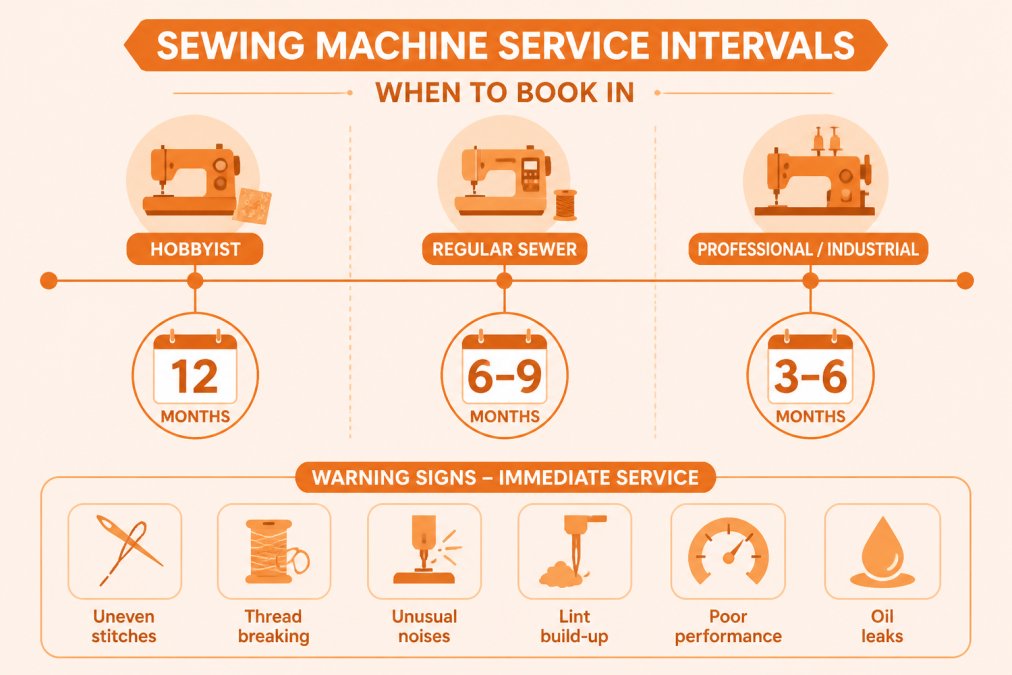
Service intervals depend on how hard the machine works, not how old it is. A hobby machine used twice a month needs far less attention than one running daily.
How Often Should You Service Your Machine?
A hobby machine used occasionally should be serviced every 12 months. Machines in regular weekly use need attention every 6 to 9 months, and professional or industrial machines running daily should be booked in every 3 to 6 months.
The table below maps usage to interval and what each service protects.
| Usage Level | Service Interval | What It Protects |
|---|---|---|
| Occasional hobby use | Every 12 months | Timing, tension accuracy |
| Regular weekly sewing | Every 6-9 months | Feed dogs, stitch quality |
| Daily or professional use | Every 3-6 months | Motor, bearings, timing |
| Embroidery units | Every 6 months | Hoop accuracy, thread path |
| Industrial machines | Every 3-6 months | Clutch, motor, tension discs |
Signs Your Machine Is Overdue a Service
Skipped stitches, uneven tension, a grinding noise or a stiff handwheel all point to a machine that needs attention. So does a machine that's started "eating" fabric or leaving loops underneath.
Book in before those symptoms turn into damage. Fabric Mouse runs an authorised service centre covering all brands, with machines typically with us for two to three weeks. Drop-off is between 10am and 3.30pm, Monday to Friday, and you'll get an email the moment your machine is ready.
How to Troubleshoot Sewing Machine Tension
Tension problems account for a large share of unnecessary repair bookings, and most are fixable at home in under ten minutes.
Start by identifying which side is misbehaving. Loops and tangles underneath mean the top tension is too loose. Knots and puckering on top mean it's too tight.
Machine Servicing & Repairs | Sewing →
Work through this sequence:
- Rethread the machine with the presser foot up, so the discs are open
- Check the bobbin is wound evenly and inserted the right way round
- Set the dial to the middle of its range and test on scrap
- Adjust in small increments, testing after each change
- Change the needle if the problem persists
- Clean the bobbin area before adjusting anything further
If tension still won't settle after that, the machine likely needs a professional check. Continuing to turn the dial rarely fixes a mechanical fault and often makes it worse.
What to Look for in an Expert Support Provider
The right provider combines authorised status with somewhere you can actually walk in and ask questions. Two factors separate genuine support from a sales desk.
Authorised Service Centre Status
Authorised status means the provider is approved to service and repair machines across brands, using correct parts and following manufacturer procedures. It also means warranty work is handled properly rather than informally.
Fabric Mouse has held authorised service centre status for all brands since 1922. That matters when something goes wrong six months after purchase: you're dealing with the same people who sold you the machine, not a distant third party.
Showroom Access and Hands-On Advice
Being able to test a machine before buying prevents most of the disappointment that follows an online-only purchase. Stitch quality, noise level and how the controls feel under your hands can't be judged from a product photo.
A showroom visit also lets you compare machines side by side. Beginners often arrive convinced they need the most feature-heavy model and leave with something simpler that suits their actual projects far better.
Expert Support for Embroidery and Industrial Machines
Embroidery and industrial machines need specialist attention, and general servicing won't cover them properly. Embroidery units need their thread path, hoop alignment and software settings checked, while industrial machines need clutch, motor and tension assembly work.
This is where brand knowledge pays off. Fabric Mouse imports and supports Bai embroidery and Poolin Embroidery equipment, along with FEIYUE sewing machines and FEIYUE industrial sewing machines. Engineers familiar with these machines spot wear patterns that a general technician would miss.
The same applies to workshop furniture and tools. A Sew Fine sewing cabinet is built to hold a machine at the correct working height, which reduces strain on your shoulders and gives you a stable surface for free-motion work. Pin scissors, meanwhile, are the tool most sewers reach for constantly and rarely think to replace.
Why Expert Sewing Machine Support Saves You Money
Good support costs less than the repairs it prevents. A routine service is a fraction of the cost of a timing repair, and it's a fraction of the cost of replacing a machine that's been run into the ground.
Fabric Mouse charges £70.00 for a sewing machine service, which covers all brands and includes the engineer's full inspection. Replacement lightbulbs aren't included: the bulb costs £10 if we supply it, or you can bring your own for the engineer to fit.
Compare that with the alternative. A machine that's been neglected for three years often needs multiple repairs at once, and by then you've also spent months fighting skipped stitches on projects that should have been enjoyable.
Support also protects your purchase decision. Guidance before you buy means you get a machine suited to what you actually make, whether that's quilting, dressmaking or commercial embroidery. That single conversation prevents the most expensive mistake of all: buying twice.
Machines fail at the worst possible moment, usually mid-project with a deadline attached. The sewers who avoid that frustration aren't luckier than everyone else; they've simply got a servicing routine and a support network behind them. Fabric Mouse offers authorised servicing for all brands, a hands-on showroom where you can test machines before buying, and a family-run team that's been advising sewers since 1922. Contact us to book your machine in or to talk through which model suits the work you do.
Frequently Asked Questions
What are the benefits of buying a sewing machine from a specialist retailer?
A specialist retailer offers hands-on guidance before you buy, so you choose a machine that suits your projects rather than guessing from specs. You also get access to authorised servicing, genuine parts and ongoing advice. Fabric Mouse, for example, has been an authorised service centre since 1922 and offers a showroom where you can test machines before committing. This level of expert sewing machine support reduces the risk of buying the wrong model and ensures you know exactly how to use it from day one.
How does expert support extend the lifespan of a sewing machine?
Regular servicing by a qualified technician keeps internal components clean, lubricated and correctly timed. A professional service catches worn parts early, before they cause damage to the motor or gears. Following sewing machine service intervals recommended by your provider, typically every 12 months for hobbyists and more often for heavy use, prevents the build-up of lint and debris that accelerates wear. Machines that receive expert care routinely last well beyond those that are only cleaned at home.
What should I look for in sewing machine aftercare?
Look for a provider that is an authorised service centre for your machine's brand, offers clear turnaround times and explains what is included in a service. Ask whether they stock genuine replacement parts and can handle both mechanical and electronic repairs. A good aftercare package also includes advice on sewing machine maintenance tips you can do at home between services. Fabric Mouse, for instance, services all brands and provides a drop-off window as well as postal options, with a typical turnaround of two to three weeks.
How can professional support help with complex embroidery projects?
Embroidery machines require precise tension, correct hooping and regular cleaning of the bobbin area to produce clean stitches. When tension goes wrong, it can ruin fabric and thread quickly. Expert support helps you diagnose issues such as birdnesting or thread breaks, and a professional service ensures the machine is calibrated for embroidery work. If you are learning how to troubleshoot sewing machine tension, a technician can show you the adjustments specific to your model, saving hours of trial and error.
How to Pick Embroidery Machine Specs: 2026 Guide
Best Fabric for Quilting Projects 2026
Related Posts

Lord of the Rings Fabric: A Guide for Quilters

How to Thread a Sewing Machine Correctly

Is a Heavy Duty Sewing Machine Worth It?

Best Fabric Shops in North Yorkshire: 2026 Guide

5 Best Portable Sewing Machines for Classes

Best Fabric Drape for Summer Dresses

Why Your Sewing Machine Smells Like Burning
