

Professional Sewing Machine Maintenance Tips: 2026 Guide
Table of Contents
- Why Professional Sewing Machine Maintenance Matters
- Daily and Weekly Habits for Sewing Machine Maintenance
- Essential Sewing Machine Cleaning Tools
- How Often to Service a Sewing Machine
- Oiling Your Sewing Machine: When and Where
- What Happens If a Sewing Machine Needle Breaks
- Tension, Stitch Quality, and Timing Checks
- Recognising When to Call a Professional
- Choosing Needles and Threads for Longevity
- Storing Your Machine and Carry Cases
- Embroidery and Industrial Machine Care
- Frequently Asked Questions
Last Updated: September 13, 2026
Why Professional Sewing Machine Maintenance Matters
A sewing machine that skips stitches, snaps thread, or grinds through thick seams rarely fails without warning. Professional sewing machine maintenance is the practice of cleaning, oiling, adjusting, and servicing a machine on a fixed schedule so small faults are caught before they become expensive repairs. At Fabric Mouse, we have serviced and repaired sewing, embroidery, and overlocker machines since 1922, and the pattern is always the same: the machines that arrive in our workshop with serious damage are almost never the ones that were looked after weekly.

The difference between a machine that runs smoothly for twenty years and one that dies at five comes down to a handful of habits. Below, we break down exactly what to do daily, weekly, and annually, how to tell a hobby schedule from a professional one, and when to stop fiddling and hand the machine to a technician.
Most guides treat maintenance as a list of chores. It is not. It is a diagnostic routine. Every time you clean the bobbin area or change a needle, you are reading the machine for early warnings: lint colour, thread shredding, stitch irregularity. Learn to read those signals and you will rarely be caught out.
Daily and Weekly Habits for Sewing Machine Maintenance
Sewing machine maintenance works best as a rhythm rather than a rescue mission. A two-minute routine after each session prevents the build-up that causes most breakdowns.
After every sewing session:
- Raise the presser foot and needle to the highest position
- Remove the bobbin and brush out visible lint from the bobbin case
- Wipe the needle plate with a dry cloth
- Cover the machine or close its carry case to keep dust out
Weekly, or after roughly eight hours of sewing:
- Unscrew the needle plate and clean the feed dogs with a small brush
- Check the needle for burrs by running a finger along the shaft (carefully)
- Run a test seam on scrap fabric and inspect the stitch quality
- Check the thread path for frayed or shredded sections
What most guides miss is that lint behaves differently depending on what you sew. Quilting cotton produces fine, powdery dust that migrates into the tension discs. Fleece, minky, and towelling shed fibres that wrap around the bobbin case and jam the feed dogs. If you sew a lot of either, shorten your cleaning interval rather than stretching it.
A common mistake is using canned air to blow lint out of the machine. This forces fibres deeper into the mechanism, where they mix with oil and form a gritty paste that accelerates wear. Use a soft brush instead.
Essential Sewing Machine Cleaning Tools
The right sewing machine cleaning tools cost very little and last for years. You do not need a specialist kit; you need four or five items kept together so you actually use them.
- A soft bristle brush, ideally the one supplied with the machine, for the bobbin area and feed dogs
- Microfibre cloths for wiping the needle plate and exterior without leaving fibres behind
- A small screwdriver that matches your needle plate screws, so you are not improvising with the wrong size
- A pipe cleaner or long thin brush for reaching into the bobbin case race
- A small lidded pot for collecting blunt or bent needles, so they do not end up in the bin liner or the carpet
For thread and fabric debris, a pair of small pin scissors is genuinely useful for snipping loose threads close to the fabric without nicking the seam. Keep them with the cleaning kit rather than in your general sewing box, or they will migrate.
Brush, Lint, and Bobbin Area Care
The bobbin area deserves its own routine because it is where the majority of problems start. Remove the bobbin, lift out the bobbin case if your machine allows it, and brush downwards and outwards, never towards the centre of the machine. Lint pushed into the race will eventually interfere with the hook timing.
Check the bobbin case itself for scratches or burrs. A tiny nick on the case edge will shred thread and produce the looping, bird-nesting tangles that look like a tension fault but are not. If you find a burr, replace the case rather than trying to smooth it.
How Often to Service a Sewing Machine
A hobby machine used a few hours a week should be professionally serviced every 12 months. Machines used regularly for dressmaking, quilting, or teaching should be serviced every 6 months, and machines in commercial or industrial use every 3 months. These intervals are a starting point, not a rule, and heavy fabrics shorten them.
Our own workshop turnaround is typically two to three weeks, and we email you when the machine is ready for collection. You can drop machines off between 10am and 3.30pm Monday to Friday without booking. If you are posting a machine in, pack it securely with the needle removed and the presser foot down.
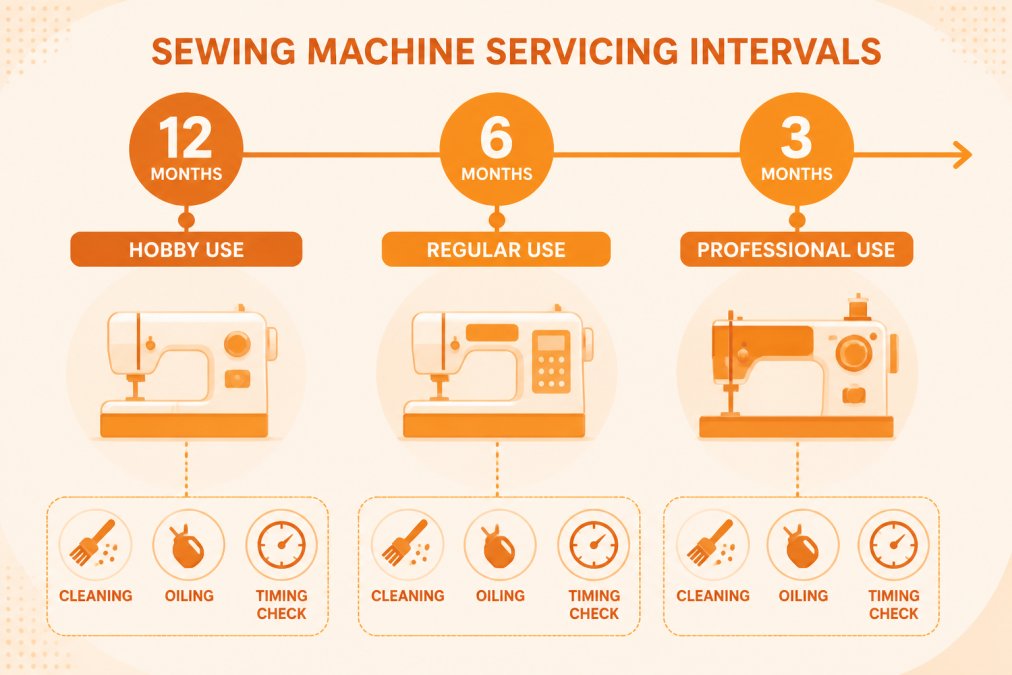
Hobby vs Professional Use Schedules
The gap between hobby and professional servicing is wider than most people assume. A hobby quilter sewing two evenings a week accumulates perhaps 100 to 150 hours of machine time a year. A dressmaker working commercially can hit that in six weeks.
| Use Level | Typical Hours | Service Interval | Extra Checks |
|---|---|---|---|
| Occasional hobby | Under 100 hours/year | Every 12 months | Clean after each session |
| Regular hobby | 100-300 hours/year | Every 6-9 months | Weekly bobbin clean |
| Semi-professional | 300-800 hours/year | Every 6 months | Monthly needle change |
| Commercial or industrial | 800+ hours/year | Every 3 months | Weekly tension check |
If you are unsure which band you fall into, keep a note of when you start and finish a project. Most sewers underestimate their hours by a wide margin.
Oiling Your Sewing Machine: When and Where
Oil only where your manual tells you to, and only with the oil type it specifies. Modern machines vary enormously. Some have sealed bearings and need no oil at all; oiling them can cause damage. Others, particularly mechanical models and many overlockers, have clearly marked oiling points that need a drop or two regularly.
The practical rule: if your manual has an oiling diagram, follow it exactly. If it does not, do not oil the machine yourself. Bring it in for servicing instead.
Where oiling is required, use a single drop per point. More is not better. Excess oil migrates, collects lint, and stains fabric on the next project. After oiling, run the machine without thread on a scrap of waste fabric for a minute to distribute the oil and clear any excess before you sew anything you care about.
A common mistake is oiling a machine that is already stiff or noisy in the hope it will loosen up. Stiffness usually means dried oil and compacted lint inside the mechanism, and adding fresh oil on top makes the problem worse. That machine needs cleaning, not oiling.
What Happens If a Sewing Machine Needle Breaks
When a sewing machine needle breaks, the machine usually survives, but the fragments do not always end up where you expect. Pieces can lodge in the bobbin case, behind the needle plate, or inside the race. Sewing on before finding every fragment risks scratching the hook, jamming the feed dogs, or driving a shard into the timing mechanism.
Stop immediately. Do not finish the seam.
Removing Broken Needle Fragments Safely
Unplug the machine first. This is not optional, and it is the step most people skip.
- Remove the needle plate screws and lift the plate clear
- Take out the bobbin and bobbin case
- Brush the visible area into a tray, not onto the floor
- Use a torch to inspect the race and feed dog area for metal fragments
- Run a magnet over the bobbin area to catch anything too small to see
- Reassemble, fit a new needle, and sew a test seam slowly
If the machine makes an unusual noise or the handwheel feels stiff after reassembly, stop and bring it in. A fragment caught in the timing mechanism will cause far more damage if you keep sewing than if you stop now.
Tension, Stitch Quality, and Timing Checks
Tension problems account for a large share of the faults that arrive in our workshop, and most of them are not tension problems at all. Before you touch the tension dial, check three things: is the needle new and correct for the fabric, is the bobbin wound evenly, and is the bobbin area clean. Lint, a blunt needle, or a badly wound bobbin will all mimic a tension fault.
Test stitch quality on a scrap of the actual fabric you are using, with the actual thread. Sew a line, then inspect both sides. Loops underneath mean the top tension is too loose or the bobbin is misfed. Loops on top mean the reverse. Adjust in small increments, a quarter turn at a time, and retest.
Timing is different. If the needle and hook are out of sync, you will see skipped stitches that no amount of tension adjustment fixes, or the needle will strike the needle plate. Timing is a workshop job. Attempting it at home without the right gauges usually makes it worse, and on some machines it voids the service agreement.
Recognising When to Call a Professional
Bring the machine in when you see any of the following, because each one points to a fault that home maintenance cannot fix:
- Repeated skipped stitches after a new needle, clean bobbin area, and correct tension
- A grinding or knocking noise that changes with speed
- The handwheel stiffens or feels notchy when turned by hand
- The machine will not pick up the bobbin thread at all
- Visible thread nests forming underneath, repeatedly, on fabric you have sewn successfully before
- Any burning smell, however faint
Fabric Mouse is an authorised service centre for all brands, and we service and repair sewing, embroidery, and overlocker machines regardless of where you bought them. Our standard sewing machine service is £70.00, and we will tell you honestly if a repair is not economic before we start work.
If you have bought a machine from us, you also get the benefit of a team that knows the model inside out. That is the practical difference between buying from a specialist and buying from a general retailer.
Choosing Needles and Threads for Longevity
Needle and thread choices affect how long your machine lasts far more than most people realise. A blunt or wrong-gauge needle forces the machine to work harder, and poor-quality thread sheds fibres that clog the tension discs.
Change your needle every eight to ten hours of sewing, or sooner if you hear a dull thud instead of a clean punch. Match the needle to the fabric: a universal 80/12 for medium-weight wovens, a sharp or microtex for fine cottons and silks, a ballpoint for jersey, and a denim or leather needle for heavy materials. Hemline universal needles in size 80/12 cover most everyday sewing, and an assorted fine pack is worth keeping for lighter fabrics.

Thread matters just as much. Cheap thread with a fuzzy finish sheds constantly, and the lint it produces is what clogs your machine. A quality branded thread such as Richword thread runs cleaner, breaks less often, and produces less debris inside the machine. If you sew a lot, the extra cost pays for itself in fewer services.
Storing Your Machine and Carry Cases
Dust is the quiet enemy of any sewing machine, and storage is where most machines pick it up. A machine left uncovered on an open table for months will collect a fine layer of household dust inside the bobbin area and along the needle bar.
Cover the machine when it is not in use, even if it lives on a permanent table. If you transport it, use a proper case rather than a bag. A Pfaff sewing machine carry bag has a solid, stable floor with feet, a shoulder strap, and a two-way zip, which keeps the machine upright and protected in transit. For smaller machines and overlockers under 45cm, a padded sewing machine carry case does the same job at a lower cost.

Store machines away from radiators, windows, and damp garages. Humidity causes rust on metal parts, and heat dries out the oil film. A cupboard in a heated room is better than a shelf in a cold workshop.
Embroidery and Industrial Machine Care
Embroidery machines and industrial machines need the same fundamentals as domestic machines, but with shorter intervals and a few extras.
Embroidery machines run at high speed for long stretches and use a lot of thread, so lint builds up faster. Clean the bobbin area and the thread path far more often than you would on a standard machine, and check the embroidery arm and hoop carriage for dust. If you use Bai embroidery or Poolin Embroidery machines, follow the manufacturer's cleaning schedule in the manual and keep the tension settings documented for each thread you use.
Industrial machines, including FEIYUE industrial sewing machines, are built for continuous running and generally have more accessible oiling points. They still need daily cleaning, and the oil reservoirs need checking regularly. Industrial machines are also less forgiving of the wrong needle: a bent needle at industrial speed can damage the hook in seconds.
For anyone setting up a dedicated sewing room, a proper Sew Fine sewing cabinet keeps the machine at the correct height and reduces the vibration that loosens screws over time. It is not a maintenance task, but it prevents one.
Machines fail quietly long before they fail loudly, and the sewers who avoid expensive repairs are the ones who treat maintenance as a routine rather than a reaction. If your machine is due a service, or you would rather have an expert look at a fault before it worsens, Fabric Mouse is an authorised service centre for all brands, with in-house servicing, repairs, and honest advice on whether a fix is worth it. Get in touch with Fabric Mouse to book a service or drop your machine in, and keep your sewing, embroidery, or overlocker running the way it should.
Frequently Asked Questions
How often should a sewing machine be professionally serviced?
For hobby sewers, a professional service every 12 months is usually enough. If you sew most days, aim for every six months. Professional or commercial embroidery machines benefit from a service every three months. Regular servicing catches worn belts and timing issues before they cause costly damage. Fabric Mouse offers authorised servicing for all brands, with machines typically ready in 2-3 weeks.
What are the signs that my sewing machine needs professional maintenance?
Watch for skipped stitches, thread bunching underneath, unusual noises, a stiff handwheel, or the needle hitting the plate. If you have cleaned and rethreaded the machine and problems persist, it is time to book a service. Ignoring these signs often leads to bigger repairs and longer downtime.
Can I oil my sewing machine myself or should I call a professional?
Many modern machines are self-lubricating and should not be oiled by the user. Older mechanical models usually need a drop of sewing machine oil in specific points. Always check your manual first. Over-oiling attracts lint and can stain fabric. If unsure, bring your machine to a professional service centre for advice.
What happens if a sewing machine needle breaks inside the mechanism?
A broken needle can leave fragments in the bobbin area or jam the timing. Switch off and unplug the machine immediately. Remove the needle plate and use tweezers or a small brush to extract visible pieces. Never use your fingers near the needle bar. If the machine still will not turn freely, stop and book a professional repair to avoid further damage.
How do I clean the bobbin area of a modern sewing machine?
Remove the bobbin and bobbin case, then use a small brush or lint brush to sweep out dust and thread clippings. Wipe the area with a dry cloth. Avoid metal tools that could scratch the race. Clean the bobbin area after every few projects.
Is it worth repairing an older sewing machine?
Often yes, especially for well-built mechanical models from brands like Pfaff or FEIYUE. A service costing £70 or less can restore smooth operation and extend life by years. If the machine has cracked gears or electronic faults, a technician can advise whether repair or replacement makes more sense for your budget and projects.
Best Embroidery Machines for Home: 2026 UK Guide
The Best Cotton Fabric for Quilting: A 2026 Guide
Related Posts

How to Thread a Sewing Machine Correctly

Is a Heavy Duty Sewing Machine Worth It?

Best Fabric Shops in North Yorkshire: 2026 Guide

5 Best Portable Sewing Machines for Classes

Best Fabric Drape for Summer Dresses

Why Your Sewing Machine Smells Like Burning

How to Choose Your First Sewing Machine
