

Best Sewing Studio Alternative for Beginners in 2026
Table of Contents
- Why a Sewing Studio Alternative Makes Sense for Beginners
- What to Look for in a Beginner Sewing Machine
- Best Sewing Machines for Beginners: Five Reliable Options
- How to Learn Sewing at Home Without a Studio
- Essential Sewing Tools for Hobbyists Setting Up at Home
- Sewing Studio Alternative vs Traditional Classes: What Changes
- Where to Buy Your First Machine and Get Real Support
- Common Mistakes Beginners Make When Buying a Machine
- Conclusion
- Frequently Asked Questions
Last Updated: 15 September 2026
Why a Sewing Studio Alternative Makes Sense for Beginners
A sewing studio alternative is any way of learning to sew that doesn't rely on weekly in-person classes, whether that's a machine at your own kitchen table, online tutorials, or a mix of both. For beginners, the appeal is simple: you sew when it suits you, at your own pace, without travelling to a class or paying termly fees.
This guide from Fabric Mouse looks at the practical side of setting up at home, from choosing a first machine to building a toolkit that won't gather dust. Fabric Mouse is a family-run sewing retailer with a history stretching back to 1922, so we've watched a lot of beginners find their feet.
The case for going it alone has strengthened as machines have become easier to use. Modern entry-level models thread themselves, control their own speed, and cost less than a term of evening classes. Below, we'll show you exactly which machines suit which beginner, what to buy alongside them, and the mistakes that trip people up in the first month.
What to Look for in a Beginner Sewing Machine
The best sewing machines for beginners share four traits: simple controls, a top-loading bobbin, a sensible stitch count, and enough build quality to survive weekly use. Everything else is a bonus.
Stitch count matters less than beginners expect. Most projects use straight stitch and zigzag, with a buttonhole for garments. A machine with 14 to 27 stitches covers everything a hobbyist needs for the first year or two.
Bobbin loading is the specification people overlook, and it's the one that causes the most frustration. Top-loading bobbins drop in under a clear cover, so you can see the thread and clear jams without dismantling anything. Older front-loading systems are fiddlier, which is why almost every beginner model now uses a drop-in design.
Controls split into two camps. Mechanical machines use dials for stitch selection and tension, which suits learners because the settings stay where you put them. Computerised machines use a screen and buttons, offering speed control and a start/stop button instead of a foot pedal.
Weight and noise deserve a mention too. A lighter machine is easier to move between rooms or take to a friend's house, though heavier models tend to vibrate less at speed.
| Feature | Why It Matters for Beginners | What to Aim For |
|---|---|---|
| Stitch count | Covers everyday projects without overwhelming | 14-27 stitches |
| Bobbin type | Affects how often you deal with jams | Top-loading, drop-in |
| Controls | Determines the learning curve | Dials or simple jog dial |
| Needle threader | Saves time and eye strain | Built-in, where budget allows |
| Speed control | Helps you sew accurately at first | Slider or pedal control |
Best Sewing Machines for Beginners: Five Reliable Options
Five Brother models cover the beginner market from the simplest possible starting point to a first computerised machine. All five are mechanical or lightly computerised, all use top-loading bobbins, and all are available with support and servicing behind them.
Here's how they compare before we look at each one in detail.
| Model | Price | Stitches | Bobbin | Best For |
|---|---|---|---|---|
| Brother L14s | £115.00 | 14 | Top-loading | Absolute beginners |
| Brother LX17 | £149.00 | 17 | Top-loading | Simple everyday sewing |
| Brother LX25 | £169.00 | 25 | Top-loading | Growing skill set |
| Brother XR27NT | £229.00 | 27 | Top-loading | Long-term hobbyist |
| Brother Innov-is NV15 | £299.00 | 16 | Drop-in | First computerised machine |
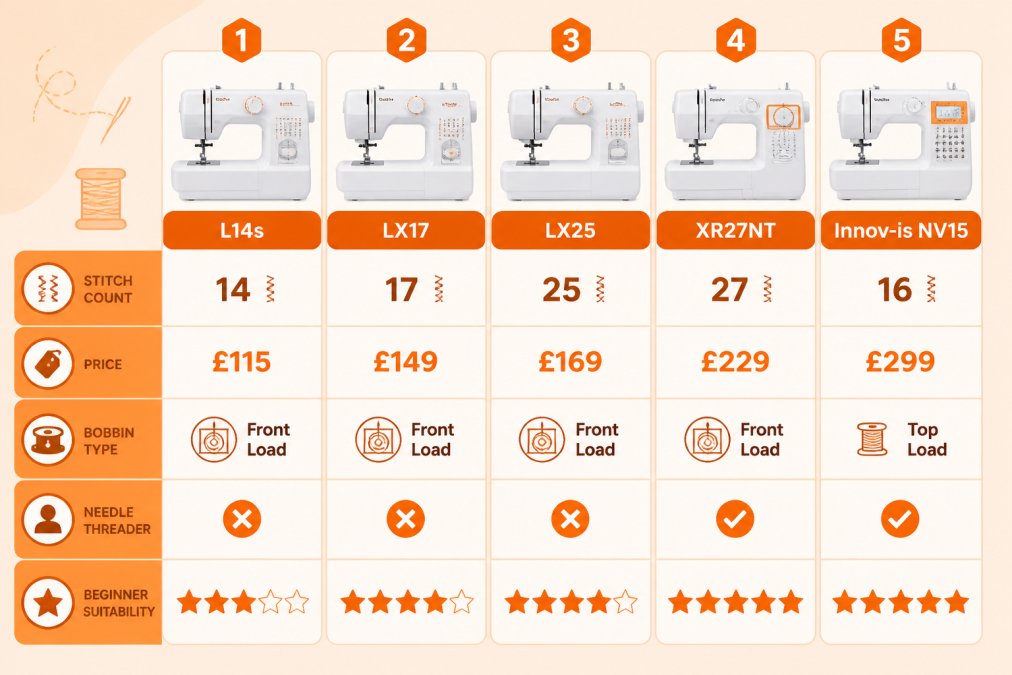
Brother L14s: The Simplest Starting Point
The Brother L14s Sewing Machine is the machine we recommend when someone wants to spend as little as possible without buying something disposable. At £115.00, it offers 14 stitches including a 4-step buttonhole, straight stitch, and zigzag, with a built-in needle threader and LED lighting over the needle area.

What most guides miss is how much the manual dial controls matter here. There's no screen, no menu, and no mode to get lost in. You turn a dial, press the pedal, and sew. For a complete beginner, that simplicity is worth more than extra stitches you won't use for months.
The one drawback is the lack of adjustable speed control. You manage pace with the foot pedal alone, which takes a little practice. It's also light enough that it can shift slightly on a smooth table if you sew quickly, so a non-slip mat helps.
Brother LX17, LX25 and XR27NT: Growing With Your Skills
The three mechanical models in the middle of the range step up in stitch count and features, and each suits a slightly different beginner.
The Brother LX17 Sewing Machine sits at £149.00 with 17 built-in stitches and a 4-step buttonhole. It's the natural upgrade from the L14s if you want a few more stitch options without changing how the machine works. Dial selection, top-loading bobbin, LED light, reverse lever. Nothing to learn beyond the basics.

Move up to the Brother LX25 Sewing Machine at £169.00 and you get 25 stitches, including stretch and decorative options. This is the point where a beginner can start thinking about jersey fabrics and simple quilting, because the stretch stitches handle knit fabric properly. The top-loading bobbin is clear and jam-resistant, which matters more once you're sewing longer seams.

The Brother XR27NT Sewing Machine at £229.00 is the one we'd point a serious hobbyist towards. It has 27 stitches, a built-in needle threader, and a solid build that handles light to medium-weight fabrics comfortably. The needle threader alone saves minutes on every project, and it's the feature beginners underestimate most before they own a machine that has one.
A common mistake is buying the cheapest machine and upgrading within a year. If you know you'll stick with sewing, the XR27NT costs less over three years than two budget machines.
Brother Innov-is NV15: A First Computerised Machine
The Brother Innovis NV15 Sewing Machine is the step into computerised sewing, priced at £299.00. It offers 16 built-in stitches, a clear LCD screen, a jog dial for stitch selection, and a speed control slider.
That speed slider is the feature that changes how beginners learn. You set the machine to a slow, steady pace and concentrate on guiding the fabric rather than racing the pedal. The start/stop button means you can sew without the foot pedal at all, which suits anyone who finds pedal control awkward.
Setup is also quicker. The needle threader and thread cutter are built in, and the drop-in bobbin sits under a clear cover so you can monitor thread levels at a glance. Where it falls short is stitch variety, 16 stitches is fewer than the XR27NT offers, so if you want decorative options you're paying for the computerised controls instead.
How to Learn Sewing at Home Without a Studio
Learning to sew at home works when you follow a structured path rather than jumping between random tutorials. The craft rewards repetition, and a plan keeps you moving forward.
Start with the machine itself. Before you thread it for the first time, read the manual section on winding the bobbin and threading the upper path. These two steps cause most beginner problems, and getting them right takes twenty minutes of patient practice.
Then work through projects in order of difficulty:
- Straight-line practice. Sew parallel lines on scrap cotton until your seam allowance is consistent. Aim for ten minutes a day for a week.
- A simple tote bag. Teaches seams, corners, and pressing. No pattern fitting required.
- A cushion cover. Introduces measuring, cutting, and an invisible or envelope closure.
- A basic skirt or pair of pyjama trousers. Your first garment, with a waistband or elastic casing.
- A buttonhole project. A shirt or blouse collar puts your 4-step buttonhole to work.
Video tutorials suit this approach better than written instructions for the machine-handling stages, because you can watch the threading path and the fabric feed in motion. For construction techniques, written guides with diagrams are often clearer.
Press as you go. Beginners who skip ironing produce seams that pucker, and no amount of machine skill fixes that.
Essential Sewing Tools for Hobbyists Setting Up at Home
Essential sewing tools for hobbyists come down to a cutting setup, a measuring setup, and a pressing setup. Buy these once, buy them well, and they'll outlast several machines.
For cutting, you need fabric scissors kept exclusively for fabric, a small pair of snips for thread, and a seam ripper. The pin scissors are the type of small, sharp tool that gets used on every single project, which is why cheap versions are a false economy.
For measuring, a flexible tape measure, a clear quilter's ruler, and a fabric marker or tailor's chalk cover almost everything. If you plan to quilt, add a rotary cutter and self-healing mat, though these can wait until your second or third project.
For pressing, an iron and a pressing cloth are non-negotiable. A sleeve board helps with garment work but isn't essential at the start.
Storage matters more than beginners expect. A sewing cabinet or a dedicated table keeps your machine set up and ready, which removes the friction of getting everything out and putting it away. A machine that lives in a cupboard gets used far less than one that's always ready.
Thread choice deserves a mention too. Cheap thread snaps and sheds lint into the machine. Brands like Richword thread and Sakura Thread are worth the small extra cost because they run smoothly through the tension discs and produce cleaner stitches.
Sewing Studio Alternative vs Traditional Classes: What Changes
Traditional classes give you a tutor watching your technique and a fixed weekly commitment. The studio alternative gives you flexibility and lower long-term cost, but you supply your own structure.
The trade-off is real, and it's worth being honest about it. In a class, someone catches your mistakes within seconds, a twisted seam, a mis-threaded machine, a tension problem you didn't notice. At home, you diagnose those yourself, usually by consulting a manual or a video.
What you gain is pace control. Beginners in classes often feel rushed or held back depending on the group. At home, you can spend three evenings on threading until it's automatic, then move on.
| Factor | Studio Classes | Sewing at Home |
|---|---|---|
| Cost structure | Termly fees | One-off machine purchase |
| Pace | Group-led | Self-directed |
| Feedback | Immediate, in person | Manuals, videos, retailer support |
| Travel | Weekly trip required | None |
| Equipment | Studio machines provided | You own and maintain yours |
The strongest setup combines both. Buy your own machine, learn the basics at home, and book occasional one-to-one help when you hit something specific, like fitting a zip or adjusting tension for a new fabric. Many retailers, including us, offer hands-on guidance in a showroom where you can test machines before buying.
Where to Buy Your First Machine and Get Real Support
Buying from a specialist retailer rather than a general marketplace changes what happens after the sale. The machine arrives checked, and there's someone to call when the bobbin tension misbehaves at 9pm on a Sunday evening project.
We're an authorised service centre for all brands, which means repairs and servicing happen with us rather than being sent away for weeks. That matters if your machine develops a fault six months in. We also run an authorised service centre for embroidery machines alongside sewing and overlockers, so the same support covers you if you upgrade later.
For beginners who aren't sure which model suits them, the showroom is the answer. You can sit at each machine, test the controls, and feel the difference between a £115 mechanical model and a £299 computerised one before committing. That's not something a product page can replicate.
Free shipping and 24-hour delivery mean your machine arrives quickly, and our family-run setup means you're talking to people who sew rather than a call centre reading a script. If you'd rather not commit to buying everything from one place, you don't have to. We're happy to supply the machine and let you source fabric and notions wherever suits you.
If you're weighing up a purchase and want a straight answer about which model fits your projects, contact us and we'll talk it through.
Common Mistakes Beginners Make When Buying a Machine
The most expensive mistake is buying on stitch count alone. A machine with 60 stitches that's awkward to thread will frustrate you more than a 14-stitch model that works smoothly every time.
The second is skipping the manual. Every Brother machine ships with a clear guide covering threading, bobbin winding, and tension adjustment. Twenty minutes with it prevents weeks of guesswork.
Buying too cheap is the third. Machines under £100 often use plastic internal components that wear quickly under regular use, and the money saved disappears into a replacement within eighteen months.
Ignoring servicing is the fourth. A machine that's never cleaned or oiled develops tension problems and skips stitches. Learning to remove the bobbin case and brush out lint takes five minutes and prevents most faults.
Finally, beginners often buy fabric before they've practised on scraps. Calico or an old bedsheet is the right material for your first week of stitching. Save the good cotton until your seams are straight.
Conclusion
Setting up at home asks you to make a few decisions upfront, and the machine is the one that shapes everything else. Get that right and the rest follows. Our beginner range starts with the Brother L14s at £115.00 and runs through to the Innov-is NV15 at £299.00, with each model suited to a different stage of learning. Every purchase comes with free shipping, 24-hour delivery, and access to our authorised service centre for repairs and servicing, plus hands-on advice in the showroom before you commit. Get started with Fabric Mouse and build a sewing setup that grows with your skills.
Frequently Asked Questions
Can I learn to sew effectively without attending a physical sewing studio?
Yes. A sewing studio alternative works well for most beginners because modern machines are designed for home use and video tutorials cover every basic technique. Start with a straightforward mechanical machine such as the Brother L14s at £115, which has just 14 stitches and clear dial controls. Pair it with a beginner's book or free online course, and practise straight seams on scrap fabric before moving to projects. The main thing a studio offers is feedback, so consider posting photos of your work in sewing forums for constructive criticism.
What are the best sewing machines for beginners who want to learn at home?
The best sewing machines for beginners balance simplicity with room to grow. The Brother L14s (£115) suits absolute beginners with 14 stitches and a top-loading bobbin. If you want more stitch variety from the start, the Brother LX25 (£169) offers 25 stitches including stretch and decorative options. For those ready to try computerised sewing, the Brother Innov-is NV15 (£299) has an LCD screen, speed control and a start/stop button. All three are lightweight, reliable and easy to thread.
What essential sewing tools for hobbyists should I buy alongside my first machine?
Beyond the machine itself, you need a few basics: sharp fabric scissors kept only for cloth, a seam ripper, pins and a pincushion, a tape measure, and a selection of machine needles in different sizes. Tailor's chalk or a fabric marker helps with marking hems and seam lines. A small iron and ironing board matter more than most beginners expect, because pressing seams as you sew makes the biggest difference to how professional your finished work looks.
How do I choose the right sewing machine for home learning?
Match the machine to what you plan to sew. For mending, simple cushions and basic dressmaking, a mechanical model with 14 to 17 stitches is plenty. If you want to try jersey fabrics, quilting or decorative work, look for 25 or more stitches including stretch options. Check the bobbin system too: top-loading bobbins are easier for beginners because you can see the thread and they jam less often. A built-in needle threader, found on the Brother XR27NT, saves real frustration.
Is it better to learn sewing through video tutorials or structured courses?
Both work, and many beginners use a mix. Video tutorials suit specific techniques you can pause and rewatch, such as inserting a zip or sewing a buttonhole. Structured courses give you a logical order to learn in, which helps if you feel overwhelmed by choice. Start with a free structured course to cover the basics, then use short videos whenever you hit a technique you have not tried before. Your machine's manual is also a genuinely useful reference for tension and stitch settings.
UK Government guidance on product safety and consumer rights
British Standards Institution guidance on textiles and consumer goods
Office for Product Safety and Standards consumer information
The Best Cotton Fabric for Quilting: A 2026 Guide
How to Pick Embroidery Machine Specs: 2026 Guide
Related Posts

Lord of the Rings Fabric: A Guide for Quilters

How to Thread a Sewing Machine Correctly

Is a Heavy Duty Sewing Machine Worth It?

Best Fabric Shops in North Yorkshire: 2026 Guide

5 Best Portable Sewing Machines for Classes

Best Fabric Drape for Summer Dresses

Why Your Sewing Machine Smells Like Burning
