

Why Sewing Machine Repair Takes Time: A 2026 Guide
Table of Contents
- Why Sewing Machine Repair Takes Time: The Honest Answer
- The Real Reasons for Repair Delays
- Average Sewing Machine Repair Turnaround Time
- The Diagnostic Process: What Happens When Your Machine Arrives
- Signs Your Sewing Machine Needs Professional Maintenance
- Your Sewing Machine Service Checklist
- How to Maintain Your FEIYUE Sewing Machine
- Tips for Faster Repairs
- Frequently Asked Questions
Last Updated: September 20, 2026
Why Sewing Machine Repair Takes Time: The Honest Answer
Most people assume a sewing machine repair is a same-week job. In reality, a proper repair involves queuing behind other machines, a full diagnostic teardown, and often a wait on parts that are not stocked on every high street. At Fabric Mouse, we have run an authorised service centre since 1922, and the honest answer is that a thorough repair protects your machine far better than a rushed one.

Here is what actually happens between drop-off and collection, and how to shorten the wait.
A sewing machine repair is the process of diagnosing, correcting and retesting a fault in a sewing, embroidery or overlocker machine. It is rarely a single fix. A technician typically works through tension, timing, lubrication and electrical checks in sequence, which is why even a straightforward fault can take days rather than hours.
Below, we break down the real reasons repairs take time, what a fair turnaround looks like, and the maintenance habits that keep your machine out of the workshop in the first place.
The Real Reasons for Repair Delays
Two factors cause nearly every delay: how many machines are already booked in, and whether the replacement part is on the shelf. Everything else is a variation on those two.
Technician Workload and Scheduling
A service centre runs on a queue, not a stopwatch. Machines arrive continuously, and each one needs a slot with a qualified technician rather than a general repair bench.
That queue has a rhythm to it. Peak periods, such as the run-up to Christmas and the start of quilting season, push waiting times out. A machine booked in during a quiet spell can move through faster than an identical job booked in a busy week.
There is also a skills bottleneck. Not every technician can service an embroidery unit or time an industrial machine. A specialist may only be on site certain days, and your machine waits for that person rather than the next free pair of hands.
Parts Availability and Shipping Times
Most faults need at least one replacement component: a bobbin case, a needle plate, a belt, a bulb, or a set of blades. These are not universal. A part that fits one brand and model often will not fit another.
A common mistake is assuming every part is a stock item. Many are not. If your machine is an older model, or a brand the workshop does not hold spares for, the part has to be ordered in. That order sits in a shipping queue before the repair can even begin.
This is also why a diagnosis sometimes cannot be confirmed until the machine is opened up. As the UK government guidance on consumer rights and repairs sets out, you are entitled to clear information about what is being done and why, so a reputable service centre will tell you when a part delay is the reason for the wait.
Average Sewing Machine Repair Turnaround Time
A standard sewing machine service typically takes two to three weeks from drop-off to collection. That window covers the queue, the diagnostic assessment, any parts ordering, the repair work itself, and final testing.
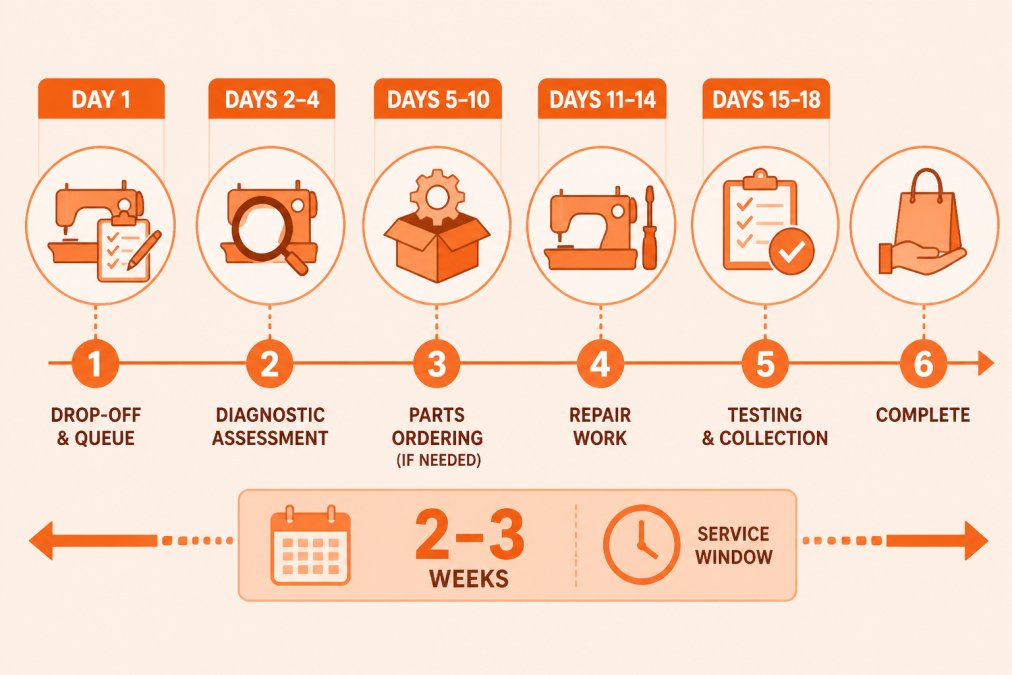
The timeline above reflects a typical service. A warranty repair can move faster because the fault is already known and the part is usually a current stock item. A parts-only repair, where you post in a foot pedal or a single component rather than the whole machine, is quicker still because there is no full teardown involved.

Where it slows down is on older or imported machines. If a part has to come from overseas, add shipping time on top of the workshop queue. No honest service centre can promise a fixed date before the machine has been opened and assessed.
The Diagnostic Process: What Happens When Your Machine Arrives
Diagnosis is the most misunderstood stage. A technician cannot simply look at a machine and name the fault. They have to reproduce it, isolate it, and confirm the fix actually holds under stitching.
The process usually runs in this order:
- Intake and logging. Your machine is booked in with your name or order number, and any accessories you supplied are noted.
- Visual and mechanical inspection. The technician checks for obvious damage, wear, and thread or lint build-up.
- Function testing. The machine is run to reproduce the fault under real stitching conditions.
- Teardown where needed. Covers come off to inspect timing, tension discs, the hook, and the feed mechanism.
- Fault confirmation. The technician identifies the cause, not just the symptom.
- Repair and reassembly. Parts are replaced or adjusted, then the machine is rebuilt.
- Retest. The machine is stitched out again to confirm the fault has gone.
That final retest matters. A machine that sews correctly for ten seconds on a bench can still fail under a full seam. Testing takes time, and skipping it is how faults come back.
Signs Your Sewing Machine Needs Professional Maintenance
Catching problems early shortens repairs. A machine that is booked in at the first sign of trouble usually needs an adjustment, while one left until it seizes often needs parts.
Watch for these signals:
- Repeated thread breakage that persists after rethreading and a new needle
- Skipped stitches that continue after a fresh needle and correct thread
- Tension that will not balance no matter how you adjust the dial
- A machine that runs dry, stiff, or unusually loud
- Fabric feeding unevenly or puckering without a setting change
- The needle striking the plate or the bobbin area
- A burning smell, or the machine cutting out mid-seam
Any one of these is a reason to book a service rather than push on. Continuing to sew on a machine with a timing fault can turn a simple adjustment into a hook replacement.
Your Sewing Machine Service Checklist
Use this checklist before you book a service. It saves the technician time, which shortens your wait.
Machine Servicing & Repairs | Sewing →
- Note the exact fault and when it happens, such as at speed or on thick seams
- Check the needle is the correct type and not blunt
- Clean out visible lint from the bobbin area and feed dogs
- Confirm you are using the right thread for the fabric
- Check the machine has been oiled as its manual advises
- Gather your bobbin and bobbin case, and leave them in the machine
- Include your standard presser foot, and the embroidery foot and hoop if it is an embroidery machine
- Include your thread if the machine is an overlocker
- Write your order number or name on the machine or case
- Leave the accessory tray, instruction book, quilting table and cover at home
- Leave the power cable at home unless it is unique to your machine
- Leave the foot pedal at home if your machine has a stop/start button
Following this list avoids the most common hold-up: a machine that cannot be tested because a required foot, hoop or bobbin was left behind.
How to Maintain Your FEIYUE Sewing Machine
FEIYUE machines are built for regular use, and they reward consistent care. A few habits keep them running between services.
Clean the bobbin area after every few projects. Lint compacts there faster than anywhere else on the machine, and a clogged bobbin case causes tension faults that look like bigger problems. Brush out the feed dogs at the same time.
Oil according to your manual, and never let the machine run dry. A machine left near a radiator or in direct sun dries out its lubricant, which speeds up wear and brings a service forward. If you are unsure which oil to use, ask before you apply anything.
Change the needle regularly rather than waiting for it to blunt. A worn needle strains the timing and the hook, and that is how small running costs turn into repair bills.
Store the machine covered when it is not in use. Dust is abrasive, and a machine that sits uncovered collects it in the very places that need to stay clean.
When a FEIYUE does need attention, book it in rather than adjusting the timing yourself. Timing is set by feel and by test stitching, and a wrong adjustment causes more damage than the original fault.
Tips for Faster Repairs
Speed comes from preparation, not from chasing the workshop. The customers who get their machines back quickest are the ones who make the job easy to start.
Book in during a quiet period if you can. Late summer and early spring are usually calmer than the weeks before Christmas. If your machine is not urgent, waiting for a quieter slot can shave days off the queue.
Bring everything the technician needs. A machine that arrives with its bobbin, case, correct foot and, for an overlocker, its thread can be tested immediately. A machine missing a part sits in the queue while someone chases you for it.
Describe the fault precisely. "It skips stitches on stretch fabric at speed" tells a technician far more than "it does not work". Better information means a faster diagnosis.
If you are posting the machine, package it properly. As Royal Mail guidance on sending items safely explains, inadequate packaging can invalidate any claim if the parcel arrives damaged, and a damaged machine takes far longer to put right than the original fault.
Finally, collect promptly once you are notified. Machines left beyond the collection window can attract storage charges, and that is a delay entirely within your control.
At Fabric Mouse, we have serviced and repaired all brands from our workshop since 1922, and we will always tell you honestly whether a wait is down to the queue or a part on order.
A long repair wait is frustrating, but it is usually a sign that the job is being done properly rather than rushed. The fix is to make your machine easy to assess, keep up with maintenance, and use a service centre that tells you the truth about timing.
Fabric Mouse is an authorised service centre for all brands, with a team that has looked after sewing, embroidery, overlocker and quilting machines for generations. Our sewing machine service covers a full diagnostic and repair for £70, with a parts-only repair option at £40 for smaller jobs, and a no-charge warranty repair booking for machines still under manufacturer cover. Our showroom lets you test machines before you buy, and free shipping with 24hr delivery means the right accessories reach you quickly.
Contact us to book your machine in, and we will give you a clear, honest turnaround from the moment it arrives.
Frequently Asked Questions
How long does a professional sewing machine service usually take?
A professional sewing machine service typically takes 2-3 weeks from drop-off to collection. This window allows for diagnostic assessment, any necessary repairs, thorough testing, and quality checks. At Fabric Mouse, machines are serviced by authorised technicians with experience across all major brands. The timeframe can extend if replacement parts need ordering, particularly for older or specialist models. Booking during quieter periods and ensuring your machine arrives clean with the correct accessories can help avoid unnecessary delays.
Can I speed up the repair process for my sewing machine?
You can help speed things up by bringing the right items: your bobbin and bobbin case, standard presser foot, and embroidery hoop if applicable. Leave accessory trays, instruction books, and quilting tables at home. Booking a service before a fault develops also helps, since maintenance visits are quicker than diagnostic repairs. If your machine is under warranty, check what is covered first, as wear items like bobbin cases and needle plates are not included. Clear communication about the fault also reduces diagnostic time.
Why do older machines often require longer repair times?
Older machines often need longer repairs because parts are no longer in regular production. A technician may need to source components from specialist suppliers or wait for delivery. Older mechanisms can also seize or wear in ways that require careful adjustment rather than simple replacement. Machines that have been stored near radiators or windows may have dried-out lubrication, adding to the work. The diagnostic process itself takes time because the technician must test thoroughly to identify every fault before quoting.
What should I check before taking my machine for a professional repair?
Before booking a repair, check the basics: is the machine threaded correctly, is the bobbin wound evenly, and is the needle the right type and size for your fabric? Sometimes what seems like a fault is a simple threading or tension issue. If the problem persists, note exactly what happens and when. Bring your bobbin, bobbin case, and standard presser foot. Remove any accessory trays, covers, or quilting tables. If under warranty, confirm whether the issue is covered, as adjustments and wear items usually are not.
Best Sewing Machine for Dressmaking: 2026 Guide
Buy Premium Sewing Fabric Online: 2026 Guide
Related Posts

Quilting Patterns for Beginners: Step by Step

How to Sew Mitered Corners on Hems

Standard Sewing Machine for Free-Motion Quilting: Pros and Cons

How to Use Quilting Rulers for Beginners

Types of Premium Cotton for Quilting

Why Bobbin Thread Bunches Up: Fix It Now

How to Grade Sewing Patterns for Custom Fit
