

Best Sewing Machine for Dressmaking: 2026 Guide
Table of Contents
- Quick Comparison: Best Sewing Machines for Dressmaking
- Essential Dressmaking Sewing Machine Features
- 1. Brother Innov-is A16: Best for Beginners
- 2. Janome Sewist 725S: Best Mechanical Option
- 3. Brother Innov-is A50: Best Value Computerised
- 4. Janome 360DC: Best for Confident Improvers
- 5. Janome DKS30SE: Best for Busy Dressmakers
- 6. Brother Innov-is A65: Best Portable Option
- 7. Brother Innov-is A150: Best for Creative Dressmaking
- 8. Janome M50 QDC: Best for Dressmaking and Quilting
- 9. Husqvarna Epic 980Q: Best Premium Investment
- Which Dressmaking Machine Should You Choose?
- Frequently Asked Questions
Last Updated: September 19, 2026
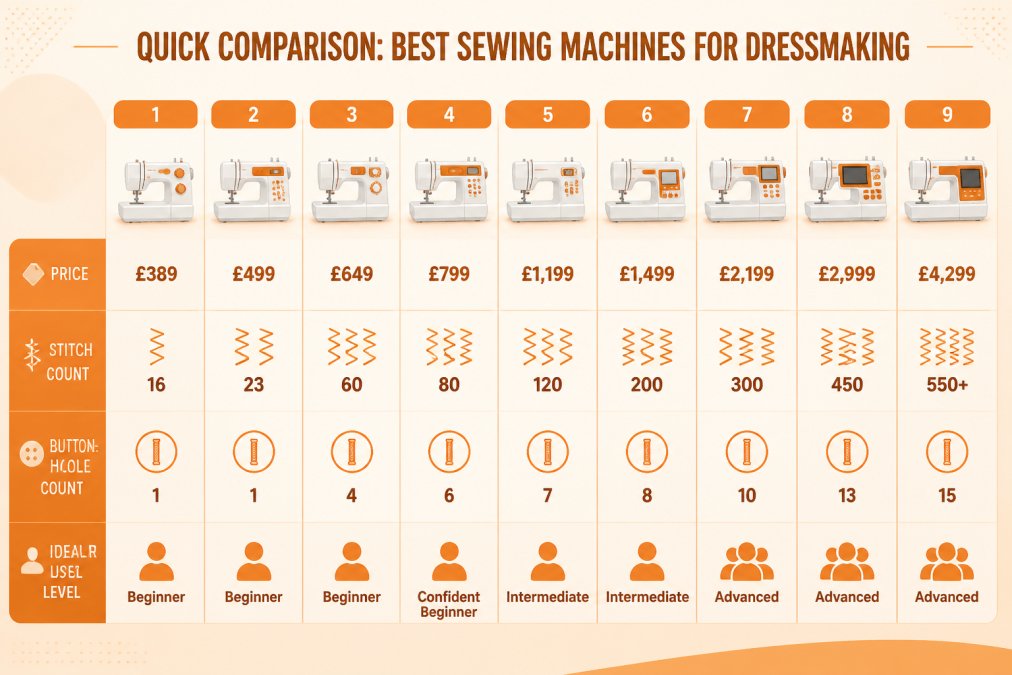
Quick Comparison: Best Sewing Machines for Dressmaking
Choosing the best sewing machine for dressmaking comes down to matching stitch control, buttonhole quality and fabric handling to how you actually sew. At Fabric Mouse, we have fitted and serviced dressmaking machines for hobby sewists and professionals for years, and the same question comes up every time: which machine will still feel right two years from now?
This guide compares nine machines we stock and service, from the mechanical Janome Sewist 725S at £389 to the Husqvarna Epic 980Q at £4,299. Below, we break down which suits beginners, improvers and busy dressmakers, so you can shortlist with confidence rather than guesswork.
| Machine | Price | Stitches | Buttonholes | Best For |
|---|---|---|---|---|
| Brother Innov-is A16 | £399 | 16 | 1 | Absolute beginners |
| Janome Sewist 725S | £389 | 23 | 1-step | Mechanical simplicity |
| Brother Innov-is A50 | £449 | 50 | 5 one-step | Best value computerised |
| Janome 360DC | £479 | 60 | 7 | Confident improvers |
| Brother Innov-is A65 | £499 | 60 | 7 one-step | Portability |
| Brother Innov-is A150 | £599 | 150 | Multiple | Creative dressmaking |
| Janome DKS30SE | £619 | 30 direct-select | Multiple | Busy dressmakers |
| Janome M50 QDC | £649 | 50 | Multiple | Dressmaking and quilting |
| Husqvarna Epic 980Q | £4,299 | 550+ | Multiple | Serious investment |
Essential Dressmaking Sewing Machine Features
Essential dressmaking features are the specifications that directly affect garment quality: adjustable stitch length and width, a reliable one-step buttonhole, a needle up/down function, and enough presser foot pressure control for light fabrics.

Stitch count matters less than stitch control. A machine with 16 well-tuned stitches will sew better seams than one with 150 poorly calibrated ones. For dressmaking specifically, look for:
- One-step buttonholes with auto-sizing, since garments need consistent buttonholes
- Speed control slider, which helps on slippery linings and fine cottons
- Needle up/down setting, useful for pivoting around collars and curves
- Free arm, essential for cuffs, sleeves and trouser hems
- Drop feed, which opens up free-motion work and darning
A common mistake is buying on stitch count alone. In practice, the machines that dressmakers keep longest are the ones with the smoothest feed and clearest controls, not the longest feature list.
1. Brother Innov-is A16: Best for Beginners
The Brother Innov-is A16 is the most straightforward route into dressmaking, with 16 essential stitches, a jog dial for one-handed stitch selection, and an automatic needle threader. At £399, it covers seams, hems, mending and basic buttonholes without overwhelming a new sewist.

Where it wins is simplicity. The start/stop button means you can sew without the foot pedal, which many beginners find easier while learning to guide fabric. The needle up/down setting helps at corners, and the drop-in bobbin with a clear cover makes threading far less fiddly than a front-loading system.
The limitation is honest: 16 stitches will not carry you through decorative work or heirloom finishes. If you already know you want more, step up.
2. Janome Sewist 725S: Best Mechanical Option
The Janome Sewist 725S is the mechanical machine we recommend most often to sewists who distrust menus. It has 23 stitches, a one-step buttonhole, a built-in needle threader and a strong internal frame that keeps vibration down at speed. It costs £389.

Manual dial selection is the point here. There is no screen to navigate, no mode to exit, and nothing to relearn if you leave the machine for six months. The front-loading bobbin system is strong and simple to maintain, and the snap-on feet and drop feed make appliqué and light quilting possible.
Where it falls short is fine control. You adjust stitch length and width by feel rather than by number, so precise repeat work takes more practice than on a computerised model.
3. Brother Innov-is A50: Best Value Computerised
The Brother Innov-is A50 gives you computerised control for £449, with 50 built-in stitches, five one-step buttonholes, an LCD screen and a speed slider. For the money, it is the strongest all-round dressmaking package in this list.
What most guides miss is how much the small features matter. The lock stitch button ties off seams cleanly, the quick-set drop-in bobbin resists jamming, and the hard cover means it travels safely to classes. It handles stretch, utility and decorative stitches, which covers most garment sewing.
The one drawback is the plastic outer casing, which feels less substantial than the Janome mechanical options. Treat it as a machine to learn on and eventually upgrade from, not a lifetime purchase.
4. Janome 360DC: Best for Confident Improvers
The Janome 360DC is the natural upgrade for someone who has outgrown a basic machine. It offers 60 built-in stitches, seven buttonholes, an easy-set top-loading bobbin and an LCD display, priced at £479.
This is the machine for sewists who want to alter clothes, make soft furnishings and handle stretch fabrics properly. The speed control slider and start/stop button let you slow right down on tricky seams, and the lock stitch, needle up/down and reverse buttons give a professional finish. Snap-on feet and a free arm make cuffs and necklines far easier.
Where it falls short is ambition. There is no lettering, no programmable stitch memory and no extension table, so quilters and monogrammers will want to look further up the range.
5. Janome DKS30SE: Best for Busy Dressmakers
The Janome DKS30SE is built for speed of use, with 30 direct-select stitch buttons, an automatic thread cutter and a powerful motor, priced at £619. Every stitch has its own button, so there is no scrolling through menus mid-project.
For anyone sewing to a deadline, the automatic thread cutter is the standout feature. It trims cleanly at the press of a button, which saves real time across a garment with dozens of seams. The powerful motor handles heavier fabrics without straining, and the large LCD screen keeps stitch information visible.
The trade-off is stitch count. Thirty stitches is plenty for garment construction but limited for decorative work, and the Special Edition positioning means fewer accessories ship in the box than with the M50 QDC.
6. Brother Innov-is A65: Best Portable Option
The Brother Innov-is A65 is the machine to buy if your sewing happens in more than one place. It weighs little, ships with a hard case and offers 60 built-in stitches and seven one-step buttonholes for £499.
Portability does not mean compromise here. The speed control slider handles tricky fabrics, the needle up/down setting helps with pivoting and appliqué, and the drop-in bobbin with a clear cover lets you monitor thread levels without dismantling anything. It suits dressmaking, home decor and classroom use equally well.
The honest limitation is stability at high speed. Lightweight machines vibrate more than heavier ones, so if you mostly sew at home on a permanent table, a sturdier model will feel better.
7. Brother Innov-is A150: Best for Creative Dressmaking
The Brother Innov-is A150 is the creative dressmaker's machine, with 150 built-in stitches, three lettering fonts and programmable stitch settings for £599. It handles detailed garment work and personalisation in one unit.
The lettering fonts are the differentiator. Adding names, initials or labels to handmade garments turns a hobby project into something giftable, and programmable stitch settings let you save and reuse combinations rather than rebuilding them each time. The advanced needle threader, lock stitch function and needle up/down button keep the basics fast.
Where it falls short is the learning curve. With 150 stitches and multiple fonts, the interface takes an evening to get comfortable with, and beginners may find the A50 easier to live with.
8. Janome M50 QDC: Best for Dressmaking and Quilting
The Janome M50 QDC is the pick for sewists who make garments and quilts on the same machine. It has 50 built-in stitches, an extension table, a hard cover and an easy-set bobbin system, priced at £649.
The extension table is what makes this work for quilting. Larger pieces need support, and the included table stops heavy fabric dragging off the edge of the machine. The 50 stitches cover utility, stretch, quilting and decorative work, and the speed slider and start/stop button suit both beginners and experienced sewists.
The trade-off is that it does two jobs well rather than one job perfectly. Dedicated quilters will want a larger throat space, and dedicated dressmakers may prefer the direct-select speed of the DKS30SE.
9. Husqvarna Epic 980Q: Best Premium Investment
The Husqvarna Epic 980Q is the machine for sewists who want the highest level of control available. It offers over 550 stitches, a multi-touch LED display, a large working area and instant interactive guidance, priced at £4,299.
What sets it apart is automatic adjustment. The Epic 980Q constantly adjusts itself to keep stitches consistent regardless of fabric or thread, which removes much of the tension guesswork that frustrates dressmakers working across different materials. The large working area suits full skirts, coats and quilting projects, and the LED lighting keeps the needle area clear.
This is a serious investment, and it is overkill for occasional sewers. For a professional dressmaker or a committed hobbyist sewing most days, the consistency is worth the outlay.
Which Dressmaking Machine Should You Choose?
Match the machine to the stage you are actually at, not the stage you hope to reach. Beginners should start with the Brother Innov-is A16 or the Janome Sewist 725S. Improvers who want computerised control get the best value from the Brother Innov-is A50, while the Janome 360DC and Brother Innov-is A65 suit sewists handling varied fabrics and locations.
For busy dressmakers, the Janome DKS30SE and Janome M50 QDC cover speed and versatility respectively. Creative sewists should look at the Brother Innov-is A150, and professionals ready to invest should consider the Husqvarna Epic 980Q.
Fabric Mouse is a family-run business and an authorised service centre for all brands we stock, so whichever machine you choose, servicing and repairs stay straightforward. Free delivery is available, and our showroom lets you test machines before you commit.
One more thing worth adding to the basket: a Janome Gathering Foot Category B at £21 makes light work of gathered skirts and sleeves, which is one of the fiddliest jobs in dressmaking.
Frequently Asked Questions
What features are essential for a dressmaking sewing machine?
A dressmaking machine needs adjustable stitch length and width, a reliable straight stitch, and at least one stretch stitch for knits. Look for a one-step buttonhole, a free arm for cuffs and collars, and a needle threader to save time. Speed control helps with curved seams. The Janome DKS30SE includes a powerful motor and automatic thread cutter, both useful for garment construction.
Is a mechanical or computerised sewing machine better for dressmaking?
Mechanical machines like the Janome Sewist 725S offer tactile dial controls and fewer electronics to fail, which suits sewists who prefer simplicity. Computerised models such as the Brother Innov-is A50 provide speed control, needle up/down, and more stitch options. For dressmaking, computerised machines make it easier to repeat exact settings across a project. Neither is objectively better; it depends on whether you value simplicity or precision.
Do I need an industrial sewing machine for professional dressmaking?
Not necessarily. Domestic machines like the Husqvarna Epic 980Q handle multiple fabric layers and heavy materials well. Industrial machines sew faster and run continuously, which suits factory production. For a home studio or small business, a computerised domestic machine with a powerful motor covers most garment work without the space and cost of industrial equipment.
Which sewing machine brands are most reliable for garment construction?
Brother and Janome both have strong track records for dressmaking. The Brother Innov-is range offers consistent stitch quality and easy threading. Janome machines are known for smooth feeding and durable build. Husqvarna suits sewists who want advanced features.
How does stitch quality affect the finish of handmade garments?
Uneven stitches show on seams, hems, and topstitching. A machine with good tension control and a strong internal frame produces consistent stitches across different fabrics. The Janome Sewist 725S has a strong internal frame that reduces vibration. The Husqvarna Epic 980Q adjusts itself to maintain stitch quality across fabric types. Better stitch quality means fewer skipped stitches and a more professional finish.
Choosing a dressmaking machine is really a question of matching capability to habit, and that is where hands-on advice beats a spec sheet every time. Fabric Mouse stocks the full range covered here, from the Brother Innov-is A16 to the Husqvarna Epic 980Q, with free delivery, an authorised service centre for every brand, and a showroom where you can test before you buy. Get started with Fabric Mouse and find the machine that fits how you actually sew.
Best Fabric for Quilting Projects 2026
Why Sewing Machine Repair Takes Time: A 2026 Guide
Related Posts

How to Sew Mitered Corners on Hems

Standard Sewing Machine for Free-Motion Quilting: Pros and Cons

How to Use Quilting Rulers for Beginners

Types of Premium Cotton for Quilting

Why Bobbin Thread Bunches Up: Fix It Now

How to Grade Sewing Patterns for Custom Fit

How to Fix Gaping Armholes in Dresses: 7 Methods
