

Choosing a Sewing Machine for Hobbyists: 2026 Guide
Table of Contents
- What to Look for When Choosing a Sewing Machine for Hobbyists
- Mechanical vs Computerised Sewing Machines: Which Suits You?
- Budget-Friendly Options for New Hobbyists
- Mid-Range Machines: The Sweet Spot for Growing Confidence
- Essential Sewing Machine Features for Dressmaking
- FEIYUE Sewing Machines for Home Use
- Comparison Table: Hobbyist Sewing Machines at a Glance
- Portability and Storage: Space-Saving Solutions
- How to Maintain a Sewing Machine at Home
- Common Mistakes When Choosing Your First Machine
- Where to Buy and What Support Matters
- Accessories and Add-Ons Worth Considering
- Making Your Final Decision
- Frequently Asked Questions
Last Updated: September 26, 2026
What to Look for When Choosing a Sewing Machine for Hobbyists
Choosing a sewing machine for hobbyists can feel overwhelming when you're staring at dozens of options online. The truth is, most beginners don't need half the features they think they do. What matters most is finding a machine that matches your actual projects, not the one with the longest stitch list.
When you're selecting a sewing machine for hobbyists, focus on three core elements: ease of use, reliability, and whether the machine handles the fabric types you'll work with most. A beginner tackling cotton quilts needs something different from someone making stretch jersey garments. At Fabric Mouse, we've helped countless hobbyists find their perfect match by starting with these fundamentals rather than getting distracted by unnecessary bells and whistles.
The best sewing machine for hobbyists is one you'll actually use. That means it should thread easily, start and stop without fuss, and feel comfortable under your hands for hours at a time. Speed control matters more than maximum speed. A bright work light beats fancy stitches you'll never touch. Portability matters if you're taking it to classes or storing it in a small flat.
Mechanical vs Computerised Sewing Machines: Which Suits You?
The choice between mechanical vs computerised sewing machines often comes down to your comfort level with technology and what you're willing to spend. Mechanical machines are simpler, more durable, and easier to repair. They've been around for decades because they work reliably without needing electricity beyond the motor.
Computerised machines offer convenience, automatic needle threading, one-step buttonholes, stitch selection via buttons instead of dials. They're faster to set up and more forgiving if you're still learning. The trade-off is they're more expensive upfront, and if something goes wrong, repairs are pricier.
For a sewing machine for hobbyists just starting out, mechanical is often the smarter choice. You'll learn the fundamentals without relying on automation to do the thinking for you. You'll understand why tension matters, how to adjust it, and what happens when something isn't quite right. That knowledge transfers to any machine you use later.
That said, if you're upgrading from a very basic model or you know you want a machine that handles stretch fabrics and decorative stitches without fiddling, a computerised option might be worth the extra investment. The Brother Innov-is A65 sits in that sweet spot, computerised enough to feel modern, but straightforward enough that you won't spend an hour deciphering the manual.

Budget-Friendly Options for New Hobbyists
Starting your sewing journey doesn't require spending hundreds of pounds. A quality budget sewing machine for hobbyists can deliver years of reliable stitching without draining your wallet.
The Brother SH40 is genuinely one of the best value options available. At £249.00, it offers 40 built-in stitches, an LCD screen for easy navigation, and a drop-in bobbin system that takes the frustration out of threading. It's light enough to move between rooms or take to a class, and the automatic needle threader alone saves your eyesight and sanity. For beginners working with cotton fabrics, quilting cotton, and light home décor projects, this machine handles everything you'll throw at it.

The FEIYUE FY410 represents something different, a compact, lightweight option at £225.00 with 79 stitch options and an LED display. It's exclusive to Fabric Mouse, which means you won't find it elsewhere. The smaller footprint makes it ideal if you're short on space, and the stitch variety gives you room to grow into more complex projects without outgrowing your machine. Complete beginners have successfully quilted coasters on this machine with no prior experience.
Both machines share the same advantage: they're genuinely affordable without feeling cheap. The build quality is solid, and you're not sacrificing reliability for the lower price tag.
| Machine | Price | Stitches | Best For | Key Advantage |
|---|---|---|---|---|
| Brother SH40 | £249.00 | 40 | Beginners, home décor | Automatic needle threader |
| FEIYUE FY410 | £225.00 | 79 | Space-conscious hobbyists | Compact, exclusive design |
Mid-Range Machines: The Sweet Spot for Growing Confidence
Once you've completed a few projects and know you're serious about sewing, a mid-range sewing machine for hobbyists gives you the features and reliability to tackle more ambitious work without the price tag of professional-grade equipment.
The Brother Innov-is A16 at £399.00 bridges the gap between basic and advanced. With 16 essential stitches, speed control, and a helpful needle threader, it's designed for sewists who want simplicity without sacrifice. The jog dial for stitch selection means you can adjust on the fly, and the start/stop button lets you sew without a foot pedal if you prefer. It's lightweight and portable, so it works equally well at home or in a workshop setting.
The Janome 230DC at £449.00 offers 30 built-in stitches and a hard cover included in the price. The snap-on feet and free arm make it versatile for sleeves, cuffs, and trousers, projects that require more than just straight seams. The LCD display and easy navigation buttons mean you're not hunting through a manual every time you want to switch stitches. This machine rewards hobbyists who are ready to move beyond basic garment construction.
The Brother Innov-is A65 at £499.00 is where many hobbyists land as their "final" machine, the one they keep for years. It offers 60 built-in stitches, seven one-step buttonholes, and speed control that feels natural rather than finicky. The hard case is included, which matters if you're transporting it regularly. This machine doesn't overwhelm you with unnecessary features, but it won't hold you back either.
Essential Sewing Machine Features for Dressmaking
If dressmaking is your primary goal, certain features become non-negotiable. A sewing machine for hobbyists focused on garments needs different capabilities than one built for quilting or home décor.
Start with stitch variety. You need at least a good stretch stitch for jersey and knit fabrics, a zigzag for seam finishing, and buttonhole options. Most machines in the mid-range and above offer these, but budget models sometimes skimp on stretch stitches. The Brother Innov-is A65 includes stretch stitches specifically because dressmakers need them.

Needle up/down positioning matters more than most people realise. When you're pivoting at a corner, turning a collar or rounding a neckline, the ability to leave the needle down and lift the presser foot lets you rotate the fabric without shifting. Every machine mentioned here offers this, but it's worth checking on any model you're considering.
A free arm is essential for dressmaking. It's that removable section that lets you slide a trouser leg or sleeve over the machine bed. Without it, you're fighting the fabric rather than working with it. All the machines we've discussed include a free arm.
Buttonhole quality matters. One-step buttonholes are faster, but they need to be consistent and strong enough to handle wear. The Brother Innov-is A65 offers seven styles, which gives you options for different fabric weights and garment types. The Janome 230DC handles buttonholes reliably without the extra variety, perfectly adequate for most dressmaking.
For essential sewing machine features for dressmaking, don't get distracted by decorative stitches. You might use them once. Focus instead on reliability, stitch quality, and the practical features that make construction faster and more accurate.
FEIYUE Sewing Machines for Home Use
FEIYUE sewing machines for home use represent a different approach to machine design, compact, lightweight, and surprisingly capable. The FY410 at £225.00 is exclusive to Fabric Mouse, and it's proven popular with hobbyists who value space efficiency without compromising on stitch options.
What sets FEIYUE machines apart is their attention to portability. If you're moving between rooms, taking your machine to classes, or living in a smaller space, the compact footprint is genuinely liberating. You're not sacrificing build quality for the smaller size, the machine is engineered to be durable despite its lighter weight.
The 79 stitch options on the FY410 might sound excessive, but it actually gives you flexibility as your skills grow. You won't use all 79 stitches, but having them available means you can explore decorative options without outgrowing your machine. The LED display makes stitch selection intuitive, and the machine handles basic dressmaking, quilting, and home décor projects equally well.
FEIYUE sewing machines for home use work particularly well if you're a hobbyist with limited storage space or someone who likes to move their machine around. The weight and footprint mean it's genuinely portable, not just "technically transportable but heavy enough that you won't bother."
Comparison Table: Hobbyist Sewing Machines at a Glance
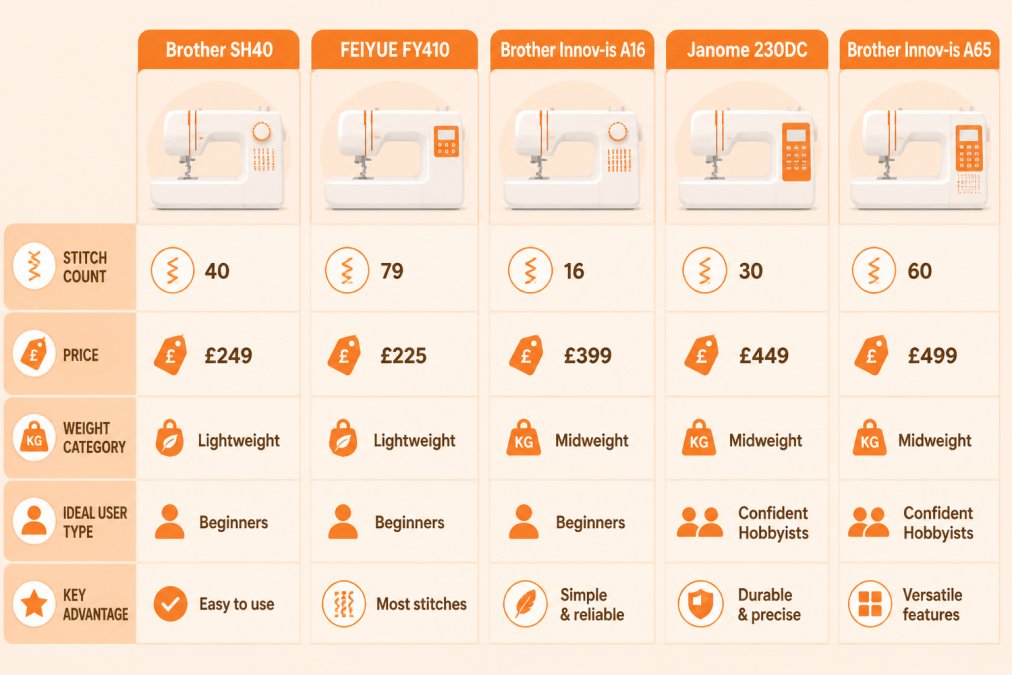
| Machine | Price | Stitches | Speed Control | Needle Threader | Best For |
|---|---|---|---|---|---|
| Brother SH40 | £249.00 | 40 | Yes | Automatic | Budget-conscious beginners |
| FEIYUE FY410 | £225.00 | 79 | Yes | Automatic | Space-limited hobbyists |
| Brother Innov-is A16 | £399.00 | 16 | Yes | Automatic | Simplicity-focused sewists |
| Janome 230DC | £449.00 | 30 | Yes | Built-in | Portable, class-going hobbyists |
| Brother Innov-is A65 | £499.00 | 60 | Yes | Automatic | Growing hobbyists, dressmakers |
Portability and Storage: Space-Saving Solutions
One of the most underrated factors when choosing a sewing machine for hobbyists is whether you can actually store it without it dominating your space. A machine that lives in a cupboard gets used. One that takes up permanent table space often doesn't.
Brother Innov-is A16 Sewing Machine →
Weight matters more than you'd think. The Brother SH40 and FEIYUE FY410 are both genuinely light, you can move them one-handed without strain. The Brother Innov-is A16 is similarly portable. If you're carrying your machine to classes or workshops regularly, this matters. The heavier machines like the Brother Innov-is A65 are still manageable, but they're not something you'll casually relocate.
Hard cases make a real difference if you're transporting your machine regularly. The Brother Innov-is A65 and Janome 230DC include them. A hard case protects against dust, accidental spills, and damage during transport. It also makes the machine feel like less of an eyesore on a shelf, it looks intentional rather than abandoned.
Consider vertical storage options. A rolling cabinet designed for sewing machines keeps everything accessible without taking up floor space. Sew Fine sewing cabinets are specifically designed for this purpose and work well with any of the machines mentioned here. They're an investment, but if you're serious about making space work, they're worth it.
For hobbyists in smaller homes or flats, the FEIYUE FY410 and Brother SH40 are genuinely practical choices because they don't demand permanent real estate. You can store them in a cupboard and pull them out when you need them.
How to Maintain a Sewing Machine at Home
A well-maintained sewing machine lasts decades. Neglected ones fail within years. The good news is that basic maintenance is straightforward and doesn't require special knowledge.
Clean your machine regularly. After every project, use a small brush to remove lint and thread scraps from around the bobbin area and feed dogs. This prevents buildup that can affect stitch quality. Keep a small brush in your sewing basket, it takes 30 seconds and makes a real difference.
Oil your machine according to the manual. Most modern machines need very little oil, and some are sealed and shouldn't be oiled at all. Check your specific model's instructions. If you do oil, use only sewing machine oil, regular oil attracts dust and causes problems. A drop or two in the right places goes a long way.
Change your needle regularly. A dull or bent needle is the single most common cause of skipped stitches and tension problems. Change it after every 8-10 hours of sewing, or whenever you notice quality issues. Fresh needles are cheap. Fixing tension problems or replacing damaged fabric isn't.
Store your machine in a dust cover when you're not using it. This prevents lint accumulation and protects against accidental spills. A simple cotton cover works fine, you don't need anything fancy.
Have your machine serviced professionally every 2-3 years if you sew regularly. Fabric Mouse offers professional servicing for all brands, which means your machine gets cleaned, adjusted, and checked by someone who knows what they're doing. This catches small problems before they become expensive ones.
Common Mistakes When Choosing Your First Machine
Most hobbyists make the same predictable mistakes when choosing a sewing machine. Knowing what to avoid saves you money and frustration.
The biggest mistake is buying based on stitch count alone. A machine with 200 stitches isn't better than one with 40 if you only use 10 of them. You're paying for features you'll never touch. Focus on the stitches you actually need, straight, zigzag, buttonhole, and maybe a stretch stitch, and ignore the rest.
Another common error is choosing portability over stability. A machine that's light enough to carry everywhere is useless if it's too flimsy to hold tension properly. There's a difference between portable and cheap. The machines recommended here are portable without sacrificing build quality.
Don't assume you need computerisation if you're a beginner. Computerised machines are convenient, but they're not necessary. A mechanical or basic electronic machine teaches you more about how sewing actually works. You learn to troubleshoot tension problems instead of assuming the machine is broken. That knowledge transfers to any machine you use later.
Skipping the manual is a recipe for frustration. Every machine has quirks, specific threading sequences, tension settings for different fabrics, presser foot options. Spending 20 minutes with the manual before you start saves hours of troubleshooting later.
Where to Buy and What Support Matters
Where you buy your sewing machine matters more than many people realise. Online retailers offer convenience and sometimes lower prices, but they can't help when something goes wrong.
Accessories and Add-Ons Worth Considering
The right accessories make sewing more enjoyable and your results better. Not all add-ons are worth the money, but some genuinely improve your experience.
Making Your Final Decision
After considering all these factors, your final decision should feel straightforward rather than overwhelming. You've eliminated machines that don't match your needs, your budget, and your space situation. What remains are genuinely good options, you can't make a wrong choice from the machines recommended here.
Frequently Asked Questions
What features should a hobbyist look for in a sewing machine?
Focus on stitch variety (at least 20-30 stitches), automatic needle threading, speed control, and a clear bobbin cover. For hobbyists, portability and ease of use matter more than industrial features. Built-in buttonhole functions and adjustable stitch length and width give you flexibility for most projects. A machine with an LED light and intuitive controls will save you frustration as you build your skills.
Is it better to buy a mechanical or computerised sewing machine for beginners?
Both mechanical and computerised machines have their merits for beginners. Computerised models often offer automatic features like needle threading and stitch selection via buttons or LCD screens, which can reduce setup time and frustration. Mechanical machines are simpler and can help you learn the fundamentals without relying on automation. For hobbyists starting out, a model like the Brother Innov-is A16 or Janome 230DC can help you focus on learning to sew.
How much should I expect to spend on a reliable hobbyist sewing machine?
Quality hobbyist machines start around £225-£250 for basic computerised models and range up to £500 for feature-rich options. The Brother SH40 at £249 offers excellent value with 40 stitches and electronic controls. Mid-range machines like the Brother Innov-is A65 at £499 provide more stitches and portability. Spending more than £500 typically targets semi-professional users. Your budget should reflect whether you're testing the hobby or committing to regular projects.
Do I need an industrial machine for home dressmaking?
No. Industrial machines are built for high-volume production and are overkill for hobbyist dressmaking. A standard computerised sewing machine with 30-60 stitches, adjustable speed, and a good needle threader handles home garment construction perfectly. Machines like the Brother Innov-is A65 or Janome 230DC are designed for exactly this purpose, offering the precision and reliability you need without the bulk, cost, or complexity of industrial equipment.
How do I maintain a sewing machine at home to ensure it lasts?
Clean your machine regularly by removing lint and dust from the bobbin area after each project using a small brush. Oil the machine according to your manual (typically every 8-10 hours of use) with sewing machine oil only. Change your needle regularly, especially after hitting pins or working with heavy fabrics. Store your machine in a dust cover, and keep it away from direct sunlight and damp areas. Have it serviced professionally every 2-3 years to keep it running smoothly.
What accessories should I buy when starting out as a hobbyist?
Essential accessories include spare needles (various sizes), quality thread in basic colours, bobbins, a seam ripper, fabric scissors or rotary cutter, measuring tape, and pins. Presser feet sets (for buttonholes, zips, and free-motion work) expand your machine's capabilities. A pressing ham and tailors' chalk help with finishing. Many machines come with basic accessories, so check what's included before buying extras. Start with essentials and add specialised tools as your projects demand them.
Can I use a hobbyist sewing machine for quilting?
Yes, most modern hobbyist machines handle quilting well, especially those with drop-feed options for free-motion quilting. Look for machines with a free-arm design and adequate space under the presser foot. Machines like the Janome 230DC and Brother SH40 include drop-feed capability. For serious quilting, you may eventually want a dedicated quilting machine, but hobbyist models are perfectly suitable for small to medium quilting projects, patchwork, and learning the craft.
The Sewing Studio Alternative for Quilters
Sewing Machine Repair Service: Your Guide
Related Posts

7 Ways to Tell if Fabric is Synthetic or Natural

Quilting Patterns for Beginners: Step by Step

How to Sew Mitered Corners on Hems

Standard Sewing Machine for Free-Motion Quilting: Pros and Cons

How to Use Quilting Rulers for Beginners

Types of Premium Cotton for Quilting

Why Bobbin Thread Bunches Up: Fix It Now
