

Lightweight Sewing Machine: A 2026 Review
Table of Contents
- What Makes a Lightweight Sewing Machine Worth Considering
- Lightweight Sewing Machine Comparison Table
- Lightweight Sewing Machine for Beginners: Where to Start
- Brother L14S: Simple, Affordable, and Genuinely Portable
- Sewing Machine for Travel: Compact Options That Go the Distance
- Portable Sewing Machine for Quilting: Handling Layers and Detail Work
- Can a Portable Sewing Machine Handle Denim and Heavy Fabrics?
- How to Choose the Right Lightweight Machine for Your Needs
- Conclusion: Finding Your Ideal Lightweight Sewing Machine
- Frequently Asked Questions
Last Updated: 12 October 2026
What Makes a Lightweight Sewing Machine Worth Considering
A lightweight sewing machine is a portable device designed for easy transport and storage, typically weighing between 3 and 7 kilograms. For sewers who attend classes, travel, or simply prefer machines that don't demand dedicated desk space, this category solves a real problem: you get reliable stitching without the bulk of traditional models.
The appeal goes beyond portability. Many sewers find that lightweight machines force manufacturers to focus on essential features rather than overwhelming you with options you'll never use. That simplicity often translates to faster learning curves for beginners and less frustration when something goes wrong.
At Fabric Mouse, we help customers navigate this choice. Whether you're starting from scratch, looking for a travel companion for your sewing projects, or seeking a machine that won't dominate your workspace, the right lightweight option can transform how you approach your craft. Below, we'll walk you through the machines that actually deliver on their promise, and help you spot the trade-offs that matter most for your situation.
Lightweight Sewing Machine Comparison Table
| Model | Price | Stitches | Best For | Key Strength |
|---|---|---|---|---|
| Brother L14S | £115 | 14 | Absolute beginners | Affordable entry point |
| Brother Innov-is A16 | £399 | 16 | Beginners with budget | Computerised ease |
| Janome 230DC | £449 | 30 | Hobbyists and classes | Balanced features |
| Pfaff Passport 2.0 | £669 | 70 | Quilters and improvers | Integrated dual feed |
| Pfaff Passport 3.0 | £799 | 100 | Advanced sewers | Automatic thread cutting |
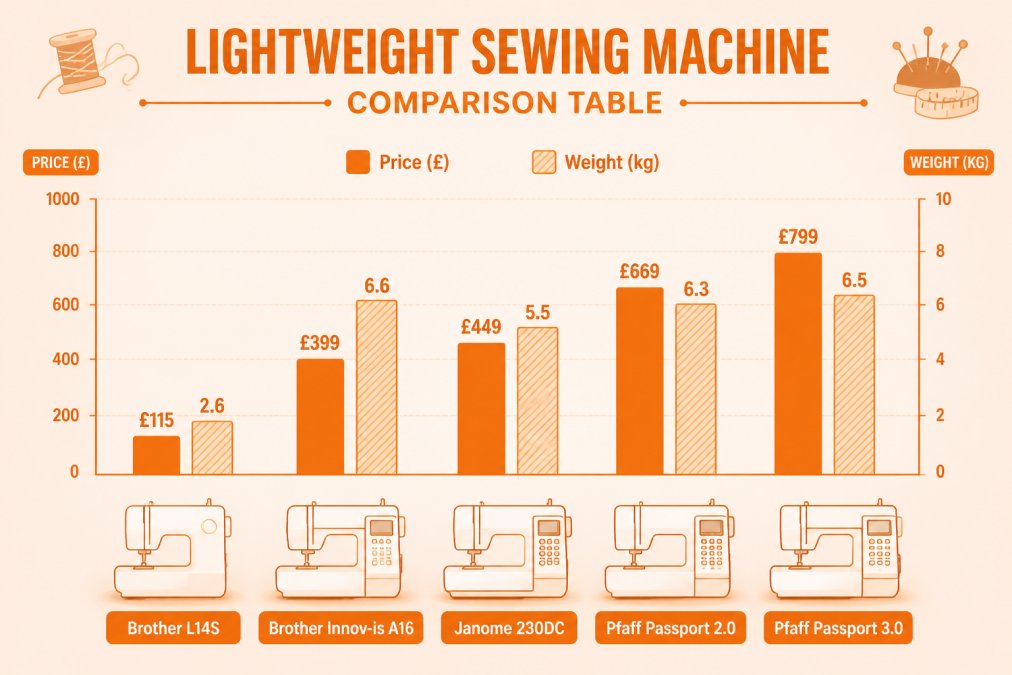
The table above shows why choosing the right lightweight sewing machine depends on both your budget and what you actually plan to sew. Notice the price jumps considerably once you move beyond the Brother entry-level models. That extra investment buys you more stitches, better feed systems, and features designed for specific tasks like quilting.

Lightweight Sewing Machine for Beginners: Where to Start
Starting with the right machine removes a major source of frustration. Beginners often abandon sewing not because they lack skill, but because their machine fights them at every turn.
The British Craft Council's guidance on choosing sewing equipment emphasises that beginners benefit most from machines with straightforward controls and clear threading systems. A lightweight sewing machine for beginners should prioritise simplicity over stitch count. Fourteen stitches is genuinely enough to make clothes, mend garments, and complete basic projects. Fifty stitches is confusing when you don't yet know what most of them do.
Look for these essentials in a beginner lightweight sewing machine:
- Built-in needle threader: Threading by hand is the single most common reason new sewers get frustrated and stop
- Top-loading bobbin: Reduces tangles and thread jams that derail confidence
- Speed control: Lets you sew slowly whilst learning without the machine running away from you
- Clear LED lighting: You need to see what you're doing, especially when learning to guide fabric straight
Many beginners worry that a lightweight machine means compromised quality. That's not accurate. A compact frame doesn't affect stitch quality, it just means less metal around the mechanism. The stitches themselves come from the same needle-and-bobbin system regardless of the machine's weight.
Brother L14S: Simple, Affordable, and Genuinely Portable
The Brother L14S is the entry point most beginners should consider first. At £115, it's the most affordable lightweight sewing machine in this comparison, and it doesn't compromise on the basics.
This machine delivers 14 stitches, enough for straight seams, zigzag, buttonholes, and simple decorative work. The top-loading bobbin system is genuinely quick to use, and the LED lighting is bright enough for detailed work. Manual tension and dial controls mean you're learning how a sewing machine actually works, rather than letting computerised systems hide the mechanics from you.
The Brother L14S is the lightest option here. That matters if you're moving it between rooms or storing it in a cupboard. Many students and young sewers choose this machine because portability is their priority, and the price leaves room in the budget for fabric and thread.
What it doesn't do: this machine won't handle heavy denim or canvas without struggle, and there's no automatic buttonhole, you'll need to adjust settings manually. The stitch selection is genuinely basic. But for learning to sew, mending clothes, and light craft projects, those limitations barely matter.
We recommend the Brother L14S if you're testing whether sewing is actually for you, or if you need a reliable backup machine for simple jobs.
Sewing Machine for Travel: Compact Options That Go the Distance
A sewing machine for travel needs to be genuinely portable without sacrificing the ability to handle real projects. The difference between a lightweight machine and a travel machine is intentionality, travel machines are built to move.
Weight matters here. Anything under 7 kilograms fits comfortably in a carry bag. The Pfaff Passport 2.0 at 6.3 kilograms and the Janome 230DC at approximately 5.5 kilograms both travel well. Both come with hard covers that protect the machine in transit, which is essential if you're moving between locations regularly.

For travel sewing, you also need a machine that handles variable conditions. You might be sewing in unfamiliar rooms with different lighting, on unfamiliar tables, with fabrics you've brought from home. A speed slider becomes genuinely useful, it lets you slow down when working in poor light or on tricky fabric. A start/stop button means you can sew without a foot pedal if your travel setup doesn't have room for one.
The Janome 230DC includes 30 stitches and a built-in needle threader. The Pfaff Passport 2.0 offers 70 stitches and an integrated dual feed system that helps layers travel together, invaluable for quilting or sewing multiple layers. Both are legitimate sewing machines for travel because they're light enough to move but capable enough to handle real projects, not just basic repairs.
Portable Sewing Machine for Quilting: Handling Layers and Detail Work
Quilting demands something different from a lightweight sewing machine. You're handling multiple fabric layers, often working with precision piecing where accuracy matters. A portable sewing machine for quilting needs to feed fabric evenly even when you're working with three or four layers of cotton plus batting.
Standard feed systems sometimes struggle with layers because they grip fabric from the top only. The Pfaff Passport series uses an integrated dual feed system (called IDT) that grips fabric from above and below simultaneously. That's the feature that matters most for quilting. It keeps pieced sections moving together, reducing the frustration of layers shifting mid-seam.
The Pfaff Passport 2.0 offers 70 stitches, which includes all the straight and decorative stitches quilters actually use. The Pfaff Passport 3.0 adds 100 stitches and automatic thread cutting, a feature that sounds minor until you're quilting and reaching for scissors between every seam. That automatic function saves time and keeps your hands on the fabric where they should be.

Both Pfaff models include a free arm, which is genuinely useful for quilting. For quilters working on larger projects, that flexibility matters.
The trade-off: Pfaff machines cost more than Brother or Janome options. But if quilting is your primary focus, the integrated dual feed justifies the investment. You're not paying for extra features you won't use, you're paying for a system designed specifically for the work you do.
Can a Portable Sewing Machine Handle Denim and Heavy Fabrics?
This is where honesty matters. Most lightweight sewing machines struggle with heavy denim or canvas. That's not a design flaw, it's physics. Lighter machines have less downward pressure from the presser foot, so they can't push heavy fabric through the needle as effectively.
A portable sewing machine for denim work is a compromise. You can sew denim on most of these machines, but you'll need to slow down, use a heavy-duty needle, and sometimes manually turn the handwheel to push the needle through particularly thick sections. It's doable, but it's not comfortable.
The Brother L14S, being the lightest, struggles most with denim. The heavier Pfaff models handle it better because their frame provides more stability and pressure. But even the Pfaff Passport 3.0 isn't a dedicated heavy-duty machine, it's a portable machine that can manage denim occasionally, not regularly.
If you're planning to sew heavy fabrics regularly, you need a different category of machine. A portable sewing machine works best for cotton quilting fabric, linen, knits, and light wools. For serious denim work, consider keeping a heavier machine at home and using a lightweight machine for travel and lighter projects.
How to Choose the Right Lightweight Machine for Your Needs
Choosing the right lightweight sewing machine comes down to matching features to your actual projects, not to impressive specifications you'll never use.
Start by answering these questions honestly:
What will you sew most often? If it's mending and simple repairs, the Brother L14S is sufficient. If it's piecing quilts, you need integrated dual feed. If it's a mix of dressmaking and home projects, the Janome 230DC hits the balance.
How often will you move the machine? If it stays in one place and "lightweight" just means it fits in a cupboard, weight matters less. If you're genuinely carrying it between locations, prioritise anything under 6 kilograms.
What's your budget? The Brother L14S at £115 is honest value. The Brother Innov-is A16 at £399 adds computerised stitch selection. The Janome at £449 adds more stitches and features. The Pfaff models at £669 and £799 are investments in integrated dual feed and advanced features for specific work.
How confident are you with mechanical systems? Manual controls (like the Brother L14S) teach you how machines work. Computerised machines (Brother A16, Janome, Pfaff) make stitch selection easier but hide the mechanics. Neither is wrong, it depends on whether you want to learn the details or just sew.
Research from the Textile Arts Council's equipment guide suggests that sewers who choose machines matching their actual projects (not their aspirational projects) stick with sewing longer and report higher satisfaction.
We recommend visiting a showroom if you can. Feeling the machine, threading it yourself, and testing the speed control matters more than reading specifications. At Fabric Mouse, we have a hands-on showroom to explore and test machines, and we can help you understand what each feature actually means for your work.
Conclusion: Finding Your Ideal Lightweight Sewing Machine
A lightweight sewing machine solves a real problem for sewers who value portability, simplicity, or space. The right choice depends on what you actually plan to sew, how often you'll move the machine, and what budget you're comfortable with.
The Brother L14S remains the entry point for absolute beginners and anyone testing whether sewing is for them. The Janome 230DC suits hobbyists who want more stitches without overwhelming complexity. The Pfaff Passport series serves quilters and sewers who need integrated dual feed and advanced features.
What matters most is choosing a machine you'll actually use. An expensive machine sitting in a cupboard unused is worse than an affordable machine that gets regular work. Start with honest assessment of your projects, your space, and your budget, then choose the machine that matches those realities.
Frequently Asked Questions
What is the best lightweight sewing machine for beginners?
The Brother L14S at £115 is ideal for absolute beginners. It has 14 stitches, a built-in needle threader, and straightforward controls that won't overwhelm you. If you want computerised features and portability, the Janome 230DC (£449) offers 30 stitches and weighs around 4.5 kg with its hard cover, making it perfect for taking to classes whilst building your skills.
How much should a lightweight sewing machine weigh?
Most portable models weigh between 3 and 7 kg without their cover. The Brother L14S is the lightest option, whilst the Pfaff Passport 2.0 weighs 6.3 kg before accessories. Check the weight without the cover if you plan to move the machine frequently.
Can a portable sewing machine handle denim and heavy fabrics?
Most lightweight machines struggle with multiple layers of denim or thick upholstery. The Pfaff Passport 3.0 and 2.0 have integrated dual feed (IDT) systems that help grip layered fabrics better, making them more capable than basic models. For consistent denim work, look for machines with adjustable presser foot pressure and a sturdy needle system. Lighter machines excel at quilting cotton and everyday fabrics rather than heavy-duty projects.
Which lightweight sewing machines have an automatic needle threader?
The Brother L14S, Brother Innov-is A16, Janome 230DC, and both Pfaff Passport models include built-in needle threaders. The Brother A16 and Pfaff models feature advanced threaders that make setup even quicker. This feature saves time and frustration, especially if you're new to sewing or have vision difficulties.
At Fabric Mouse, we stock all these lightweight sewing machines and can help you find the right fit for your needs. We offer free UK delivery, 24-hour delivery options, and professional servicing for every machine we sell. If you're uncertain which model suits your work, contact us, our team can walk you through the differences and help you make a choice you'll be confident about. We're here to help you sew with confidence, not just sell you a machine.
Doctor Who Fabric Guide: Types, Prints & Projects
Sewing Machine Needle Types Explained
Related Posts

Sewing Machine Needle Types Explained

Doctor Who Fabric Guide: Types, Prints & Projects

Moda French General Fabric: A Guide for UK Sewers

Moda Jelly Rolls: A Complete Guide to Quilting

Guess How Much I Love You Fabric: Projects & Ideas

Lord of the Rings Fabric: A Guide for Quilters
