

Sewing Machine Needle Types Explained
Table of Contents
- Why Sewing Machine Needle Types Matter
- Understanding Needle Sizes and Numbering Systems
- Universal Needles: The Workhorse for General Sewing
- Ballpoint Needles for Stretch and Knit Fabrics
- Sharp Needles for Tightly Woven and Microfibre Fabrics
- Specialist Needle Types for Specific Projects
- Sewing Machine Needle Chart: Quick Reference by Fabric Type
- Which Sewing Machine Needle for Which Fabric
- When to Change a Sewing Machine Needle
- Sewing Machine Needle Troubleshooting: Common Problems and Solutions
- Frequently Asked Questions
Last Updated: 13 October 2026
Why Sewing Machine Needle Types Matter
The difference between a beautiful stitch and a frustrated afternoon often comes down to one small detail: the needle in your machine. Most sewers reach for whatever needle is closest, assuming all needles do the same job. They don't. A universal needle won't perform the same way on stretch fabric as a ballpoint needle will. A sharp needle designed for microfibre can actually damage delicate silks.
Understanding sewing machine needle types isn't just about avoiding broken threads or skipped stitches, though that matters too. The right needle protects your fabric, produces cleaner seams, and makes your machine run more smoothly. Whether you're a beginner picking up your first machine or an experienced quilter tackling a new project, choosing the correct needle is one of the easiest ways to improve your results immediately.

Understanding Needle Sizes and Numbering Systems
Sewing machine needles come in different sizes, and the numbering system can feel confusing at first. Most needles use a two-number sizing system: European sizing followed by American sizing. A size 80/12 needle, for example, is size 80 in European measurements and size 12 in American measurements. The smaller the number, the finer the needle; the larger the number, the heavier and thicker the needle.

Think of needle sizes like thread weights. A fine needle (size 60/8) works beautifully on lightweight fabrics like silk or delicate cotton lawn. A heavy needle (size 110/18) handles thick denim, canvas, or multiple layers without bending or breaking. Most general sewing falls somewhere in the middle, around size 80/12 or 90/14.
The needle shaft diameter and point shape also change with size. Larger needles have thicker shafts and deeper grooves to accommodate heavier threads. The eye of the needle, the opening where thread passes through, also enlarges proportionally. This matters because if your needle is too small for your thread weight, the thread frays as it passes through the eye, causing tension problems and skipped stitches.
Universal Needles: The Workhorse for General Sewing
Universal needles are called that for a reason: they're designed to work on many fabrics. These needles have a slightly rounded point that sits between the sharpness of a true sharp needle and the rounded tip of a ballpoint. This design allows them to work on both woven and knit fabrics reasonably well, making them the default choice for most home sewers.
The universal needle's design works by penetrating woven fabrics cleanly while avoiding the thread damage that a sharp needle might cause on knits. The slight ball point means the needle pushes fabric threads apart rather than piercing through them, reducing the risk of laddering or runs in stretch fabrics. However, this compromise means universal needles aren't optimised for any single fabric type, they're adequate for many, but not perfect for any.
You'll find universal needles in virtually every pack of mixed needles and in most sewing boxes. The Hemline Universal Sewing Machine Needles Fine Assorted offer precision and quality work with a professional finish. These needles have a slight ball point that provides precision, are resistant to breakage, and work well on both knitted and woven fabrics. Available at Fabric Mouse for £3.00, they're an economical choice for general sewing.

Universal needles work best on light to medium-weight woven fabrics and stable knits. They're your go-to choice for cotton quilting, basic garment sewing, and general repairs. However, if you're working with delicate fabrics, heavy denims, or stretchy lycra, a specialist needle will deliver noticeably better results.
Ballpoint Needles for Stretch and Knit Fabrics
Ballpoint needles have a rounded tip that's specifically designed to slide between the fibres of knit and stretch fabrics rather than piercing through them. This design prevents laddering, runs, and skipped stitches that plague sewers working with lycra, jersey, or other elastic materials. The rounded point is the key difference, it's blunt enough to part fabric threads without breaking them.
When you use a sharp needle on stretch fabric, the pointed tip can actually split the delicate fibres of the yarn, creating weak spots that eventually ladder or run. Ballpoint needles avoid this entirely by pushing fibres aside rather than breaking them. This makes them essential for swimwear, activewear, lingerie, and any project involving lycra or elastane blends.
The Janome Ballpoint Needle Super Stretch (HAX1SP) is made from high-quality steel and comes with a protective case for storage. These needles are ideal for woven and knitted fabrics, particularly those with stretch content. At £5.00, each pack contains five needles, giving you enough for multiple projects.
Ballpoint needles also work well on densely knitted fabrics like jersey or interlock cotton. They're less suitable for woven fabrics, where their rounded point can cause puckering or skipped stitches. If you're mixing fabric types in a single project, say, attaching a knit neckband to a woven bodice, start with a universal needle, then switch to ballpoint for the knit sections.
Sharp Needles for Tightly Woven and Microfibre Fabrics
Sharp needles have a fine, pointed tip designed to penetrate tightly woven fabrics cleanly and precisely. Unlike universal needles, sharp needles don't have a ball point, they're genuinely sharp, which means they cut through dense fibres rather than pushing them aside. This design produces crisp, clean stitches on microfibre, silk, linen, and other tightly woven materials where a universal needle might struggle.
Microfibre fabrics, in particular, benefit from sharp needles. These synthetic fabrics are densely woven and can be tricky to sew. A sharp needle cuts through cleanly, producing neat stitches and reducing the risk of skipped stitches or tension problems. Sharp needles are also excellent for topstitching because the precise point allows you to follow a line exactly, creating professional-looking visible stitching.
The Hemline Sharps Sewing Machine Needles Assorted pack contains mixed sizes. These needles have a fine sharp point ideal for topstitching and work beautifully on tightly woven fabrics such as microfibre and other synthetics. Available at Fabric Mouse for £3.00, they're perfect for sewers who work regularly with structured fabrics.
Sharp needles are less forgiving on delicate fabrics, their pointed tip can leave visible holes or damage delicate yarns. They're also not suitable for stretch fabrics, where the sharp point can split threads and cause laddering. Use sharp needles specifically for projects involving microfibre, dense cottons, linens, or when you need the precision of topstitching.
Specialist Needle Types for Specific Projects
Beyond the basic universal, ballpoint, and sharp needles, specialist needles exist for particular techniques and materials. These needles are worth keeping on hand if you regularly work with specific fabric types or sewing methods.
Topstitching and Embroidery Needles
Topstitching needles have a larger eye and deeper groove than standard needles, allowing thicker threads to pass through without fraying.
Embroidery needles are similar to topstitching needles but optimised for decorative work. They have a scarf (a slight indentation behind the eye) that helps prevent thread shredding when working with delicate embroidery threads, metallic threads, or rayon. The larger eye accommodates specialty threads.
These needles are useful if you're doing visible decorative stitching or machine embroidery. They're not suitable for general sewing, so keep them separate from your everyday needles and use them only for their intended purpose.
Denim and Heavy-Duty Needles
Denim needles (sometimes called jeans needles) have a reinforced shaft and a sharp point designed to penetrate multiple layers of thick fabric without bending or breaking. If you've ever sewn through four layers of denim and felt your needle flex slightly, a proper denim needle makes an immediate difference.
Heavy-duty needles are even stronger, with a thicker shaft designed for upholstery, canvas, or multiple-layer projects. The Hemline Universal Sewing Machine Needles Heavy Assorted (size 110/18) are suitable for heavier fabrics and multiple layers. At £3.00, they're an affordable option against needle breakage on demanding projects.
Using a standard needle on heavy fabrics increases the risk of bending or breaking the needle mid-project. A bent needle produces skipped stitches and can damage your machine's timing. Denim and heavy-duty needles are inexpensive enough that keeping a pack on hand is worthwhile.
Metallic and Wing Needles
Metallic needles have a specially designed scarf and groove to prevent the delicate metallic threads from shredding or breaking. If you've worked with metallic embroidery thread, you know how easily it can split.
Wing needles are designed for heirloom sewing and decorative work. They have flat "wings" on either side of the shaft that create decorative holes in the fabric as you stitch. These needles are for specific techniques and aren't used for general sewing.
Hemline H100.80 Universal Sewing Machine Needles Size 80/12 →
Sewing Machine Needle Chart: Quick Reference by Fabric Type
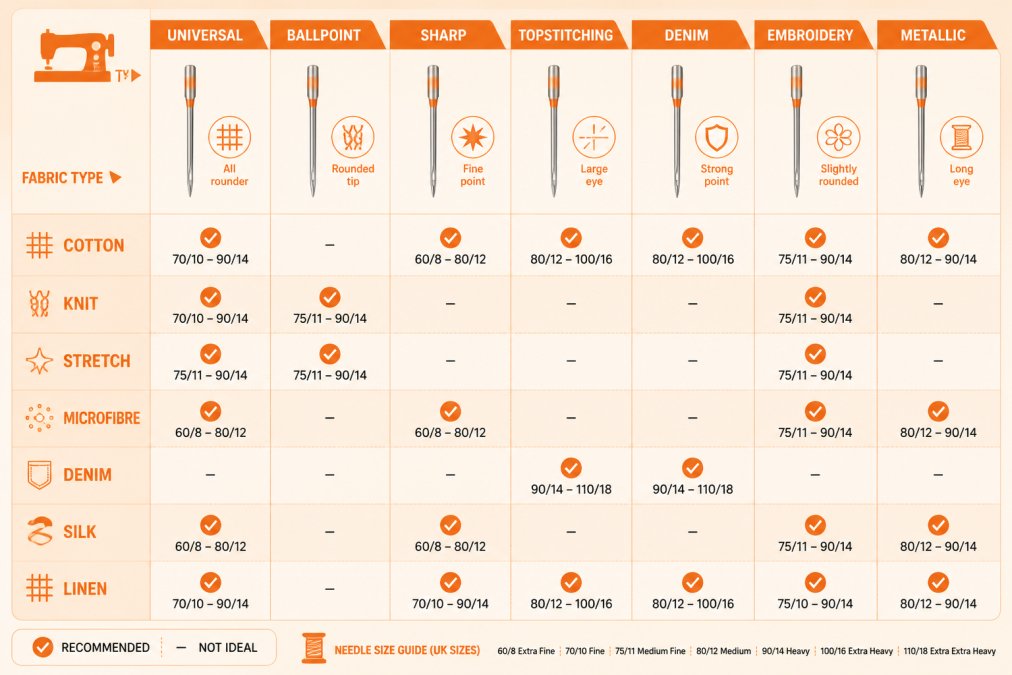
Different fabrics demand different needle types. This chart helps you match your fabric to the correct needle quickly:
| Fabric Type | Recommended Needle Type | Suggested Size | Why This Works |
|---|---|---|---|
| Cotton (light to medium) | Universal | 80/12 or 90/14 | Versatile point handles standard weaves |
| Silk | Sharp or Universal | 70/10 or 80/12 | Sharp point prevents visible holes; fine sizes respect delicate yarns |
| Microfibre | Sharp | 80/12 or 90/14 | Sharp point cuts through dense synthetic fibres cleanly |
| Jersey or Knit | Ballpoint | 80/12 or 90/14 | Rounded point prevents laddering and runs |
| Lycra or Stretch | Ballpoint | 75/11 or 80/12 | Essential to prevent thread breakage in elastic fibres |
| Denim or Heavy Canvas | Denim or Heavy-Duty | 100/16 or 110/18 | Reinforced shaft prevents needle deflection |
| Linen | Sharp | 90/14 or 100/16 | Sharp point handles dense weave; larger size for thread weight |
| Topstitching Project | Topstitching | 80/12 or 90/14 | Larger eye accommodates thicker threads |
| Machine Embroidery | Embroidery | 75/11 or 80/12 | Scarf prevents thread shredding with specialty threads |
Which Sewing Machine Needle for Which Fabric
Choosing the right sewing machine needle for which fabric comes down to understanding what your fabric is made from and how it behaves. The fundamental rule is simple: finer, more delicate fabrics need finer needles; heavier, denser fabrics need larger, stronger needles.
Start by identifying your fabric's fibre content and weight. Is it a natural fibre like cotton, wool, or silk, or a synthetic like polyester, nylon, or microfibre? Is it a woven fabric (where threads cross at right angles) or a knit (where loops interlock)? Does it have stretch or elastane content? These questions determine which needle type you need.
For natural woven fabrics without stretch, cottons, linens, woollens, a universal needle in the appropriate size usually works well. For delicate natural fabrics like silk or fine linen, a sharp needle in a fine size produces cleaner results. For any knit or stretch fabric, ballpoint needles are non-negotiable.
Synthetic fabrics vary widely. Microfibre and densely woven synthetics prefer sharp needles. Knit synthetics like jersey or interlock benefit from ballpoint needles. Stretch synthetics containing lycra or elastane absolutely require ballpoint needles to prevent damage.
When you're uncertain, err on the side of a universal needle in an appropriate size. Universal needles are forgiving enough to work on most fabrics without causing obvious problems, even if they're not optimal. Once you've sewn the seam, evaluate the results. Are stitches skipping? Is the fabric puckering? Is the needle flexing noticeably? These signs tell you to switch to a specialist needle.
When to Change a Sewing Machine Needle
Many sewers change their needles far too infrequently. A needle that looks fine to the naked eye can be bent, burred, or dulled in ways that cause problems. A good rule is to change your needle at the start of each new project, or after every 8-10 hours of sewing.
Visible signs that you need a new needle include a bent shaft (hold the needle up to the light and look along its length), a burred or rough tip (run your fingernail gently along the point, a rough feeling means it's damaged), or a bent or enlarged eye. If you've hit a pin, broken the needle, or sewn over a thick seam, change the needle immediately.
Beyond visible damage, needles dull with use. A dulled needle produces skipped stitches, puckering, and uneven tension. You might not see the dullness, but your stitches will tell you the needle has lost its edge. If you're experiencing skipped stitches or tension problems and you've checked your threading and tension settings, a fresh needle often solves the problem.
Different fabrics and threads dull needles at different rates. Metallic threads, for example, dull needles faster than standard thread. Rough fabrics like canvas dull needles quicker than smooth cotton. Heavy sewing sessions, like quilting a large quilt, will dull a needle faster than casual garment sewing.
Keep a variety of fresh needles on hand. The Hemline H100.80 Universal Sewing Machine Needles Size 80/12 are ideal for general sewing and available at Fabric Mouse for £3.00. Having multiple packs means you can change needles frequently without worrying about running out.
Sewing Machine Needle Troubleshooting: Common Problems and Solutions
Skipped stitches are often blamed on tension problems, but the needle is frequently the culprit. If you've adjusted tension and the problem persists, try a fresh needle. A bent, dulled, or incorrectly inserted needle causes skipped stitches far more often than tension settings do.
Thread breaking consistently during sewing often points to a needle problem. A burred needle, a needle inserted incorrectly, or a needle too fine for your thread weight all cause thread breakage. Check that your needle is inserted correctly (most machines require the needle to face a particular direction), then try a fresh needle in an appropriate size for your thread.
Puckering, where fabric gathers along seams, can result from several causes, but an incorrect needle is a common one. Universal needles on delicate fabrics sometimes cause puckering because the ball point isn't quite right for the fabric. Switching to a sharp needle often solves this. Alternatively, puckering can indicate your needle is too fine for your fabric; try the next size up.
Needle breakage suggests you're using a needle too fine for your work. If you're regularly breaking needles, you're either sewing through too-thick fabric, hitting pins, or using a needle that's too delicate for the job. Switch to a heavier needle, slow your sewing speed, and remove pins before they reach the needle.
Loud clunking or grinding sounds from your machine when sewing suggest a bent needle or a needle inserted incorrectly. Stop immediately, turn off your machine, and check the needle. A bent needle can damage your machine's timing if left in place.
When in doubt about any needle problem, start by inserting a fresh needle correctly. Many sewing problems disappear once you've done this simple step. If problems persist after changing the needle, look at other variables: threading, tension, or fabric preparation.
Choosing the right sewing machine needle type makes an immediate, visible difference in your projects. Whether you're working with delicate silks, stretchy lycra, or heavy denims, the correct needle transforms your sewing experience from frustrating to enjoyable. At Fabric Mouse, we stock a comprehensive range of quality needles from brands like Hemline and Janome. Our expert team can guide you toward the perfect needle for your specific fabric, and our professional servicing ensures your machine runs smoothly with the right needle installed. Get in touch with us to discuss your sewing needs or to stock up on needles for your next project.
Frequently Asked Questions
What are the different types of sewing machine needles?
The main sewing machine needle types are universal (general purpose), ballpoint (for knits and stretch fabrics), sharp (for tightly woven materials), topstitching (for decorative stitching), denim (for heavy fabrics), metallic (for decorative threads), and wing needles (for heirloom work). Each type has a different point shape and eye size designed for specific fabrics and techniques. Choosing the correct needle type prevents skipped stitches, thread breakage, and fabric damage.
How do I choose the right sewing machine needle for my fabric?
Match your needle to your fabric weight and fibre content. Use universal needles for most woven fabrics, ballpoint needles for knits and stretch materials, and sharp needles for microfibre or densely woven textiles. The needle size should also suit your thread weight, finer threads need smaller needles (60/8 or 70/10), while heavier threads require larger needles (100/16 or 110/18). When in doubt, test on a fabric scrap first to check stitch quality.
What do the numbers on sewing machine needles mean?
Sewing machine needles use a two-number system: the first number is the European size (60-120), and the second is the American size (8-20). The European number indicates the needle's diameter in hundredths of a millimetre, higher numbers mean thicker needles. For example, a 70/10 needle is thinner than a 100/16 needle. Thicker needles suit heavier fabrics and threads, while thinner needles work better with lightweight fabrics and delicate threads.
When should I change a sewing machine needle?
Change your needle every 8-16 hours of sewing, after completing a major project, or immediately if you notice skipped stitches, puckering, or a blunt sound when the needle strikes fabric. Needles become dull, bent, or develop microscopic burreds that damage fabric and thread. Always use a fresh needle when switching to a different fabric type or thread weight. Keep spare needles in your sewing kit, Hemline universal needles and Janome ballpoint needles are reliable options available in assorted packs.
Can I use any sewing machine needle in my machine?
Not all needles fit all machines. Most domestic sewing machines use the 15×1 needle system, but some vintage or specialised machines require different shank types. Always check your machine's manual to confirm the correct needle system. Within the correct system, you can use different needle types and sizes, but ensure your machine is switched off and threaded correctly before inserting a new needle. Incorrect insertion can cause needle breakage or machine damage.
What needle should I use for denim or thick fabric?
Use a denim needle (size 100/16 or 110/18) or a heavy-duty needle for thick fabrics like denim, canvas, or upholstery material. These needles have a reinforced shaft and a sharp point that pierces dense weaves without bending or breaking. If you don't have a dedicated denim needle, a size 100/16 sharp needle can work as an alternative. Always test on a scrap of your fabric first to ensure the stitch quality is acceptable.
What is the difference between universal and ballpoint needles?
Universal needles have a slightly rounded point designed for both woven and knit fabrics, making them the most versatile choice for general sewing. Ballpoint needles have a more pronounced rounded tip that slides between fabric fibres rather than piercing them, preventing laddering and runs in stretch and knit materials. Use universal needles for cotton and most woven fabrics, and ballpoint needles specifically for jersey, lycra, and other stretchy textiles. The Hemline universal sewing machine needles and Janome ballpoint needles are both excellent choices for these applications.
Related Posts

Lightweight Sewing Machine: A 2026 Review

Doctor Who Fabric Guide: Types, Prints & Projects

Moda French General Fabric: A Guide for UK Sewers

Moda Jelly Rolls: A Complete Guide to Quilting

Guess How Much I Love You Fabric: Projects & Ideas

Lord of the Rings Fabric: A Guide for Quilters
