

What Is the Purpose of a Walking Foot?
Table of Contents
- What Is a Walking Foot and Why Does It Matter?
- When to Use a Walking Foot
- Walking Foot vs Regular Presser Foot: Key Differences
- How to Use a Walking Foot Correctly
- Walking Foot for Stretchy Fabric: What You Need to Know
- Common Mistakes When Using a Walking Foot
- Choosing the Right Walking Foot for Your Machine
- Frequently Asked Questions
Last Updated: October 14, 2026
What Is a Walking Foot and Why Does It Matter?
Understanding what is the purpose of a walking foot starts with knowing it's a specialised presser foot attachment that moves fabric layers evenly through your sewing machine. Unlike a standard presser foot, a walking foot has feed dogs on both the top and bottom, which grip and advance all fabric layers at the same speed. This prevents the common problem of fabric shifting or puckering when you're working with multiple layers.
Grasping what is the purpose of a walking foot means recognising it solves a real problem that many sewers encounter. When you're quilting, topstitching, or sewing through thick fabrics, the standard presser foot can only feed fabric from underneath. The top layers slip and move at a different pace, creating uneven seams and frustration. A walking foot keeps everything in sync.
You'll hear this attachment called by several names: even-feed foot, dual-feed foot, or walking-foot mechanism. They all refer to the same principle, coordinated feeding from both sides. At Fabric Mouse, we stock a range of walking feet designed for different machine types, including Janome models that fit various categories of machines.

The difference between using a walking foot and not using one becomes obvious once you try it. Your seams stay straight. Your layers stay aligned. Your finished projects look professional rather than wonky.
When to Use a Walking Foot
You need a walking foot whenever you're sewing through multiple layers of fabric that might shift. The most common use is quilting, where you're stitching through batting and backing fabric along with the quilt top. But walking feet serve many other purposes too.
Quilting and patchwork is the classic application. When you're free-motion quilting or following a marked line across your quilt, a walking foot keeps all three layers moving together. Without it, you'll end up with puckering on the back or bunching in the middle.
Topstitching thick seams is another ideal use. If you're sewing a decorative line on denim, canvas, or other heavy fabrics, the walking foot prevents the presser foot from pushing fabric down unevenly. This is especially helpful when you're stitching near seams where fabric thickness changes.
Sewing with slippery fabrics like silk, rayon, or satin benefits from a walking foot. These materials slide easily under a standard presser foot, causing misalignment. The top and bottom feed dogs work together to hold the fabric in place.
Matching plaids or stripes requires precision. A walking foot helps you keep pattern alignment consistent, which is nearly impossible with a regular foot when layers want to slip.
You should also reach for a walking foot when sewing laminated fabrics, vinyl, or faux leather. These materials stick to a standard presser foot and bunch up. A walking foot's smooth action prevents this damage.
Walking Foot vs Regular Presser Foot: Key Differences
The main difference is mechanical. A regular presser foot has feed dogs only underneath the foot, which push fabric forward. A walking foot has additional feed dogs on top that grip and pull fabric at the same time. This synchronised motion is what prevents layers from shifting.
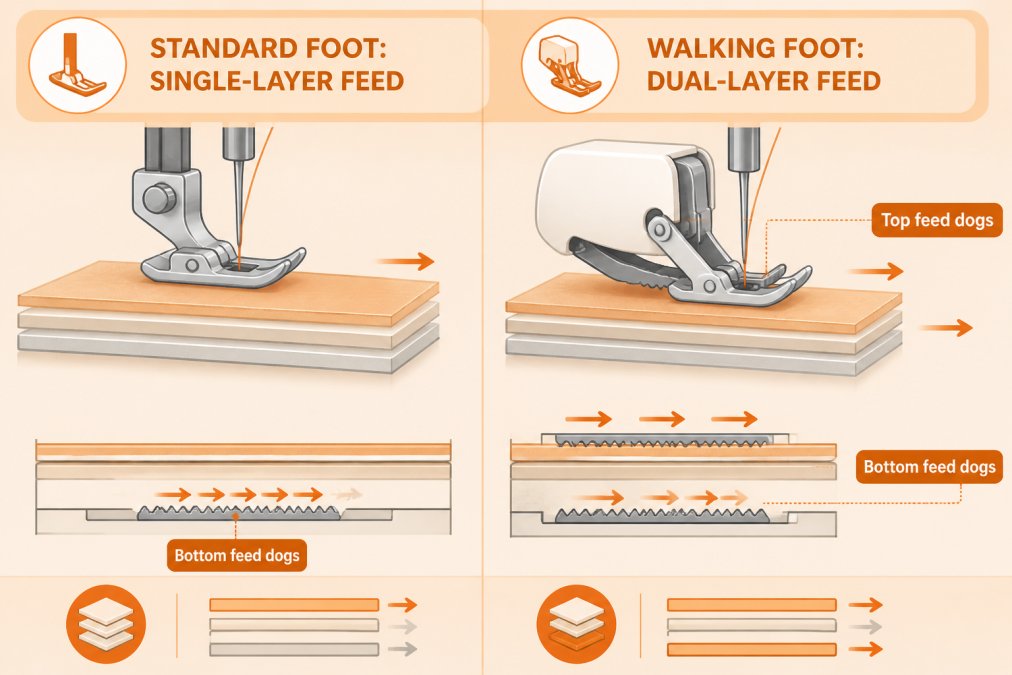
A standard presser foot works fine for most everyday sewing. It's adequate for single-layer projects like garments or simple seams. But the moment you add a second or third layer, the limitations become clear. The top layer creeps forward. The bottom layer lags behind. Your seams curve or bunch.
A walking foot maintains consistent stitch length across all layers because both sets of feed dogs move at the same pace. This is why quilters and anyone working with thick fabrics consider it essential.
The trade-off is that a walking foot is bulkier and requires more clearance under the presser bar. You can't use it on all machines without an adapter.
Another difference: a walking foot gives you less visibility of your stitching area because it sits higher on the machine. Some models have an open-toe design to improve sightlines, which helps when you're following a marked line or trying to see exactly where your needle is going.
How to Use a Walking Foot Correctly
Using a walking foot properly starts with understanding your machine's attachment system. Different machines use different fittings, so you need the right foot for your model. Janome machines, for example, come in several categories with different shank heights and attachment methods.
Attaching Your Walking Foot
Before you attach anything, check your machine's manual or the foot's packaging to confirm it's compatible. This step saves time and prevents damage. If you're unsure, contact the retailer, Fabric Mouse can help you identify the correct fitting for your specific machine.
To attach the foot, first lower your presser bar completely. Remove your current presser foot by pressing the release button or lever (this varies by machine). Slide the walking foot onto the presser bar, aligning the shank with the bar's slot. Press or screw it in place, depending on your machine's design. Make sure it's secure before you start sewing.
Some walking feet, like the Janome convertible models, come with interchangeable components. You might have both a closed-toe and open-toe option in the same set. Choose the closed-toe version for general quilting and the open-toe version when you need to see your stitching line clearly.

Raise the presser foot once you've attached it. The foot should sit flat and level on your fabric. If it's tilted or uneven, remove it and reattach it.
Tension and Stitch Settings
Your tension settings usually need adjustment when you switch to a walking foot. Because the foot controls fabric feed differently, the balance between top and bottom thread changes. Start by testing on scrap fabric in the same weight as your project.
Set your stitch length slightly longer than you would use with a standard presser foot, typically 3.0 to 3.5mm for quilting. A longer stitch works better because the walking foot moves fabric more deliberately. Shorter stitches can cause skipped stitches or thread breakage.
Check your tension by sewing a test seam through two or three layers of fabric. Look at both sides. The stitches should be balanced, with no loops on either side. Adjust the top tension dial if needed. Most sewers find they need slightly looser tension with a walking foot than with a regular foot, but this varies by machine and fabric.
Janome Even Feed/Walking foot - Category A/B/C/D →
Run a few practice seams before starting your actual project. This takes five minutes and prevents wasted fabric and frustration.
Walking Foot for Stretchy Fabric: What You Need to Know
Stretchy fabrics like jersey, knit, or elastic materials present a special challenge. A walking foot helps, but it's not a complete solution on its own. The top and bottom feed dogs will move the fabric evenly, but the fabric itself still wants to stretch.
Combine a walking foot with a ballpoint or stretch needle to handle knit fabrics properly. The needle's rounded tip slides between fibres rather than piercing them, which prevents laddering and skipped stitches. This combination works well for sewing stretch seams or topstitching on knit garments.
You may also need to reduce your presser foot pressure. Many machines let you adjust how much downward force the presser foot applies. Lower pressure allows stretchy fabric to move naturally without being crushed or distorted. Check your manual for how to adjust this setting.
For very stretchy materials, consider using a walking foot alongside a stabiliser underneath your fabric. This gives the feed dogs something solid to grip and prevents the fabric from shifting sideways.
Test on scraps first. Stretchy fabrics are forgiving during testing but costly to ruin on a finished project. Spend ten minutes experimenting and you'll save time and money later.
Common Mistakes When Using a Walking Foot
Many sewers attach a walking foot and expect instant perfect results. Then they're disappointed when something still goes wrong. The most common mistake is using the wrong foot for your machine. Janome machines come in different categories with different shank types. A Category A foot won't fit a Category B machine properly. Check your machine's category and the foot's part number before ordering.
Another frequent error is forgetting to adjust tension and stitch length. A walking foot changes how fabric moves through your machine, so your previous settings won't work anymore. Skipped stitches, thread breakage, and puckering often result from using old settings with new equipment.
Some sewers don't lower the presser bar all the way before attaching the foot. This creates an uneven surface and causes stitching problems. Always lower the bar completely and check that the foot sits level on your fabric.
Using a walking foot on a single layer of fabric is unnecessary and wastes the foot's advantages. Save it for jobs where you actually have multiple layers. For single-layer work, a standard presser foot does the job fine.
Applying too much pressure is another issue. Beginners often press down hard on the fabric, thinking it helps. A walking foot works best when you guide the fabric gently. Let the feed dogs do their job. Your hands should guide, not force.
Choosing the Right Walking Foot for Your Machine
Walking feet come in different styles designed for different machines. The wrong one won't work, so matching your machine's specifications matters.
Janome machines are categorised by shank height and attachment style. Category A and Category B machines use low-shank fittings. Category C uses a high-shank 7mm fitting. The Janome Convertible Even Feed Foot Set for Category B (£71.00) includes both closed and open-toe options with interchangeable components, making it versatile for different projects.
For Category C machines, the Janome Convertible Even Feed Foot Set Category C High Shank 214516003 (£71.00) offers the same flexibility with the correct high-shank fitting. Both sets include ditch-quilting and adjustable quilting guides, which help you maintain consistent spacing between rows of stitching.
If you prefer a simpler option without interchangeable parts, the Janome Even Feed/Walking Foot for Category A/B/C/D machines (£54.00) provides a standard closed-toe design. This is a solid choice if you know your machine's category and don't need the flexibility of switching between closed and open toes.

Open-toe walking feet like the Janome Open-Toe Walking Foot Category B 200339007 (£54.00) give you better visibility of your stitching line. This matters when you're following a marked quilting pattern or trying to keep your stitches perfectly straight.
Before ordering any foot, check your machine's exact model and category. The packaging or manual lists this information. If you're uncertain, contact Fabric Mouse, our team can help you find the correct fitting for your machine without guesswork.
A walking foot transforms what feels difficult into something manageable. Quilting becomes enjoyable rather than frustrating. Topstitching stays straight. Fabric layers stay aligned. If you've been struggling with shifting layers or uneven seams, a walking foot is the practical solution. We stock genuine Janome walking feet in multiple styles and categories, all designed to fit properly and perform reliably. Get in touch with our team to find the right foot for your machine, or browse our full range of Janome accessories to discover what else might improve your sewing.
Frequently Asked Questions
What does a walking foot do on a sewing machine?
A walking foot feeds all layers of fabric evenly through your machine by using feed dogs on both the top and bottom of the foot. This prevents shifting, puckering, and uneven seams, especially when quilting or sewing multiple layers. The purpose of a walking foot is to keep thick or slippery fabrics moving together at the same pace, giving you straighter, more professional results.
When should you use a walking foot?
Use a walking foot when quilting, topstitching through multiple layers, sewing knits or stretchy fabrics, working with slippery materials like silk or satin, or combining fabrics with different weights. Any project involving two or more layers benefits from a walking foot, as it prevents the top layer from creeping ahead of the bottom layer during stitching.
Can you use a walking foot for stretchy fabric?
Yes, a walking foot works well for stretchy fabrics like jersey, lycra, and knits. The dual feed system prevents the fabric from stretching unevenly as it passes through the machine. This is particularly helpful when sewing seams in activewear or swimwear, where consistent stitch length matters. Pair it with a ballpoint needle and reduce presser foot pressure slightly for best results.
What's the difference between a walking foot and a standard presser foot?
A standard presser foot relies only on lower feed dogs to move fabric, which can cause the top layer to shift or bunch. A walking foot has its own feed dogs on top that work alongside the machine's lower feed dogs, creating synchronised movement. This dual-feed system is essential for quilting, topstitching, and handling difficult fabrics where precision and even feeding are critical.
Sewing Machine Needle Types Explained
How to Sew a Professional Tailored Collar
Related Posts

How to Sew a Professional Tailored Collar

Sewing Machine Needle Types Explained

Lightweight Sewing Machine: A 2026 Review

Doctor Who Fabric Guide: Types, Prints & Projects

Moda French General Fabric: A Guide for UK Sewers

Moda Jelly Rolls: A Complete Guide to Quilting
